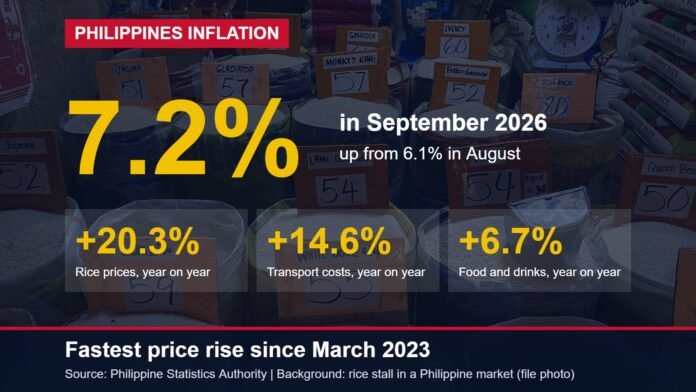
October 6: Consumer prices in the Philippines rose 7.2% in September from a year earlier, the Philippine Statistics Authority (PSA) said on Tuesday, up from 6.1% in August and from 1.7% in September last year. National Statistician Claire Dennis Mapa said the figure matched April’s 7.2% and was the fastest since March 2023. Rice, the country’s staple, cost 20.3% more than a year ago.
Key highlights
- Headline: 7.2% in September, against 6.1% in August. Four months of easing have ended.
- Food: Food and non-alcoholic drinks rose 6.7%, up from 4.6%. Rice rose 20.3%.
- Transport: Up 14.6%, from 13.5% in August.
- Core inflation: 4.7%, up from 4.1%.
- Poorest households: Inflation for the bottom 30% by income was 9.0%.
- Next: The central bank, which has a 2% to 4% target, meets on 22 October.
What the statistics office said
“The uptrend in the overall inflation rate in September 2026 was primarily influenced by the faster annual increment in the heavily-weighted food and non-alcoholic beverages at 6.7 percent during the month from 4.6 percent in August 2026,” the PSA said. It also pointed to faster increases in housing, water, electricity, gas and other fuels.
Food accounted for 73.4% of the overall rise in September, according to Astig.ph’s account of the PSA data. The average for January to September is 5.4%.
The numbers
| Item | August 2026 | September 2026 |
|---|---|---|
| Headline inflation | 6.1% | 7.2% |
| Core inflation | 4.1% | 4.7% |
| Food and non-alcoholic drinks | 4.6% | 6.7% |
| Rice | 19.4% | 20.3% |
| Vegetables, tubers and pulses | -3.4% | 10.7% |
| Fish and seafood | 6.6% | 7.4% |
| Transport | 13.5% | 14.6% |
| Housing, water, electricity, gas and fuels | 7.9% | 8.4% |
| Bottom 30% of households | 8.2% | 9.0% |
Source: Philippine Statistics Authority, as reported by The Manila Times, Context.ph and Astig.ph. All figures are year-on-year changes.
Higher than economists expected
The result was above every forecast in a poll of 13 economists published by The Philippine Star on Monday. Their median estimate was 6.7%, and the highest was 7.0%. It was inside the 6.4% to 7.4% range that the central bank, Bangko Sentral ng Pilipinas (BSP), had given for the month.
Economists in that poll blamed fuel and food prices, weather that damaged vegetable supplies, floods that disrupted farm transport and a weak peso. Core inflation, which strips out volatile food and energy items, rose to 4.7%, its highest since October 2023.
What the central bank faces
The BSP’s policy rate is 5.0%. It raised the rate by a quarter point in August, its third increase in a row, and its next meeting is on 22 October. Its target for inflation is 2% to 4%.
Economic planning secretary Arsenio Balisacan said: “These are significant supply-side pressures, but they are being met with targeted interventions.” Emilio Neri Jr, lead economist at Bank of the Philippine Islands, said the September figure could signal a broader wave of price rises driven by food and labour costs and not by fuel alone, Astig.ph reported.
Analysis: why it matters beyond Manila
Analysis by the Business Desk. With prices rising 7.2% and the policy rate at 5.0%, interest rates in the Philippines are below inflation by more than two points, which is why the central bank’s meeting on 22 October will be watched closely. The jump also arrived one day after the regional watchdog AMRO cut its growth forecast for the Philippines while keeping the forecast for the wider region at 4.1%. Slower growth and faster inflation together leave the central bank with a harder choice, and the poorest 30% of households are already facing 9% inflation.
References
- The Manila Times: Food, transport, energy push inflation up to 7.2% in Sept
- Context.ph: Inflation surges to 7.2% in Sept., to test BSP policy
- Astig.ph: Inflation hits 7.2% in September, the fastest since March 2023
- The Philippine Star: Poll: September inflation likely rose to 6.7%
- Philippine Statistics Authority

The Business Desk covers markets, the economy, companies and personal finance. Stories are checked against at least two credible sources before publication.