
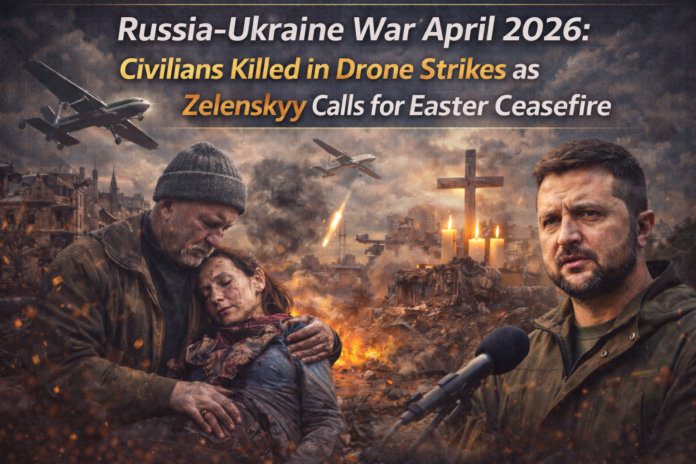

The Russia-Ukraine war continued to claim civilian lives on both sides of the conflict on April 7, 2026, with tit-for-tat drone attacks killing at least seven people in Ukraine and three in Russia. The latest cycle of violence unfolded a day after Ukrainian President Volodymyr Zelenskyy renewed his proposal for an Easter ceasefire, offering to halt attacks on Russian infrastructure if Moscow stopped targeting Ukrainian civilian facilities. With Easter falling on April 12, there were tentative hopes for a brief pause in hostilities, but Russia’s continued drone campaign showed little sign of a willingness to stand down.
April 7 Drone Attacks: Casualties in Ukraine and Russia
On April 7, 2026, a Ukrainian drone strike in Russia’s Vladimir region resulted in the deaths of three civilians when drones targeted a residential structure in the Alexandrovsky district, according to Governor Alexander Avdeev. In Ukraine, a Russian drone attack on a city bus in the Dnipropetrovsk region killed three passengers, while a separate attack killed additional civilians. Interior Minister Ihor Klymenko confirmed that emergency responders managed to rescue seven individuals from the wreckage. In Russia’s Voronezh region, a man suffered burns when a downed drone crashed onto a warehouse roof, with four houses damaged as a result. Ukraine’s air force announced that its defense systems intercepted 77 out of 111 drones launched by Russia during the night of April 6-7. Russia’s Ministry of Defence reported that 45 Ukrainian drones were also brought down overnight, with 19 intercepted over the northwestern Leningrad region. These statistics illustrate the massive scale of drone warfare that has come to define the Russia-Ukraine conflict in 2026, with both sides launching dozens to hundreds of drones per day against each other’s infrastructure and military targets.
Ukraine’s Long-Range Strike Campaign Against Russian Oil Infrastructure
A major development in the Russia-Ukraine war in 2026 has been Ukraine’s intensification of long-range strikes against Russian oil and energy infrastructure. According to the Institute for the Study of War, Ukraine’s expanding long-range strike campaign against Russian oil infrastructure is exploiting overstretched Russian air defenses. Ukraine has been using ATACMS and SCALP cruise missiles, as well as its domestically developed Liutyi drones, to strike oil refineries, storage facilities, and energy infrastructure deep inside Russia. On April 6, 2026, Ukrainian forces struck Russian Black Sea export facilities in a significant attack. Ukrainian Liutyi drones have also targeted a chemical plant in Kirovo-Chepetsk, Kirov Oblast, causing fires and secondary explosions. The attacks on Russian energy infrastructure are part of a deliberate strategy to degrade Russia’s oil revenues, which fund its war effort, and to impose economic costs that might eventually force Moscow to negotiate. Russia has responded with massive drone and missile barrages against Ukraine’s own energy infrastructure, power grid, and civilian targets. On March 7, 2026, Russia attacked Ukraine with 509 drones and missiles in a single night, one of the largest such attacks of the war.
Zelenskyy’s Easter Ceasefire Proposal and Peace Talks
Ukrainian President Volodymyr Zelenskyy has been actively pushing for a ceasefire framework in early April 2026, with Easter providing a potential opportunity. On April 6, Zelenskyy reiterated his support for a ceasefire proposal contingent on Russia ceasing all attacks on energy facilities, stating that if Russia were to stop attacking Ukrainian infrastructure, Ukraine would respond in kind. He had previously suggested a ceasefire for Easter, which falls on April 12, 2026, a significant holiday for Orthodox Christians in both countries. However, Russia has not shown any interest in a ceasefire, continuing its drone and missile campaigns against Ukrainian cities. The Kremlin has maintained its maximalist position, demanding Ukrainian recognition of Russian sovereignty over the four regions it claims to have annexed — Donetsk, Luhansk, Zaporizhzhia, and Kherson — as well as Crimea, which it seized in 2014. International peace efforts have been fragmented and largely ineffective. While there have been prisoner swaps — including a significant exchange in which Ukraine and Russia each released 200 prisoners as part of a two-day swap — there has been no progress toward a sustainable ceasefire or peace deal. The Trump administration has been pushing for a negotiated settlement, but the gap between Ukrainian and Russian positions remains enormous.
The Environmental Toll: Dniester River Contamination
The Russia-Ukraine war has also been causing significant environmental damage, with a particularly alarming incident in early 2026. A Russian strike on the Dniester Hydroelectric Station caused the contamination of the Dniester River with oily substances, affecting both Ukraine and Moldova downstream. The Moldovan government declared an environmental alert in the river basin, highlighting how the conflict’s impacts extend well beyond the immediate battlefield. This type of environmental warfare, whether intentional or collateral, represents a long-term threat to the region’s water supplies, agriculture, and ecosystems. Energy infrastructure has been one of the primary targets throughout the conflict. Ukraine’s power grid has been systematically attacked by Russia, leaving millions of Ukrainians without electricity during the harsh winter months. Ukraine has responded by striking Russian oil refineries and energy facilities, aiming to degrade Russia’s economic capacity to sustain the war. The mutual attacks on energy infrastructure have created an environmental crisis that will take years to remediate after the conflict eventually ends.
The Prospects for Peace: When Will This War End?
As April 2026 marks over two years of full-scale war since Russia’s February 2022 invasion, there is no clear end in sight. Ukraine has demonstrated remarkable resilience and military capability, successfully defending its territory and launching devastating counterstrikes deep into Russia. However, it has been unable to retake all the territory occupied by Russia, and the front lines have been largely static for much of the past year. Russia, despite catastrophic losses in personnel and equipment, continues to have sufficient manpower and resources to sustain the conflict, largely due to its larger population base and the economic support of countries like China and Iran. The war has become a grinding attritional conflict that is bleeding both sides. For Ukraine, the critical question is whether Western support — in terms of weapons, ammunition, and financial assistance — will remain sufficient to maintain its defensive and offensive capabilities. The Trump administration’s approach to the conflict has created some uncertainty about long-term US commitment, though NATO as a whole has remained strongly supportive of Ukraine. As Easter 2026 approaches, the people of Ukraine and Russia are enduring another spring of war, with no peace on the horizon and the drone strikes continuing day and night.