
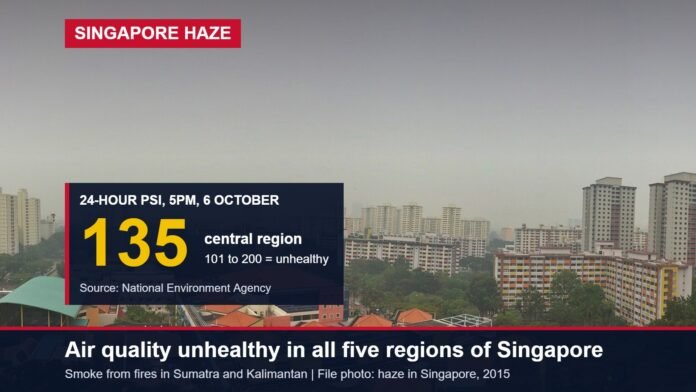
October 6: Air quality in all five regions of Singapore was in the unhealthy range on Tuesday as smoke from fires in Indonesia drifted over the island. The 24-hour Pollutant Standards Index (PSI) stood at 102 to 135 at 5pm, with the highest reading in the central region, AsiaOne reported, citing the National Environment Agency (NEA). The agency expects the index to stay in the “high moderate to mid-unhealthy range”.
Key highlights
- Readings at 5pm: Central 135, east 119, west 112. The range across the island was 102 to 135.
- What unhealthy means: The NEA classes a 24-hour PSI of 101 to 200 as unhealthy.
- The cause: The NEA said “moderate to dense smoke plumes from southern Sumatra and West Kalimantan were observed drifting towards Singapore”.
- Hotspots: 438 were counted in Kalimantan on 5 October, down from 527 the day before.
- Outlook: Winds from the east-south-east and south-east and dry weather over the fire areas are expected to keep bringing smoke.
How the day went
The south was the last region to cross the line. At noon, the 24-hour PSI was 133 in the central region, 117 in the east, 113 in the west, 110 in the north and 101 in the south, The Online Citizen reported. By 5pm the central reading had risen to 135, according to AsiaOne.
The one-hour PM2.5 reading, which shows current conditions, was 103 micrograms per cubic metre in the central region and 98 in the east at 5pm, in the “elevated” band in all five regions, AsiaOne said. At noon the central region was at 86, The Online Citizen reported.
How it built up
- 30 September: 24-hour PSI of 91 to 112.
- 3 October: 79 to 104.
- 4 October: 73 to 96.
- 5 October, noon: The central region (117) and the west (108) enter the unhealthy range.
- 6 October, noon: All five regions are unhealthy.
The figures are from The Online Citizen’s account of NEA data.
Where the smoke is coming from
The NEA said scattered hotspots have been detected in Kalimantan and Sumatra, with smaller numbers elsewhere in the southern part of Southeast Asia, The Online Citizen reported. AsiaOne quoted the agency’s hotspot count for Kalimantan as 527 on 4 October and 438 on 5 October.
“The hotspot and smoke haze situation may improve in areas experiencing showers but also continue to stay elevated in areas experiencing prolonged periods of dry weather, with a continued risk of transboundary haze occurrence,” the NEA said, as quoted by The Online Citizen.
What people are being told to do
The NEA’s advice depends on the one-hour PM2.5 reading. When it is elevated, healthy people should cut back on strenuous outdoor activity for the next hour, and the elderly, pregnant women, children and people with chronic conditions should avoid it, The Online Citizen reported. AsiaOne said vulnerable people should avoid outdoor activity altogether if the reading reaches the high band of 151 to 250 micrograms per cubic metre.
Neither report mentions school closures or any statement from Indonesia or Malaysia.
What to watch
- Whether the 24-hour PSI passes 150 in any region. The NEA’s forecast is for the “high moderate to mid-unhealthy range”.
- Rain over southern Sumatra and West Kalimantan, which the NEA says would ease the smoke.
- Readings in neighbouring Malaysia and any response from Indonesia on the fires.
More from the region: Philippine inflation jumps to 7.2% and our Asia Briefing for 6 October.
Sources
- AsiaOne: Haze update Oct 6: Unhealthy air quality across Singapore, 24-hour PSI forecast high moderate to mid-unhealthy
- The Online Citizen: Singapore air quality reaches unhealthy range across all five regions
- The Rio Times: Asia Intelligence Brief, 6 October 2026

The International Desk covers world and Asian affairs, diplomacy and conflict, with a focus on what they mean for India. Stories are checked against at least two credible sources before publication.