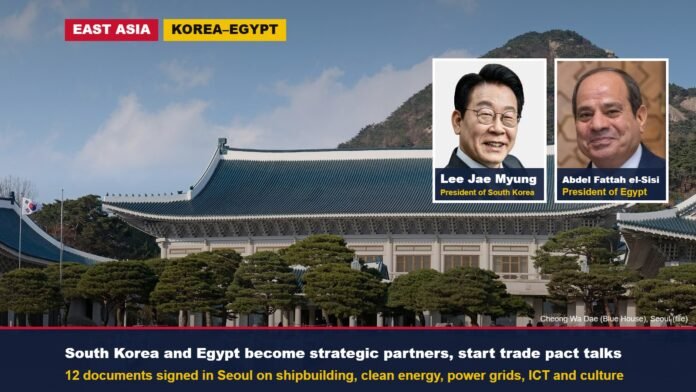
October 8: South Korea and Egypt upgraded their relations to a strategic partnership and formally launched negotiations on a Comprehensive Economic Partnership Agreement (CEPA) at a summit in Seoul on Thursday between President Lee Jae Myung and Egyptian President Abdel Fattah el-Sisi. The two countries signed or revised 12 documents covering economic, industrial, energy, technology and cultural cooperation. El-Sisi is on a three-day state visit, his first to South Korea since 2016.
Key highlights
- Lee said the two leaders agreed to “turn our previous agreements into tangible outcomes for the people of both countries”.
- South Korea became the first Asian country to sign a social security agreement with Egypt, which eases double pension contributions for workers posted between the two countries.
- Two energy memorandums cover clean energy, including solar, wind and peaceful nuclear use, and power transmission, including grid upgrades, high-voltage direct-current lines and energy storage. They name no investment amounts or companies.
- The leaders praised the joint production of Korea’s K9 self-propelled howitzer in Egypt as a model of defence cooperation, and Lee said he hoped ties would go beyond arms exports to local production and technology.
- 2027 has been designated the Korea–Egypt Year of Mutual Cultural Exchange.
What was signed
The 12 documents fall into five areas. Not every one of the 12 has been named publicly; the table lists those that were.
| Area | What was agreed or signed |
|---|---|
| Trade | Launch of CEPA negotiations, following agreement on a trade pact at the leaders’ Cairo summit last November |
| Social | Social security agreement, the first between Egypt and an Asian country |
| Industry and technology | Memorandums on shipbuilding and on information and communications technology |
| Energy | Clean energy memorandum; power transmission and distribution memorandum, signed by Korea’s climate minister Kim Sung-hwan and Egypt’s foreign minister Badr Abdelatty |
| Culture and education | National Museum of Korea and National Agriculture Museum agreements with the Grand Egyptian Museum; higher education memorandum revised for the first time in 10 years; 2027 named a year of cultural exchange |
| Peace and security | Commitment to peace on the Korean Peninsula and in the Middle East, including Gaza, and to “free and safe navigation for all vessels” |
Why energy is near the top of Egypt’s list
Egypt’s need for gas has sharpened since the war on Iran began in late February. Prime Minister Mostafa Madbouly said in March that the country’s monthly gas import bill had risen from about $560 million to $1.65 billion. By our calculation that is nearly three times as much. In July, Egypt was reported to be negotiating long-term LNG supply deals with Shell, TotalEnergies and BP for 15 to 18 cargoes a month.
Korean companies already have a stake in Egypt’s power sector. Korea Hydro & Nuclear Power signed a $2.25 billion contract in 2022 with Atomstroyexport, a subsidiary of Russia’s Rosatom, for equipment and turbine-island facilities at the El Dabaa nuclear plant, and Doosan Enerbility later signed a $1.2 billion agreement with KHNP to build turbine-island structures.
| Item | Figure | Source |
|---|---|---|
| Egypt’s monthly gas import bill before the Iran war | About $560 million | PM Madbouly |
| Egypt’s monthly gas import bill after the war began | About $1.65 billion | PM Madbouly |
| Increase | Nearly 3 times | Our calculation |
| LNG cargoes Egypt is seeking under long-term deals | 15 to 18 a month for at least three years | Public record |
| KHNP contract for El Dabaa nuclear plant (2022) | $2.25 billion | Public record |
| Doosan Enerbility agreement with KHNP | $1.2 billion | Public record |
How the relationship has moved
| When | What happened |
|---|---|
| 2016 | El-Sisi’s previous visit to South Korea |
| November 2025 | Lee visits Egypt; the leaders agree to pursue a trade pact |
| June 2, 2026 | First strategic dialogue between the two foreign ministers, in Seoul |
| October 8, 2026 | Strategic partnership, CEPA talks launched, 12 documents signed or revised |
What it means for Asia
For South Korea, Egypt is a door to Africa and the Middle East: the two sides will also work together on the Suez Canal Economic Zone and on joint projects with other African countries. It is also a buyer of the ships, power equipment and weapons that Korean industry sells. The summit also fits Seoul’s effort to build strategic partnerships beyond the United States and China. For Egypt, the deal brings partners in energy and grids at a moment when gas imports cost far more than before the war. The shared language on “free and safe navigation” matters for both: Egypt runs the Suez Canal, and Korean exporters depend on the shipping lanes between Asia and Europe that the Gulf and Red Sea conflicts have disrupted.
What to watch
- The timetable for the first round of CEPA negotiations.
- Whether the energy and shipbuilding memorandums turn into contracts with named companies and amounts.
- Any new defence deal beyond the existing K9 joint production.
- Remaining events on el-Sisi’s three-day visit.
Also today: South Korea unveils a 1 quadrillion won green transition plan.

The International Desk covers world and Asian affairs, diplomacy and conflict, with a focus on what they mean for India. Stories are checked against at least two credible sources before publication.