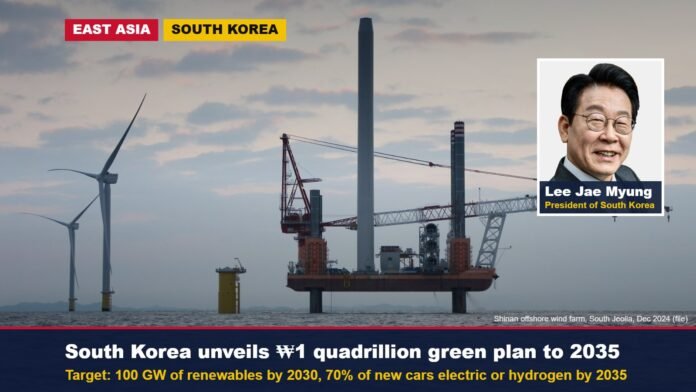
October 8: South Korea on Wednesday unveiled a plan to put about 1 quadrillion won, roughly $745 billion to $747 billion depending on the report, into its shift away from fossil fuels by 2035. The Korea Green Transformation (K-GX) strategy, presented at a public briefing in Seoul, sets a target of at least 100 gigawatts of renewable power capacity by 2030 and aims for electric and hydrogen cars to make up more than 70% of new vehicle sales by 2035, The Korea Times and Korea JoongAng Daily reported. President Lee Jae Myung said the country should stop following others and become a designer and leader of the green market.
Key highlights
- The Korea Times reported that the 1 quadrillion won is made up of 200 trillion won in fiscal spending and 790 trillion won in climate financing from five state-run financial institutions, over the next decade.
- Korea JoongAng Daily described the 1 quadrillion won as the government’s share and said the private sector would add 220 trillion won.
- Targets include hydrogen-based steelmaking, all-solid-state batteries by 2027, sodium-ion batteries by 2030 and the country’s first green government bonds in 2028, according to The Korea Times.
- JoongAng Daily linked the plan to South Korea’s goal of cutting emissions by 53% to 61% from 2018 levels by 2035, on the way to carbon neutrality in 2050.
- The energy research group Ember estimates the 100 GW target could avoid about $12 billion a year in fossil fuel imports, OilPrice.com reported.
What was announced
The Ministry of Climate, Energy and Environment announced the strategy in a press release, and Climate Minister Kim Sung-whan spoke at the briefing, JoongAng Daily reported. About 80 people attended, including Korea Chamber of Commerce and Industry Chairman Chey Tae-won and representatives of Samsung Electronics, LG Electronics, POSCO Holdings and Hanwha Qcells, according to The Korea Times. JoongAng Daily said the four companies presented their own renewable-energy and decarbonisation plans.
The Korea Times said more than half of the climate financing is to go to regions outside the Seoul metropolitan area, and at least 70% to small, medium-sized and mid-sized companies. The plan also includes new high-voltage direct-current transmission lines and the replacement of existing cables with higher-capacity ones, to carry power from new solar and wind projects.
What Lee said, in two translations
Lee’s main line was reported in slightly different English. The Korea Times quoted him as saying: “We must break away from the practice of being followers and become designers and leaders of the green market.” Reuters, as carried by OilPrice.com, translated it as: “We must move away from the practice of chasing others and become architects and leaders of the green market ourselves.” The Korea Times also quoted him as saying: “The green transition is a sure strategy for the future.”
The targets
| Area | Target | Source |
|---|---|---|
| Renewable power capacity | At least 100 GW by 2030 | The Korea Times, JoongAng Daily |
| Electric and hydrogen vehicles | More than 70% of new sales by 2035 | The Korea Times, JoongAng Daily |
| Korea’s share of the global EV market | From 3.8% (eighth) to third place by 2035 | The Korea Times |
| Greenhouse gas emissions | 53% to 61% below 2018 levels by 2035; carbon neutrality by 2050 | JoongAng Daily |
| Hydrogen-reduction steel | 300,000 tonnes by 2030; 2.5 million tonnes in 2031–2036; fully hydrogen-based by 2050 | The Korea Times |
| Batteries | All-solid-state by 2027; sodium-ion by 2030 | The Korea Times |
| Solar cells | High-efficiency tandem cells commercialised by 2028 | The Korea Times |
| Green finance | First green government bonds in 2028 | The Korea Times |
| Climate-tech start-ups | 30 potential unicorns by 2030 and 10 unicorns by 2035 | The Korea Times |
Where the money comes from
The two reports describe the funding differently, and we show both. The breakdown matters because most of the money in The Korea Times’ version is lending by state financial institutions, not budget spending.
| Item | The Korea Times | Korea JoongAng Daily |
|---|---|---|
| Headline figure | 1 quadrillion won of government-led investment over the next decade (about $746.99 billion) | 1 quadrillion won from the government by 2035 (about $745 billion) |
| Fiscal spending | 200 trillion won | Not broken down |
| Climate financing from five state-run financial institutions | 790 trillion won | Not broken down |
| Private investment | Not stated | An additional 220 trillion won |
| Note | The two stated parts add up to 990 trillion won; the report does not explain the remaining 10 trillion won |
By our calculation, using The Korea Times’ figures, climate financing from state institutions is about 79% of the 1 quadrillion won and fiscal spending about 20%. Spread evenly over ten years, the headline figure would be about 100 trillion won, or roughly $75 billion, a year. The actual yearly amounts have not been published in the reports we read.
Why energy imports are part of the story
OilPrice.com noted that South Korea remains heavily dependent on imported fossil fuels. That dependence has become costlier since the US-Israeli war on Iran began on February 28 and Iran effectively closed the Strait of Hormuz, as Al Jazeera has reported. Ember, quoted by OilPrice.com, estimated in June that at early-June spot prices South Korea’s fossil fuel imports for the whole energy sector would cost about $133 billion a year. It said existing wind and solar capacity could save about $4.7 billion in fuel imports in 2026, and that reaching 100 GW of renewables could avoid about $12 billion more a year.
What it means
The plan comes from an economy built on steel, petrochemicals, cars and chips, the same sectors the strategy names for emission cuts. For the rest of Asia it is a large public bet that cleaner production and home-grown power can cut a fuel import bill that the Gulf war has made harder to manage. Whether it works will depend on financing that mostly comes as loans, on grid lines that take years to build, and on companies following through. None of the reports we read carried criticism of the plan or details of how it will pass through the National Assembly.
What to watch
- Year-by-year budget figures for the fiscal part, and the terms of the climate financing from state lenders.
- Any legislation needed for the green government bonds planned for 2028.
- Progress on transmission lines, which the plan treats as a condition for the 100 GW target.
- Reaction from opposition parties and environmental groups, which was not reported on Wednesday.
Also today: China rejects EU call to curb hybrid car exports as Brussels weighs an import cap.
Sources
- The Korea Times: Korea to accelerate renewable energy expansion to 100GW by 2030
- Korea JoongAng Daily: South Korea to invest $745 billion in carbon neutrality by 2035
- OilPrice.com: South Korea Unveils $747 Billion Plan to Break Its Fossil Fuel Habit
- Al Jazeera: Tanker hit by multiple projectiles off north coast of Qatar, UKMTO says

The Business Desk covers markets, the economy, companies and personal finance. Stories are checked against at least two credible sources before publication.