NEW DELHI, November 3: People in Delhi and the National Capital Region (NCR) can burst firecrackers this Diwali, but only certified green crackers, only on November 7 and 8, and only for three hours a day: 6 am to 7 am and 8 pm to 10 pm. The Supreme Court allowed this in an order dated October 29 and said the complete ban on firecrackers will return on November 9. The relaxation comes as Delhi’s air has already turned “very poor”: the Commission for Air Quality Management (CAQM) put Stage II of the Graded Response Action Plan (GRAP) in force across the NCR on November 2.
Key highlights
- A bench of Justices M.M. Sundresh and Prasanna B. Varale allowed green crackers in Delhi-NCR only between 6–7 am and 8–10 pm on November 7 and 8, 2026, on the same lines as its order of October 15, 2025.
- Only green crackers certified by CSIR-NEERI may be made (November 2–6) and sold. Cancelled trader licences are restored only from November 4 to 6, and sale is allowed only at designated sites, not online.
- Every box must be sealed and carry a QR code that shows the maker, NEERI registration, PESO/DM licence, formulation and test certificate. Laris (crackers joined in series), garlands and barium-based crackers stay banned.
- No crackers within 300 metres of hospitals, nursing homes, health centres, old-age homes, silence zones and educational institutions.
- The complete ban returns on November 9. Officials must file compliance affidavits by December 14, and the court will take up the matter again on December 16.
- Delhi’s AQI rose from 117 on October 31 to 324 on November 2, according to CAQM, which then invoked GRAP Stage II across the NCR.
What is allowed, and when
| Step | Dates | Conditions |
|---|---|---|
| Manufacture | November 2–6 | Only manufacturers holding CSIR-NEERI green-cracker certification and a PESO licence, and only products listed on the CSIR-NEERI website |
| Sale | November 4–6 (cancelled licences restored for these days) | Only at locations designated by District Collectors/Commissioners with the District Superintendent of Police; no online sale; licence cancelled at once for any violation |
| Bursting | November 7 and 8 | 6:00–7:00 am and 8:00–10:00 pm only; not inside no-cracker zones |
| Complete ban | From November 9 | The earlier ban is restored |
Diwali falls on Sunday, November 8 this year, so the two permitted days are Diwali and the day before it. The order covers the whole NCR, which includes districts of Haryana, Uttar Pradesh and Rajasthan as well as Delhi.
How to tell an approved green cracker
- Sealed box: green crackers must come in completely sealed boxes, so that conventional crackers cannot be mixed in.
- QR code: each box needs a product- and batch-specific QR code. Scanning it should show the manufacturer, the NEERI registration, the PESO/DM licence, the formulation and the test certificate.
- No trading in codes: QR codes cannot be transferred, and selling them is a violation that can cost a maker its registration or licence.
- Still banned: laris and garlands, crackers containing barium, and any product not approved by NEERI.
- Shop notices: designated sites and shops must put up banners explaining how to identify approved crackers, the permitted dates and times, how to complain and the penalties, and must display the court’s directions.
Where crackers cannot be burst
The court barred bursting within 300 metres of hospitals, nursing homes, primary and district health centres, old-age homes, notified silence zones and educational institutions. Authorities must mark these areas on the ground as “No-Cracker Zones” and publicise them.
How the order will be enforced
- Money at stake: every manufacturer and trader in Delhi-NCR must deposit a security, in an amount set by the authorities, which is forfeited for any violation.
- Border checks: vehicles entering Delhi-NCR are to be checked for illegal and conventional crackers.
- Patrols: police and district teams must check sale points, confiscate illegal crackers, start prosecutions and scan QR codes at random.
- Air and health data: the Central Pollution Control Board (CPCB) and state boards must prepare AQI reports for before Diwali (November 2–6), Diwali (November 7–8) and after (November 9–30), with sand and water samples for comparison. Faulty monitoring stations must be repaired at once.
- Clean-up and awareness: waste must be cleared and the most polluted areas sprinkled with water after the festival. The Winter Action Plan 2026, the Air Pollution Mitigation Plan 2026 and CAQM’s annual action plan must be published, schools must sensitise students, and Delhi Metro is to carry awareness messages.
- Affidavits: by December 14, authorities must report on deposits, sale sites, vehicle checks, prosecutions, AQI data and any rise in hospital admissions in Delhi-NCR up to November 30. The court warned of contempt action against officials who do not comply.
Why the court did not keep a total ban
The court said the freedom to practise religion under Article 25 is subject to public health and other fundamental rights, and that the right to life under Article 21 includes a pollution-free environment. It accepted that a complete ban “seems to be the ideal solution”, but said it is “short of adequate data” because AQI readings have not improved significantly under the ban.
It noted that, according to the amicus curiae’s note, Delhi’s AQI spiked on Dussehra and the day after this year despite the ban, and that the ban was helping the illegal sale of conventional crackers passed off as green ones while blocking tested products. It therefore chose to regulate the manufacture, storage, sale and bursting of green crackers for a short period. It was also critical of last year’s trial, saying the State had “utterly failed” to comply with its October 15, 2025 directions.
The air Delhi is starting from
| Date | Delhi AQI | Category | CAQM action |
|---|---|---|---|
| October 20 | 179 | Moderate | — |
| October 21 (2 pm) | 244 | Poor | GRAP Stage I invoked across NCR |
| October 31 | 117 | Moderate | Stage I stays in force |
| November 1 | 261 | Poor | — |
| November 2 | 324 | Very poor | GRAP Stage II invoked across NCR |
CAQM said forecasts by IMD and IITM show the AQI staying in the “very poor” range in the coming days. In a separate order dated October 30, it cited AQI data for November 2018–2025 showing a recurring pattern of “Severe” and “Severe+” days in early to mid-November, and directed two measures for November 5 to 20:
- Dust-generating demolition and outdoor construction are restricted across the NCR, including linear public projects such as roads, flyovers, power lines and pipelines. Railways, metro, airports, inter-state bus terminals, hospitals, water supply and sanitation, defence and projects of national importance are exempt.
- State government and private offices in Delhi, Gurugram, Faridabad, Sonipat, Ghaziabad and Gautam Buddha Nagar are to work with up to 50% of staff present in person and the rest from home, except where this is not feasible.
Our calculation
- Time allowed: 1 hour in the morning plus 2 hours at night is 3 hours a day, or 6 hours across November 7 and 8: 12.5% of those 48 hours.
- Selling window: 3 days (November 4–6); the manufacturing window is 5 days (November 2–6).
- Air: Delhi’s AQI rose 207 points in two days, from 117 to 324, about 2.8 times.
- Monitoring: the CPCB reports cover 29 days: 5 before Diwali, 2 for Diwali and 22 after.
- Timeline: 48 days separate the order (October 29) from the compliance hearing (December 16).
What it means
For families, the safe course is to buy only sealed, QR-coded green crackers from a designated site during November 4–6, scan the code before paying, and keep to the two time slots away from hospitals, schools and other no-cracker zones. Online orders are not allowed. For sellers, a single violation can mean losing both the licence and the security deposit.
The bigger test is the data. The court has said it lacks evidence to decide between a total ban and regulation, and has ordered AQI reports and hospital-admission figures for the whole of November. With Stage II already in force before the festival, those numbers will shape what the court allows next year.
What to watch
- Lists of designated sale sites from district administrations across the NCR.
- CAQM’s next GRAP decisions if Delhi’s AQI crosses 400 (Stage III).
- CPCB AQI readings on November 7–8 and in the days after.
- Compliance affidavits due on December 14 and the hearing on December 16.
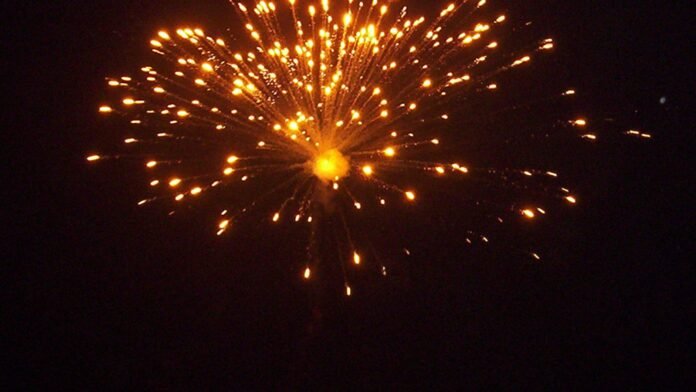
File photo: A firecracker bursts on Diwali night in New Delhi, November 1, 2005. Image: Ministry of Culture, Government of India, Government Open Data Licence – India, via Wikimedia Commons. Photo source · Licence
Sources
- Supreme Court of India: Judgments by case number (W.P.(C) No. 728/2015, Arjun Gopal & Ors. v. Union of India & Ors., order dated October 29, 2026)
- CAQM: Order dated November 2, 2026 invoking GRAP Stage II in Delhi-NCR
- CAQM: Order dated October 30, 2026 on precautionary measures for November 5–20
- CAQM: Order dated October 21, 2026 invoking GRAP Stage I in Delhi-NCR

The National Desk covers India's politics, governance, security and public-interest news. Stories are checked against at least two credible sources before publication.