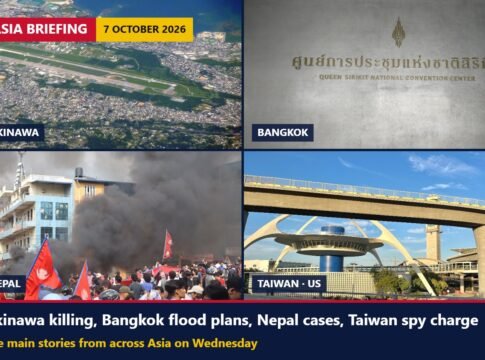
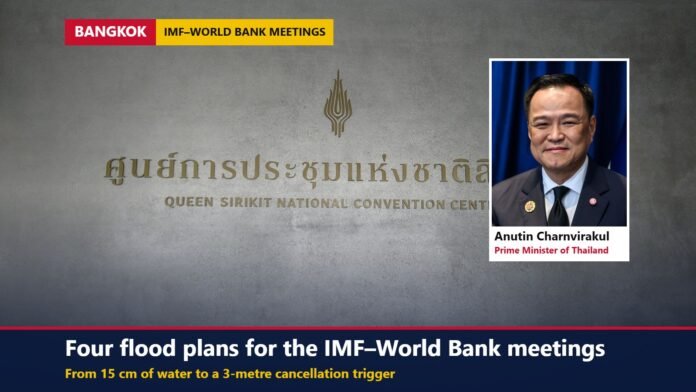
October 7: Thailand has drawn up a four-step flood plan for the IMF–World Bank Annual Meetings, which are due to be held at the Queen Sirikit National Convention Center in Bangkok from October 12 to 18. Prime Minister Anutin Charnvirakul chaired the preparatory committee on Monday, The Nation reported. The plan runs from 15 centimetres of water on the roads, when police keep traffic moving, to 3 metres, when the crisis team would recommend cancelling the event. Forecasters expect about 50 millimetres of rain a day in Bangkok from October 11 to 13, the South China Morning Post (SCMP) reported.
Key highlights
- The meetings bring about 10,000 participants from 191 countries to Bangkok, including nearly 400 leaders and senior officials, mostly finance ministers and central bank governors, according to The Nation. SCMP put the number of delegates at more than 15,000.
- Thailand last hosted the meetings 35 years ago, The Nation noted.
- Late-September rain flooded Bangkok and 29 provinces and affected 2.6 million people, the Department of Disaster Prevention and Mitigation said on September 29, as reported by The Nation.
- The Bank of Thailand said on October 1 that Bangkok “should not be affected during the meetings” if upstream water is managed well and there is no substantial further rain.
The four scenarios
The committee set out what happens at each water level, according to The Nation. Deputy Prime Minister and Finance Minister Ekniti Nitithanprapas and Deputy Prime Minister and Foreign Minister Sihasak Phuangketkeow attended the meeting.
| Water level | Who is in charge | What changes for delegates |
|---|---|---|
| 15 cm | Police command centre | Bangkok districts speed up drainage and clear the roads. |
| 25 cm | Police command centre | The electric-car convoys are replaced by buses for safety. |
| 50 cm | Crisis management team | Delegates stop travelling by road and move to the BTS Skytrain and the MRT metro. |
| 3 metres | Crisis management team | Water would reach Level G of the venue. The team recommends cancellation; the World Bank president, the IMF managing director, Thailand’s finance minister and the Bank of Thailand governor decide jointly. |
Anutin also ordered tighter airport and travel arrangements, The Nation reported. “This will certainly have an impact on Thailand’s economy,” he said of the gathering, as quoted by the newspaper. Separately, SCMP reported that the authorities plan to use large trucks and four-wheel-drive vehicles to carry delegates if roads flood during the opening weekend, and that Anutin wants to avoid a repeat of the travel disruption that followed the September rain.
The flood so far
Bangkok received more than 304 millimetres of rain over several days in late September, which damaged homes, disrupted flights and forced some factories to close temporarily, SCMP reported. By September 29 the Department of Disaster Prevention and Mitigation counted 2.6 million people and 940,300 households affected in 29 provinces and Bangkok, and 23 deaths since September 16, according to The Nation. About 700,000 Bangkok residents had been affected since September 25, and the city had opened 233 temporary shelters. Samut Prakan, next to the capital, was the worst-hit province, with more than 818,000 people affected.
Surapong Sarapa, head of forecasting at the Thai Meteorological Department, said Bangkok “could receive about 50mm (two inches) of rain a day” from October 11 to 13, SCMP reported. Those dates cover the day before the meetings open and their first two days.
What the central bank says
Chayawadee Chai-anant, an assistant governor and spokesperson of the Bank of Thailand, said on October 1 that the meetings would go ahead as planned. “Our assessment is that Bangkok should not be affected during the meetings if upstream water is properly managed and there is no substantial additional rainfall,” she said, as quoted by The Nation. The conference area and the places where participants will stay, within five kilometres of the venue, had not been flooded, the bank said.
On the cost of the floods, she said: “At this stage, we cannot yet put a figure on the impact on gross domestic product because the situation is still ongoing.” The bank’s first estimate of property damage was about 0.03 to 0.1 per cent of GDP, The Nation reported. Sixteen financial institutions have offered relief such as payment holidays and lower interest rates to affected borrowers.
By the numbers
| Figure | What it is | Source |
|---|---|---|
| October 12–18 | Dates of the meetings at the Queen Sirikit National Convention Center | The Nation |
| 191 | Member countries sending delegations | The Nation |
| About 10,000 / more than 15,000 | Expected participants (the two reports differ) | The Nation / SCMP |
| 35 years | Time since Thailand last hosted the meetings | The Nation |
| More than 304 mm | Rain in Bangkok over several days in late September | SCMP |
| 2.6 million | People affected by flooding as of September 29 | Disaster department, via The Nation |
| About 50 mm a day | Rain forecast for Bangkok, October 11–13 | Meteorological Department, via SCMP |
| 0.03–0.1% of GDP | First estimate of property damage | Bank of Thailand, via The Nation |
Why it matters for Asia
The annual meetings are the main yearly gathering of the world’s finance ministers and central bankers, and they return to Asia at a difficult moment for the region. Oil prices have been pushed up by the conflict in West Asia, inflation has climbed in several economies, including the Philippines, where it reached 7.2 per cent in September, and the regional surveillance body AMRO has warned that Asia is the most exposed if the AI investment boom turns. A host that keeps the event running through a flood season can use it to make the region’s case on energy, debt and trade. A disrupted meeting would do the opposite.
For Thailand the stakes are also domestic. The government is presenting the event as a signal to investors, as Anutin’s remark shows, and Ekniti used the committee meeting to set out an economic strategy he calls “STI”: Stabilize Today, Transition Now and Invest for Tomorrow, The Nation reported. The flood plan is detailed, but its top step is a reminder that the final decision on cancellation would not be Thailand’s alone.
What to watch
- Rainfall in Bangkok from October 11 to 13 and the volume of water arriving from the north.
- Whether any side events or delegate travel are moved before the meetings open on October 12.
- An updated damage estimate from the Bank of Thailand once the water has gone down.
Sources
- The Nation (Thailand): Thailand prepares 4 flood scenarios for Oct 12–18 IMF–World Bank meetings
- The Nation, via The Star: Thailand prepares four flood scenarios for Oct 12–18 IMF–World Bank meetings
- South China Morning Post: Possible floods threaten IMF-World Bank meetings in Bangkok
- The Nation (Thailand): BOT assesses flood damage as IMF-World Bank meetings remain on track
- The Nation (Thailand): Floods affect 2.6m people across 29 provinces and Bangkok

The International Desk covers world and Asian affairs, diplomacy and conflict, with a focus on what they mean for India. Stories are checked against at least two credible sources before publication.