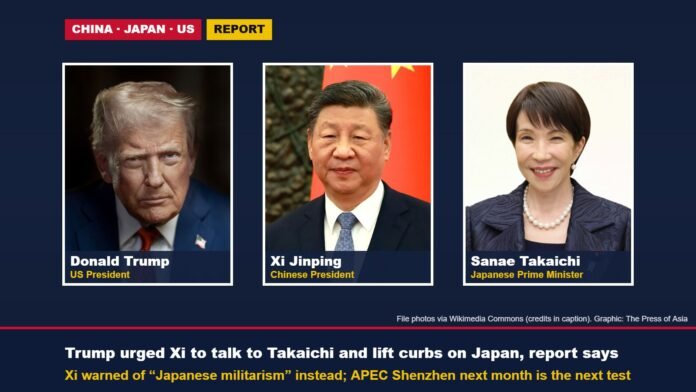
October 10: US President Donald Trump pressed Chinese President Xi Jinping during their talks in Washington last month to roll back China’s export curbs on Japan and to hold talks with Japanese Prime Minister Sanae Takaichi, the South China Morning Post reported on Thursday, citing people familiar with the discussions. Xi was not receptive and warned Trump about the growing risks of Japanese militarism, the newspaper said. None of the three governments has commented publicly on the report.
Key highlights
- Trump argued that China’s curbs, which include rare earths, threaten American industries that depend on Japanese suppliers, and called them an indirect violation of the US–China trade truce reached in Busan in October 2025, the SCMP reported.
- Xi said that “China-Japan relations and China-US relations should be kept separate and should not affect each other”, according to The Kyunghyang Shinmun’s account of the report.
- Japan has proposed a Takaichi–Xi meeting at next month’s APEC summit in Shenzhen; China rejected it and suggested a meeting with Premier Li Qiang instead, according to SCMP sources cited by The Kyunghyang Shinmun.
- The rift began in November 2025, when Takaichi said an attack on Taiwan could be a “survival-threatening situation” for Japan. Beijing then imposed strict export controls on dual-use items bound for Japan, including critical minerals and rare earths, The Korea Times reported.
- Japan was not one of Trump’s top priorities in the talks, the SCMP said.
How the rift unfolded
| Date | Event | Source |
|---|---|---|
| October 2025 | US–China trade truce reached in Busan; China and Japan explore better ties around the Gyeongju APEC summit | SCMP; The Kyunghyang Shinmun |
| November 2025 | Takaichi says an attack on Taiwan could be a “survival-threatening situation” for Japan; Beijing reacts angrily | The Korea Times |
| After November 2025 | China imposes strict dual-use export controls on items for Japan, including critical minerals, rare earths and advanced technology | The Korea Times |
| February 2026 | Takaichi’s Liberal Democratic Party wins a general election, helped by her tough stance on China | Nikkei, via The Kyunghyang Shinmun |
| September 2026 | Former foreign minister Takeshi Iwaya leads a business delegation to China and meets Wang Yi; China refuses an indirect request to drop its demand that Takaichi retract her remarks | Jiji Press, via The Kyunghyang Shinmun |
| September 22, 2026 | Trump and Takaichi meet in New York on the sidelines of the UN General Assembly, with rare earths and Taiwan on the agenda | The Korea Times |
| September 24, 2026 | Trump meets Xi during Xi’s state visit to Washington | The Korea Times; SCMP |
| October 5, 2026 | Takaichi tells parliament China is “an important relationship” but she will “say what needs to be said” | The Kyunghyang Shinmun |
| October 8, 2026 | SCMP reports Trump’s request to Xi and Xi’s refusal | SCMP |
| November 2026 | APEC summit in Shenzhen, China | The Kyunghyang Shinmun |
By our count, China’s export curbs on Japan have been in force for most of the past year, and the dispute is now 11 months old.
What China’s curbs cover, and why they matter
| Item | Detail | Source |
|---|---|---|
| Goods covered | Dual-use items destined for Japan, including critical minerals, rare earths and advanced technology | The Korea Times |
| China’s stated reason | To curb Japan’s “remilitarisation” and nuclear ambitions, presented as a countermeasure to Tokyo’s defence build-up | The Korea Times |
| China’s leverage | About 90% of processed rare earths and at least 60% of rare earth extraction | The Korea Times |
| Trump’s argument | The curbs hurt US industries that rely on Japanese suppliers and indirectly breach the Busan trade truce | SCMP |
Rare earths are used in magnets for cars, electronics and defence equipment, and Japanese parts made with them feed into US supply chains. That is the link Trump drew, according to the SCMP: a dispute between Beijing and Tokyo has become, in his framing, a problem for US supply chains.
Positions in Beijing and Tokyo
Chinese Foreign Minister Wang Yi told Iwaya that “ambiguous approaches are not good” and that the party that caused a problem should solve it, according to The Kyunghyang Shinmun’s account of a Jiji Press report. He also noted that 2027 marks the 55th anniversary of the normalisation of China–Japan ties, which leaves room for improvement. Iwaya proposed reaffirming the 1972 Joint Communiqué instead of a direct retraction by Takaichi, which he described as a heavy political burden.
Kenichi Doi of the Institute of Geoeconomics told The Korea Times before the Washington summit that Tokyo’s priority was “to prevent a U.S.-China stabilisation deal”, while Trump had “little incentive to manufacture a visible dispute with Tokyo”.
What to watch
- Whether a Takaichi–Xi meeting or only a Takaichi–Li Qiang meeting takes place at APEC in Shenzhen in November.
- Any easing of rare earth licences for Japanese companies.
- Whether Washington raises the Japan curbs again in its trade talks with Beijing.
- Official responses in Tokyo or Beijing to the SCMP report.
What it means
If the report is accurate, it shows both the reach and the limit of US influence. Trump was willing to raise Japan’s problem with Xi, but as a supply-chain issue for American industry rather than as a matter of alliance solidarity, and Xi refused to link the two relationships. For Tokyo, that is a warning: it cannot count on Washington to end China’s pressure, and with US–China ties more stable than a year ago, as The Kyunghyang Shinmun noted, Beijing has less reason to ease up on Japan. The APEC summit in Shenzhen will show whether either side is ready to move first.
Sources
- South China Morning Post: Trump urged Xi to talk to Takaichi and lift export curbs on Japan, sources say
- The Kyunghyang Shinmun: “Talk with Takaichi”: Xi Jinping rejected urging from Donald Trump; why a China–Japan APEC summit will be difficult
- The Korea Times: Shadow of Xi summit hangs over Trump’s high-stakes talks with Japan’s Takaichi

The International Desk covers world and Asian affairs, diplomacy and conflict, with a focus on what they mean for India. Stories are checked against at least two credible sources before publication.