November 17: China’s latest monthly figures show a marked gap between consumer spending and industrial production. Retail sales rose 0.4% from a year earlier in October, while value-added industrial output increased 4.8%, according to the National Bureau of Statistics release published on November 16.
Key highlights
- Retail sales increased only modestly on a year-on-year basis.
- Industrial production continued to expand at a faster rate.
- High-technology manufacturing outperformed the industrial headline.
- The indicators describe different parts of the economy and cannot be added together.
What the October data show
The NBS put October retail sales at 4,646.3 billion yuan. Its release also reported growth of 17.6% in high-technology manufacturing and 10.6% in equipment manufacturing. Those figures describe industrial categories, rather than a comparable increase in household income or consumption.
The State Council’s English-language summary separately highlighted a 4.6% increase in the services production index. It reported that retail sales of goods and services increased 2.5% over January–October, with services retailing up 4.9%. The ten-month measures should not be confused with October’s single-month goods-focused retail headline.
The indicators at a glance
| Indicator | Reported growth | Comparison |
| Retail sales | 0.4% | October, year on year |
| Industrial value added | 4.8% | October, year on year |
| Services production index | 4.6% | October, year on year |
| Retail sales of goods and services | 2.5% | January–October, year on year |
Why the contrast matters
The practical question is whether production gains are being accompanied by stronger demand across the economy. An expanding factory sector and modest retail growth can coexist. One measures output in industry; the other measures a defined set of purchases. Neither is a substitute for a complete national-accounts assessment.
For Asian businesses selling into China, it is therefore useful to identify the relevant market before interpreting the aggregate. A supplier of equipment and a business selling consumer products may face different conditions. The national figures alone do not establish the experience of an individual company or province.
Three comparisons to keep separate
First, year-on-year growth compares October with the same month of 2025. It does not show the change from September. Second, nominal sales values and measures of production are constructed differently. Third, a fast-growing subsector can outperform without accounting for the whole economy.
Our reading of the release is that the divergence deserves attention, but does not justify declaring either a universal boom or a universal slump. A stronger interpretation needs evidence that the pattern persists and a clear account of the sectors responsible.
What to watch
Subsequent retail, industrial and services releases will help show whether the gap narrows. Businesses should also keep cumulative figures separate from monthly ones when assessing the trend. This report does not infer a new stimulus decision, a change in trade rules or a market-price forecast from the statistical release.
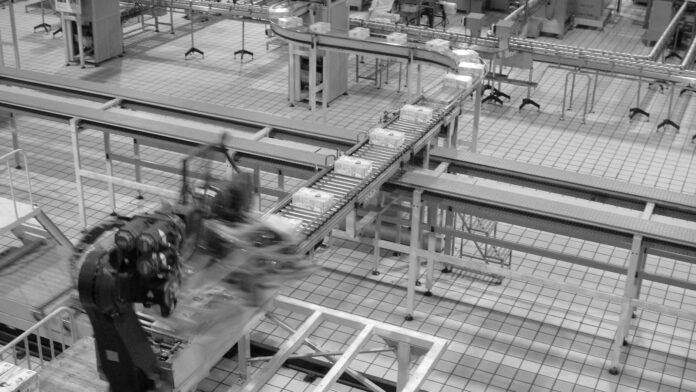
File photo: automated manufacturing equipment in China, May 8, 2010. Cory M. Grenier / Wikimedia Commons, CC BY-SA 2.0. Cropped and resized by The Press of Asia; adaptation shared under the same licence. Archival industrial image; no pictured company is identified as affected by current policy measures.
Sources
- National Bureau of Statistics: National economy in October 2026
- State Council: October economic indicators

The Business Desk covers markets, the economy, companies and personal finance. Stories are checked against at least two credible sources before publication.