November 17: India’s unemployment rate for people aged 15 and above fell to 4.9% in October, from 5.0% in September, according to the Periodic Labour Force Survey monthly bulletin released on November 16. The figures also show higher overall labour-force and workforce participation.
Key highlights
- Labour-force participation rose to 55.7%.
- The worker-population ratio increased to 53.0%.
- Female labour-force participation reached 35.0%.
- The unemployment rate uses the labour force as its denominator, not the entire population.
What changed in October
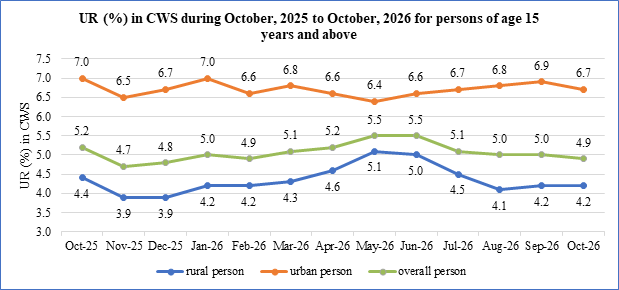
The Ministry of Statistics and Programme Implementation says urban unemployment declined from 6.9% to 6.7%, while the rural rate remained 4.2%. National unemployment was also below the 5.2% recorded in October 2025. The monthly results use the Current Weekly Status approach for people aged 15 and over.
The headline figures at a glance
| Indicator | September 2026 | October 2026 |
| Unemployment rate | 5.0% | 4.9% |
| Labour-force participation rate | 55.5% | 55.7% |
| Worker-population ratio | 52.7% | 53.0% |
| Female labour-force participation | 34.6% | 35.0% |
Why the denominators matter
The unemployment rate measures unemployed people as a share of the labour force. Labour-force participation measures the share of the relevant population that is working or seeking or available for work. The worker-population ratio measures those working as a share of that population. The ministry’s published survey guidance distinguishes these concepts.
A 4.9% unemployment rate therefore does not mean 95.1% of everyone aged 15 or above has a job. People outside the labour force are not included in that unemployment-rate denominator. Reading the participation and worker-population figures alongside unemployment gives a more complete picture.
Our calculation: the decline from 5.0% to 4.9% is 0.1 percentage point. Describing it as a one-percentage-point fall would be incorrect. Small changes should be reported using the same definitions and periods, rather than converted into an unsupported count of new jobs.
What the survey can and cannot establish
The NSO’s methodology explains that Current Weekly Status refers to activities during the seven days before the survey. Its revamped design, introduced in January 2025, provides monthly national rural and urban indicators. That reference period differs from measures based on activity over a year.
The October figures are a survey-based snapshot of labour-market conditions. They do not, by themselves, describe pay, working hours, job security or whether a particular qualification leads to suitable work. Those questions require additional indicators and the relevant detailed tables.
It is also important to separate a national average from a household’s experience. A modest aggregate improvement can coexist with difficulty finding work in a particular occupation or location. The survey should be used to examine those differences, rather than to dismiss individual circumstances.
What to watch
The next monthly bulletin will help show whether the movement continues. A useful comparison will track unemployment, participation and the worker-population ratio together, while keeping age group, reference period and rural–urban coverage consistent. A single month is insufficient to establish a durable turning point in employment conditions.
Official chart: Unemployment rates for people aged 15 and above, Current Weekly Status, October 2025–October 2026. Source: Ministry of Statistics and Programme Implementation / PIB, November 16, 2026. Reproduced from the government press release; not a photograph.
Sources
- MoSPI via PIB: October 2026 PLFS monthly bulletin press note
- NSO: July–September 2026 bulletin, survey concepts and methodology

The Business Desk covers markets, the economy, companies and personal finance. Stories are checked against at least two credible sources before publication.