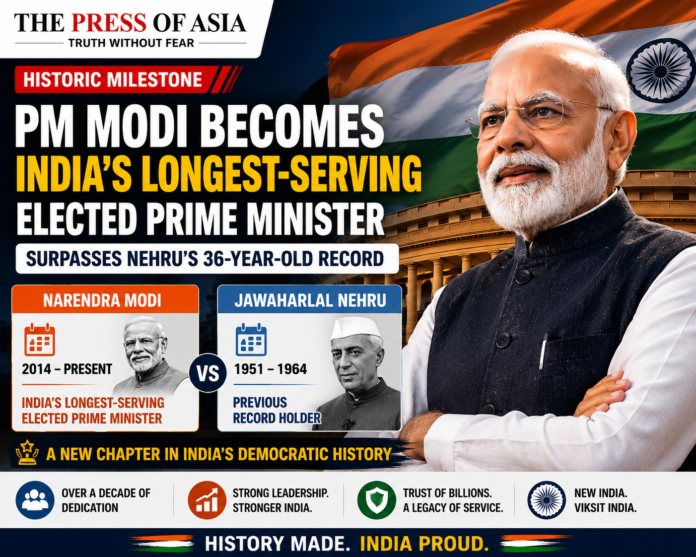

New Delhi, June 10, 2026 — Prime Minister Narendra Modi has etched his name into India’s political history by becoming the country’s longest-serving continuously elected Prime Minister. On Wednesday, June 10, 2026, PM Modi completed 4,399 consecutive days in office, surpassing the record previously held by India’s first Prime Minister, Jawaharlal Nehru, whose tenure comprised 4,398 days.
A Historic Milestone for Indian Democracy
The milestone marks a defining moment in India’s democratic journey. PM Modi, who first assumed office on May 26, 2014, and secured a third consecutive term following the 2024 Lok Sabha elections, has now led the nation for over 12 years — a testament to the enduring trust placed in his leadership by millions of Indian voters across three general elections.
The Prime Ministers’ Office confirmed the achievement in an official statement, noting that June 10, 2026, represents 4,399 consecutive days of Narendra Modi’s prime ministership. In a post on his official website, PM Modi shared a Sanskrit Subhashitam highlighting that public service is the biggest test of good governance.
Cabinet Applauds the Achievement
The Union Cabinet held a special meeting to mark the occasion, where ministers extended their congratulations to the Prime Minister. The cabinet applauded PM Modi’s record-breaking tenure, calling it a reflection of the nation’s faith in his leadership model anchored in the principle of “Nation First.”
Finance Minister Nirmala Sitharaman wrote on social media, calling the milestone a reflection of the enduring trust that millions of Indians have placed in a governance model focused on national development and welfare.
World Leaders Extend Congratulations
Leading figures from across the globe congratulated PM Modi on his historic achievement. Italy’s Prime Minister Giorgia Meloni was among the first to extend her warm wishes, praising Modi’s leadership on the global stage and his commitment to representing the interests of the Global South.
Other world leaders, including those from BRICS nations and ASEAN countries, also sent messages of congratulations, acknowledging India’s rising influence in international affairs under PM Modi’s stewardship. The diplomatic recognition underscores India’s elevated position in global geopolitics over the past decade.
Key Achievements During PM Modi’s Tenure
PM Modi’s record-breaking tenure has been marked by several transformative initiatives:
- Digital India Revolution: The nationwide push for digital infrastructure, including Aadhaar-linked services, UPI, and direct benefit transfers, has transformed governance and financial inclusion.
- Infrastructure Expansion: Record-breaking construction of highways, railways, airports, and metro networks across the country.
- Economic Reforms: Implementation of GST, the Insolvency and Bankruptcy Code, and production-linked incentive (PLI) schemes to boost manufacturing.
- International Diplomacy: India’s emergence as a key voice for the Global South, exemplified by its G20 presidency in 2023.
- Welfare Schemes: Massive expansion of healthcare, housing, sanitation, and financial inclusion programs reaching hundreds of millions of beneficiaries.
- Space Achievements: Chandrayaan-3’s historic lunar landing and India’s growing presence in space exploration.
Market Response: Sensex and Nifty Rally
Financial markets reacted positively to the historic day, with the BSE Sensex surging over 550 points and the Nifty 50 crossing the 23,400 mark. Analysts noted that the stability and continuity represented by PM Modi’s extended tenure continues to instill confidence among investors. Analysts at The Press of Asia earlier noted that Indian markets have shown resilience during PM Modi’s leadership period.
Timeline of PM Modi’s Tenure
- May 26, 2014: Narendra Modi sworn in as India’s 14th Prime Minister
- May 30, 2019: Modi begins his second consecutive term
- June 9, 2024: Modi begins his third consecutive term
- June 10, 2026: PM Modi surpasses Jawaharlal Nehru’s record with 4,399 days
Expert Analysis
Political analysts view this milestone as a significant moment in India’s democratic history. The fact that a Prime Minister has been re-elected three times consecutively demonstrates the strength of India’s democratic institutions and the evolving preferences of Indian voters.
“This is not just a personal achievement for PM Modi, but a reflection of India’s democratic maturity,” said a leading political scientist. “The ability of Indian voters to deliver consecutive mandates to the same leader shows the stability and sophistication of our electoral democracy.”
Looking Ahead
As PM Modi begins his 13th year in office, his government faces several key challenges including managing geopolitical tensions in West Asia, navigating complex trade relationships, advancing economic reforms, and addressing domestic concerns around employment and economic growth. The upcoming G7 summit, where PM Modi is expected to meet with global leaders including US President Donald Trump, will be another significant diplomatic moment.
The historic milestone also comes at a time when PM Modi’s NDA coalition is celebrating 12 years in power at the Centre, with plans to hold a special meeting to commemorate the occasion.
FAQs
Q: How many days has PM Modi served as Prime Minister?
A: As of June 10, 2026, PM Narendra Modi has completed 4,399 consecutive days as Prime Minister of India.
Q: Whose record did PM Modi surpass?
A: PM Modi surpassed Jawaharlal Nehru, India’s first Prime Minister, whose elected tenure lasted 4,398 days.
Q: How many terms has PM Modi completed?
A: PM Modi has completed two full terms (2014-2019 and 2019-2024) and is currently serving his third consecutive term which began in June 2024.
Q: What was the market reaction to this milestone?
A: The Sensex surged over 550 points and Nifty crossed 23,400, reflecting positive investor sentiment on the milestone.