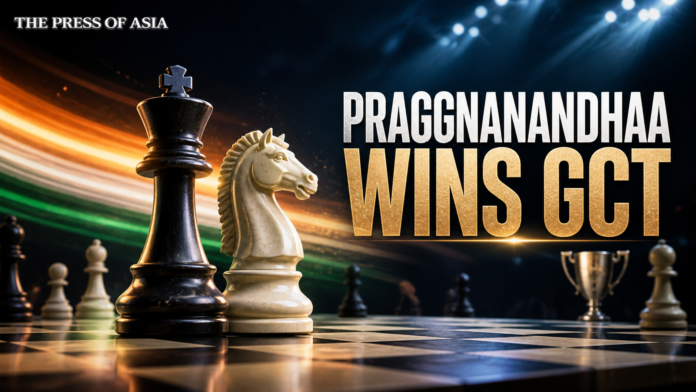
St. Louis, August 28: Indian grandmaster R Praggnanandhaa has won the Grand Chess Tour 2026 title with a remarkable comeback. He beat Fabiano Caruana of the United States 15–13 in the final at the Saint Louis Chess Club on August 27 and became the first Indian to win the prestigious tour’s overall title.
The win stands out for more than the final score. Praggnanandhaa trailed 3–9 after the classical stage, but won both rapid games to turn the match around. He led 11–9 after the rapid stage and then took the points he needed in blitz to clinch the title 15–13. As champion he receives $200,000 in prize money and a guaranteed place in the 2027 Grand Chess Tour.
Key highlights
- Praggnanandhaa beat Fabiano Caruana 15–13 in the final.
- He was 3–9 down after the classical games.
- Winning both rapid games took the score to 11–9 in his favour.
- The final margin after the blitz stage was two points.
- He is the first Indian overall winner of the Grand Chess Tour.
- He earns $200,000 and a guaranteed place in the 2027 tour.
The final, stage by stage
| Stage | Praggnanandhaa | Caruana | Running score |
|---|---|---|---|
| Classical (2 games) | 3 | 9 | 3–9 |
| Rapid (2 games) | 8 | 0 | 11–9 |
| Blitz (4 games) | 4 | 4 | 15–13 |
Our calculation: Praggnanandhaa took all eight points on offer in the two rapid games, an eight-point swing that turned a six-point deficit into a two-point lead. The four blitz games were then shared 4–4, which was enough to hold that two-point margin to the end.
How the match turned after 3–9
The opening classical stage of the final went Caruana’s way: he won the first classical game with White and the second was drawn, giving him a 9–3 lead. In a mixed-format final the classical games carry more weight, so a six-point gap was a serious challenge, and Praggnanandhaa needed almost error-free rapid play to come back.
The Indian player showed speed and judgement under pressure and won both rapid games. Their points value turned the match completely, putting him ahead 11–9. Now it was Caruana who had to overtake Praggnanandhaa in blitz, not defend a lead.
Holding the lead in blitz
In blitz each player has very little time, and one small mistake can change the result. A two-point lead was useful but not safe, and Praggnanandhaa had to balance looking for attacking chances with avoiding needless risk. Caruana levelled the score by winning the second blitz game, but Praggnanandhaa took the next one and, in the final game, agreed a draw by perpetual check from a winning position to seal the 15–13 result, FIDE reported.
The result showed how quickly he can adjust his play across time controls: after falling behind in classical, he attacked in rapid and made match-situation decisions in blitz. That was the defining feature of the win.
Why the first Indian overall title matters
The Grand Chess Tour combines performance across several top-level events and different time controls, so winning one tournament trophy and winning the whole tour are different achievements. Praggnanandhaa collected points steadily through the 2026 season to reach the final and then won it to become tour champion.
Indian players have succeeded before in world-class classical, rapid and blitz events, but the Grand Chess Tour overall title is a new chapter in Indian chess records. It also shows the depth of a generation in which several young Indian grandmasters regularly challenge the world’s best.
Why beating Caruana is a big deal
Fabiano Caruana has long been one of the world’s strongest classical players, known for deep preparation, precise calculation and experience in high-pressure matches. His lead in the classical stage reflected that strength, which makes Praggnanandhaa’s comeback from such a deficit strong evidence of his mental resilience. In a mixed time-control event, energy management, clock use and the ability to bounce back immediately after a loss matter as much as the quality of the chess.
$200,000 and a ticket to the 2027 tour
The title brings Praggnanandhaa $200,000 from a total prize fund of $450,000. Because rupee values change with the exchange rate, the official prize is best read in dollars. More importantly, his place in the 2027 Grand Chess Tour is now guaranteed, which will help him plan a calendar that has to balance the world championship cycle, national duties, club events and other international tournaments.
The wider message for Indian chess
Praggnanandhaa’s win is part of growing competitiveness in Indian chess. After Viswanathan Anand, a new generation has built a strong presence from junior level to the elite circuit, with Indian players succeeding in classical ratings, knockout events, team competitions and online formats. Modern top-level chess demands deep calculation in classical, quick plans in rapid and fast practical decisions in blitz, and his final was an example of that multi-format ability.
Three lessons from the win
- A comeback is possible until the match ends: even after a 3–9 deficit, the maths and momentum of a mixed format can change.
- Strategy has to change with the time control: Praggnanandhaa turned the pressure with aggressive rapid play and managed the match score in blitz.
- A mental reset is decisive: instead of carrying the disappointment of the classical stage forward, he started each stage like a new match.
What to watch
The 2026 title is an important milestone in Praggnanandhaa’s career, but the elite calendar never stops. His form will now be watched in upcoming classical events and the 2027 tour, and rivals will study this final, especially how he changed his rapid and blitz strategy under pressure. For now, the clearest conclusion is that he has strengthened his place among the world’s top players with a major tour title.
This article was first published in Hindi and has been translated. The Press of Asia now publishes in English only.
Sources
- FIDE: Praggnanandhaa Rameshbabu wins Grand Chess Tour 2026
- Grand Chess Tour: official GCT Finals 2026 results
- The Indian Express: Praggnanandhaa first Indian Grand Chess Tour winner
- All India Radio News: Praggnanandhaa creates history

The Sports Desk covers cricket, the Asian Games and Indian and international sport. Stories are checked against at least two credible sources before publication.