The Press of Asia Desk
Mumbai | August 28, 2026
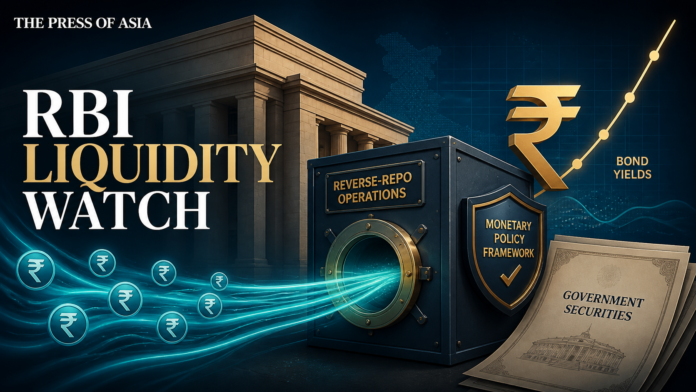
The RBI liquidity drain has become the central issue for India’s money and government-bond markets after a special foreign-currency deposit window brought a large volume of rupees into the banking system. Traders now expect the Reserve Bank of India to use larger or longer cash-absorption operations to keep short-term rates aligned with monetary policy.
The important distinction is that the market is anticipating possible policy tightening; the RBI has not announced an interest-rate increase. Its immediate action is liquidity management. On August 28, the central bank scheduled a three-day Variable Rate Reverse Repo, or VRRR, auction to absorb up to ₹3 lakh crore temporarily from banks.
Key highlights
- Banking-system surplus liquidity averaged more than ₹3.4 lakh crore in August, according to Reuters.
- RBI data reported on August 22 showed $72.85 billion of foreign-currency inflows under special swap facilities through August 21.
- FCNR(B) deposits contributed $65.397 billion, making them the dominant source of inflows.
- Bond dealers expect the RBI to consider longer-duration VRRR auctions or other absorption tools.
- Any rate hike remains a policy decision for the Monetary Policy Committee and should not be treated as confirmed.
Why surplus liquidity has risen
The increase traces back to a special dollar-rupee swap facility introduced in June to attract foreign-currency funds, support the rupee and strengthen external liquidity. Banks raised money through Foreign Currency Non-Resident (Bank) deposits and other eligible overseas borrowing channels, then exchanged those dollars with the RBI under concessional swap terms.
When the RBI receives foreign currency and provides rupees in return, domestic banking liquidity expands. The Indian Express, citing central-bank data, reported total inflows of $72.85 billion through August 21. FCNR(B) deposits accounted for $65.397 billion, followed by $4.86 billion through overseas foreign-currency borrowings and $2.591 billion through external commercial borrowings.
The RBI advanced the closing date for the FCNR(B)-linked facility to August 31 from the earlier September 30 deadline after what it described as an encouraging response. Eligible swaps against deposits mobilised by the deadline can continue to be executed for a limited period in September.
How an RBI liquidity drain works
A VRRR auction allows banks to place surplus funds with the RBI for a fixed period at a market-determined rate. The operation removes cash from the banking system temporarily. When the transaction matures, the funds return to banks.
The central bank has already used short-term VRRR auctions to prevent overnight money-market rates from falling too far below its policy corridor. A larger three-day auction on August 28 signals that the RBI is willing to absorb a meaningful amount of surplus cash, though the actual absorption depends on bids submitted by banks.
Reuters reported that six treasury officials expected the RBI to use a wider set of tools if the surplus persists. Possibilities discussed by market participants included longer VRRR operations, foreign-exchange forward swaps and, in a more forceful scenario, an incremental cash reserve requirement. These are market expectations, not decisions announced by the RBI.
Why bond markets are watching
Government-bond prices are sensitive to both policy-rate expectations and banking liquidity. Abundant cash usually supports demand for short-term debt and can pull money-market rates lower. When the RBI drains cash, those rates can move upward and the rally in shorter-maturity bonds can lose momentum.
Reuters said bond redemptions could add more than ₹63,000 crore to the system over the following fortnight. Market estimates suggested surplus liquidity could rise above ₹5 lakh crore in September if the remaining foreign-currency inflows are converted into rupees.
That prospect has encouraged dealers to look beyond overnight operations. A three-month VRRR with an early-reversal option was one idea cited by a treasury executive. Another was a temporary increase in the share of deposits banks must keep as reserves. The RBI has not committed to either approach.
Does this mean an RBI rate hike is coming?
No rate hike has been announced. Earlier in August, the RBI kept its policy rate and stance unchanged. Minutes of that meeting showed that members discussed inflation risks and the possibility that rates might need to rise later, but discussion does not amount to a decision.
Liquidity absorption can prepare money markets for tighter conditions without prejudging the next Monetary Policy Committee vote. The committee will assess inflation, growth, the rupee, global energy prices and financial conditions before changing the policy rate.
RBI Governor Sanjay Malhotra also said earlier this month that surplus liquidity was expected to peak around September and could then be absorbed through normal demand for currency, reserve requirements and maturing foreign-exchange forwards. That guidance suggests the central bank may combine routine absorption with targeted auctions rather than relying on one dramatic measure.
What it means for banks, borrowers and investors
For banks, less surplus cash can raise the marginal cost of short-term funding and reduce the incentive to chase low-yielding assets. For bond investors, it can create price volatility, particularly in short- and medium-duration securities. For ordinary borrowers and depositors, the effect is indirect unless liquidity tightening develops into a change in lending and deposit rates.
The most reliable signal will be the RBI’s announced operations and the amount banks actually place in each auction. Market forecasts should be read as scenarios, not as official guidance.
Related Press of Asia coverage
Sources / References
- Reuters: bond traders expect stronger RBI liquidity withdrawal
- The Indian Express: RBI swap-window inflow data
- RBI release: three-day VRRR auction for August 28
- Business Standard: RBI governor on the expected liquidity peak

The Business Desk covers markets, the economy, companies and personal finance. Stories are checked against at least two credible sources before publication.