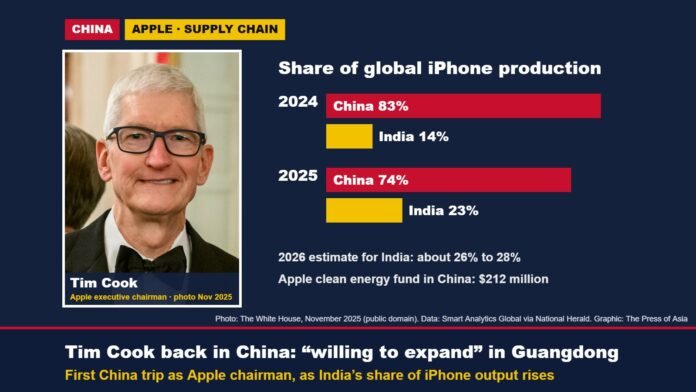
October 12: Apple executive chairman Tim Cook told the governor of Guangdong on Sunday that Apple is willing to expand its presence in the southern Chinese province, including in smart manufacturing and sales channels, on his first visit to China since handing over as chief executive to John Ternus on September 1, the South China Morning Post and Global Times reported. The trip, Cook’s third to China this year, came as Apple said its second China Clean Energy Fund had grown to $212 million, according to China Daily. It also comes as more of Apple’s iPhone production moves to India.
Key highlights
- Cook arrived in Guangzhou on Saturday, October 10, and visited the set of a Wing Chun martial arts short film being shot on the iPhone 18 Pro, Global Times and China Daily reported.
- He met Guangdong Governor Meng Fanli on Sunday and cited the province’s concentration of Apple suppliers as essential to Apple’s growth in China. Meng promised a “first-class business environment”, the SCMP reported.
- The clean energy fund has roughly doubled from its initial $100 million in 2025, and is backing a 260-megawatt wind project in Guangxi and a 50-megawatt project in Shandong, China Daily said.
- 80 of Apple’s top 100 suppliers are in China, Global Times reported.
- India’s share of global iPhone production rose to 23% in 2025 from 14% in 2024, while China’s fell to 74% from 83%, according to Smart Analytics Global figures reported by National Herald.
Cook’s three China visits in 2026
| When | Where | What he did | Source |
|---|---|---|---|
| March | Chengdu and Beijing | Visited Apple stores for Apple’s 50th anniversary and spoke at the China Development Forum | AppleInsider |
| May | China | Joined the US business delegation that accompanied President Trump to his meeting with Xi Jinping | AppleInsider |
| October 10–11 | Guangzhou | Visited a film set using the iPhone 18 Pro; met Guangdong Governor Meng Fanli | Global Times; SCMP |
| October 13–14 | Beijing | Due to chair the Tsinghua University School of Economics and Management advisory board, which he has chaired since 2019 | China Daily |
Cook was CEO for the first two visits. Since September 1 he has been Apple’s executive chairman, a role in which he continues to handle engagement with policymakers around the world, Khaleej Times reported when the handover took place. China Daily said the Tsinghua board has three new members this year: Nvidia’s Jensen Huang, AMD’s Lisa Su and Marc Pictet of the Pictet Group.
China and India in Apple’s supply chain
| Measure | China | India | Source |
|---|---|---|---|
| Share of global iPhone production, 2024 | 83% | 14% | Smart Analytics Global, via National Herald |
| Share of global iPhone production, 2025 | 74% | 23% | Smart Analytics Global, via National Herald |
| Change in one year (our calculation) | −9 points | +9 points | Our calculation |
| Estimate for 2026 | Not given | About 26% (Counterpoint Research) to 28% (industry estimates) | National Herald |
| Suppliers | 80 of Apple’s top 100 suppliers | More than 40 component suppliers | Global Times; Business Today |
| iPhone exports | Not given | ₹2 trillion in FY26 (April–February data) | Business Today |
| Apple ecosystem jobs | Not given | About 250,000 | Business Today |
By our calculation, India’s share of iPhone production grew by almost two-thirds in a single year, from 14% to 23%, while China’s share fell by the same nine points. Even so, about three of every four iPhones were still made in China in 2025. That is why Cook’s message in Guangdong was about expansion, not withdrawal: Apple’s supply chain is moving at the margin, while its core remains in China.
The clean energy fund
| Item | Detail |
|---|---|
| Total committed | $212 million, about double the initial $100 million anchored in 2025 |
| New backers | Apple suppliers including Sunwoda Electronic, Amperex Technology, Avary Holding and Diodes Inc |
| First projects | 260 MW wind farm in Guangxi and 50 MW wind project in Shandong, both under construction |
| Apple’s claim | More than 95% of Apple’s direct manufacturing in China runs on renewable energy |
| Goal | Carbon neutrality across Apple’s whole footprint by 2030 |
Chinese state media framed the trip as a vote of confidence. Analyst Ma Jihua told Global Times that China is “not merely a sales market for Apple but a core manufacturing and supply-chain hub”. The SCMP noted mixed signals on demand for the new iPhone 18 line-up in China.
What to watch
- Cook’s role at the Tsinghua advisory board in Beijing on October 13–14, where Jensen Huang and Lisa Su join as new members.
- Sales data for the iPhone 18 Pro and the iPhone Duo, Apple’s first foldable, in China.
- Whether Apple announces new investment in Guangdong after Cook’s pledge.
- The next figures on India’s share of iPhone production, expected to rise again in 2026.
What it means
Apple is running a two-track strategy, and Cook’s visit shows both tracks. In China it is reassuring officials and suppliers that it remains committed, with new money for clean energy and talk of expansion in Guangdong. In India it keeps adding capacity, and the numbers show a steady shift: from 14% of iPhone output to 23% in one year. For India, the lesson is that the gains are real but the base is still small compared with China. For China, the visit is a reminder that Apple still needs its suppliers, even as it builds a second home for iPhone assembly. Cook’s new role, focused on governments and policymakers, makes him the person managing that balance.
Sources
- South China Morning Post: Apple’s Tim Cook kicks off China visit amid mixed signals on new iPhone demand
- Global Times: Tim Cook visits Guangzhou as Apple’s executive chairman, underscores China’s key role in firm’s supply chain
- China Daily: Tim Cook makes first China visit since stepping down as Apple CEO
- AppleInsider: Tim Cook visits China for the third time in 2026
- Khaleej Times: Apple CEO Tim Cook steps down today; John Ternus set to take over
- National Herald: India’s share in global iPhone assembly projected to reach 28% in 2026
- Business Today: India’s iPhone exports cross Rs 2 trillion mark amid PLI success

The Business Desk covers markets, the economy, companies and personal finance. Stories are checked against at least two credible sources before publication.