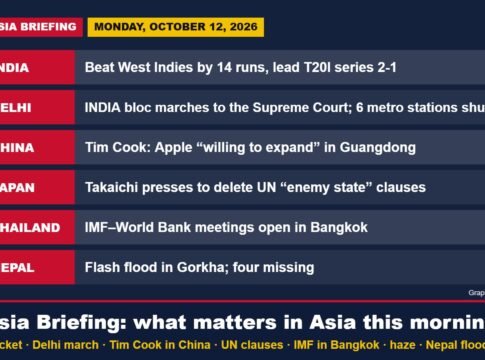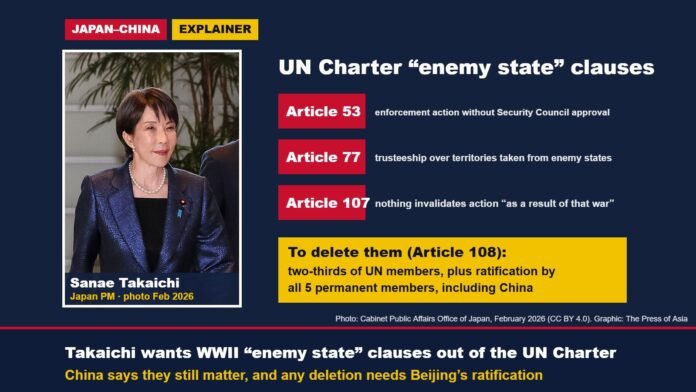
October 12: Japanese Prime Minister Sanae Takaichi’s campaign to delete the World War II “enemy state” clauses from the United Nations Charter may deepen Japan’s rift with China, Kyodo News reported in an analysis carried by Japan Today. Takaichi told the UN General Assembly on September 22 that the clauses should be deleted, and told parliament on October 7 that there is “no longer any room for any country to invoke the clauses”, according to Kyodo. China’s Foreign Ministry says the clauses remain relevant as a safeguard against “fascism and militarism”.
Key highlights
- The clauses are in Articles 53, 77 and 107 of the UN Charter. They refer to any state that was an enemy of a Charter signatory during World War II, such as Japan, Germany and Italy.
- Article 53 lets regional arrangements take enforcement action against such a state without Security Council authorisation, if it is aimed at preventing a “renewal of aggressive policy”, according to the Charter text.
- The General Assembly called the clauses “obsolete” in 1995, and world leaders resolved at the 2005 World Summit to delete the references, but the Charter has never been amended to remove them, Kyodo reported.
- Takaichi is the first sitting Japanese leader in more than 20 years, since Junichiro Koizumi, to raise the issue at the UN, and she has called the clauses “extremely humiliating”, Kyodo said.
- Any deletion needs a Charter amendment ratified by all five permanent members of the Security Council, including China, under Article 108.
What the three clauses say
| Article | What the Charter says | What it means in practice (our reading) |
|---|---|---|
| 53(1) | No enforcement action may be taken under regional arrangements without Security Council authorisation, “with the exception of measures against any enemy state” provided for under Article 107 or directed against a renewal of its aggressive policy | In theory, an exception to the ban on regional enforcement action without the Council’s approval. Japan says it is a dead letter |
| 53(2) | An enemy state is any state which during the Second World War “has been an enemy of any signatory” of the Charter | Covers Japan, Germany, Italy and other states that fought the Allies, all now UN members |
| 77(1)(b) | Allows the trusteeship system to apply to territories detached from enemy states as a result of the war | Of historical interest only: the trusteeship system has no territories left |
| 107 | “Nothing in the present Charter shall invalidate or preclude action” against such a state “taken or authorized as a result of that war” | Protects post-war settlements made by the Allies. This is the clause China points to as a guard against militarism |
Wikipedia’s summary of the clauses lists Germany, Italy, Japan, Bulgaria, Romania, Hungary and Finland as states covered by the definition. All joined the UN long ago; Japan became a member in 1956.
How the dispute developed
| When | What happened | Source |
|---|---|---|
| 1945 | UN Charter signed with the enemy state clauses | UN Charter |
| 1995 | General Assembly resolution 50/52 says the clauses have “become obsolete” and states an intention to amend the Charter | Kyodo; Wikipedia |
| 2005 | World Summit outcome document resolves to delete the references to “enemy states” | Kyodo; Financial News (Korea) |
| November 2025 | Takaichi tells parliament a Chinese attack on Taiwan could prompt a Japanese military response; China’s embassy in Tokyo refers to the enemy state clause on social media | Kyodo |
| September 2026 | At his summit with Donald Trump, Xi Jinping says China and the US stood “shoulder to shoulder” against Japanese militarist aggressors | Kyodo |
| September 22, 2026 | Takaichi, in her first UN General Assembly speech, says the clauses should be deleted in line with the 2005 resolution | Financial News (Korea) |
| September 23, 2026 | Chinese Foreign Ministry spokesman Guo Jiakun says the clauses remain highly relevant and opposes their removal | Global Times; Kyodo |
| October 5, 2026 | In a policy speech, Takaichi calls China an “important neighbor” but promises to assert Japan’s positions on the East and South China Seas | Global Times, citing Kyodo |
| October 7, 2026 | Takaichi tells parliament no country can invoke the clauses any longer | Kyodo |
| November 2026 | APEC summit in Shenzhen, China | Global Times |
A source in Takaichi’s office pointed out that China supported the 2005 resolution but now argues the clauses are still in effect, Kyodo reported. A Japanese diplomatic source suggested Beijing “may be seeking to drive a wedge between Japan and the United States” with its messaging.
Why deletion is hard: the Article 108 test
| Step | What Article 108 requires | What it means today (our calculation) |
|---|---|---|
| 1. Adoption | A vote of two-thirds of the members of the General Assembly | At least 129 of the 193 UN members |
| 2. Ratification | Ratification by two-thirds of UN members under their own constitutional processes | At least 129 national ratifications |
| 3. Permanent members | Ratification must include all permanent members of the Security Council | China, France, Russia, the UK and the US must all ratify. Any one of them can block deletion by not ratifying |
The bar is high in practice too. The Charter’s text has not changed since 1973, when the last of its amendments came into force. Those amendments, adopted in 1963, 1965 and 1971, enlarged the Security Council and the Economic and Social Council and changed the review provision in Article 109, according to the UN. A deletion of the enemy state clauses would be the first amendment in more than half a century, and it would need Beijing’s ratification.
The two positions
| Japan | China | |
|---|---|---|
| On the clauses | Already “dead letters”, in the words of a senior Foreign Ministry official; Takaichi calls them “extremely humiliating” | Meant to “prevent fascism and militarism from again becoming threats to international peace and security”, says spokesman Guo Jiakun |
| On history | The UN itself agreed in 1995 and 2005 that the clauses are outdated; Takaichi cited the 2005 decision in her UN speech | Japan must first reckon with its wartime past; Chinese scholars quoted by Global Times say Tokyo lacks standing to seek removal |
| On the wider context | Takaichi calls China an “important neighbor” and seeks a strategic relationship of mutual benefit, but says Japan will firmly assert its positions | Beijing accuses Tokyo of “remilitarization” as Japan raises defence spending |
Wang Guangtao of Fudan University’s Center for Japanese Studies told Global Times that Japan’s appeal could backfire by reviving memories of its wartime aggression. Global Times is a state-run Chinese newspaper, and the Japanese side’s views here come from Kyodo, Japan’s national news agency.
The clauses are now one of several fronts in a wider dispute. Our report on the reported Trump–Xi exchange over Japan has the background on export curbs and the path to APEC: Trump urged Xi to talk to Takaichi and lift export curbs on Japan.
What to watch
- Whether Takaichi raises the clauses again at APEC in Shenzhen in November, and whether she gets a meeting with Xi there.
- Whether Japan seeks partners, such as Germany, for a fresh push at the UN.
- Any new reference to the clauses by Chinese officials or embassies, which Tokyo would treat as an escalation.
- Whether the issue enters the wider debate on Security Council reform, which also needs an Article 108 amendment.
What it means
In legal terms, little may change: Japan treats the clauses as obsolete, and the General Assembly said so three decades ago. But because deleting them needs China’s ratification, Beijing holds the key, and it has chosen to keep the words in play as a reminder of Japan’s wartime past. For Takaichi, raising the issue is a matter of national dignity and a way to show she will not back down on history. For China, keeping it alive is cost-free leverage. That makes the clauses a symbol of the larger standoff: neither side is likely to move until the two leaders decide to repair ties, and for now there is no sign of that before APEC.
Sources
- Japan Today (Kyodo): Japan PM’s call at U.N. for cutting WWII enemy clause may roil China ties
- United Nations: Charter of the United Nations, full text (Articles 53, 77, 107 and 108)
- Financial News (Korea): Takaichi urges UN to delete ‘enemy state clauses’ targeting Japan
- Global Times: Enemy state clauses in UN Charter remain extremely relevant today, Chinese FM refutes Takaichi’s remarks at UN
- Global Times: Takaichi calls China ‘important neighbor’ but hypes ‘regional’ tensions
- Wikipedia: Enemy state clauses

The International Desk covers world and Asian affairs, diplomacy and conflict, with a focus on what they mean for India. Stories are checked against at least two credible sources before publication.