Update: In the first ten days of the sale, about 4,000 tonnes of buffer onions had been sold at ₹35 a kg across 17 cities, Consumer Affairs Secretary Nidhi Khare told PTI, Business Today reported on September 6. The all-India average retail price had still risen, to ₹50.79 a kg from ₹48.5 at the launch, and Delhi’s retail price was ₹58 a kg on September 5. Rural Voice reported on September 1 that the ministry had listed 19 cities for the release. Correction: the first Kanda Express rake of this phase had been announced at about 800 tonnes, but it carried about 453 tonnes when it reached Delhi, Outlook Business reported; the figure below has been corrected.
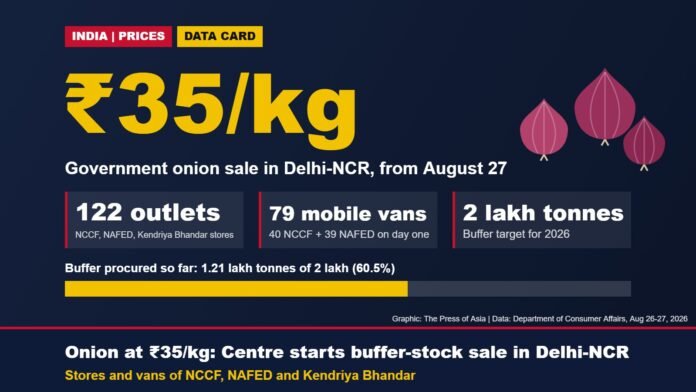
New Delhi, August 28: The Centre has started selling onions at ₹35 a kg in Delhi-NCR to give consumers relief from rising prices. According to the Department of Consumer Affairs, buffer-stock onions are being sold from August 27 through selected stores and mobile vans of the National Cooperative Consumers’ Federation (NCCF), the National Agricultural Cooperative Marketing Federation (NAFED) and Kendriya Bhandar.
The move comes at a time when rain and supply pressure usually push up retail onion prices. The government says it will release stock in phases while monitoring prices and availability, rather than putting large quantities on the market at once. The aim is to give consumers a cheaper rate and prevent sudden swings in the open market.
Key highlights
- Government retail sales began in Delhi-NCR on August 27.
- At launch, nine NCCF stores, 13 NAFED stores and 100 Kendriya Bhandar outlets were part of the scheme.
- On the first day, 40 NCCF and 39 NAFED mobile vans were deployed.
- The consumer price is ₹35 a kg.
- The government aims to build a buffer of two lakh tonnes of onions this season.
Where and how to buy cheaper onions
In Delhi and the National Capital Region, sales are happening through both fixed stores and mobile vans. The fixed points include NCCF and NAFED outlets and Kendriya Bhandar branches. The vans are meant to reach areas with no government store nearby or with high demand.
The government’s initial plan, released on August 26, spoke of 50 NAFED mobile vans. The official launch details of August 27, however, confirmed 39 NAFED vans and 40 NCCF vans on the first day. Consumers should therefore check local availability before heading to a particular spot, because van routes and timings can change with demand and stock.
The sale in numbers
| Item | Figure | Source |
|---|---|---|
| Sale price | ₹35 a kg | Department of Consumer Affairs |
| Fixed outlets at launch | 9 NCCF + 13 NAFED + 100 Kendriya Bhandar = 122 | Department of Consumer Affairs |
| Mobile vans on day one | 40 NCCF + 39 NAFED = 79 | Department of Consumer Affairs |
| Buffer target, 2026 | 2 lakh tonnes | Department of Consumer Affairs |
| Procured so far | About 1.21 lakh tonnes | Department of Consumer Affairs |
| Estimated onion production | 307.37 lakh tonnes | Government estimate |
Our calculation: procurement of about 1.21 lakh tonnes is roughly 60.5% of the two-lakh-tonne target. The full target is only about 0.65% of estimated national production (2 ÷ 307.37), which is why the buffer works as a price signal and a targeted cushion for cities, not as a replacement for normal market supply.
Why the government stepped in now
Onion prices react quickly to the crop cycle, storage losses, rain, transport and regional supply. The period between August and November, when old rabi stock runs down and new kharif arrivals have not yet come in, is considered sensitive. If arrivals at any wholesale market fall, retail prices can respond quickly.
The buffer stock is the government’s tool for softening such swings. It buys onions from farmers, stores them and later releases them in cities or states where retail prices are rising fast. Direct subsidised sales to consumers also signal to the market that extra supply can be made available when needed.
The two-lakh-tonne target and procurement so far
The Department of Consumer Affairs has set a target of building a buffer of two lakh tonnes of onions for 2026. According to official figures, procurement of about 1.21 lakh tonnes had been completed. The pace of further purchases and releases will depend on market conditions, storage capacity and price trends in different regions.
The government puts national onion production at 307.37 lakh tonnes. That estimate gives a picture of total availability, but higher national output alone does not guarantee lower retail prices in every city. Crop quality, storage losses, access to markets and distribution costs also shape the final price, so moving the buffer on time matters as much as its total size.
Kanda Express for faster supply to states
The government is also using the “Kanda Express” arrangement to move large volumes of onions by rail. The first rake of the current phase was announced at about 800 tonnes; when it reached Delhi it carried about 453 tonnes. Rail can move more at once to consumption centres than road transport and helps keep long-distance supply costs down.
In the previous 2025-26 season, about 88,000 tonnes of onions were moved through 86 rail rakes, showing that the rail network is now an important part of price-stabilisation drives. Warehouses, local vehicles and retail points are still needed for the last mile, so a train arriving and onions reaching a consumer are two separate steps.
What it means for consumers
The government rate of ₹35 a kg can bring immediate relief to families where the open-market price is higher. Its effect is not limited to people buying at government points: if enough stock is available regularly, nearby private sellers may also feel pressure to keep prices competitive.
How far the effect goes will depend on the scale of supply. Delhi-NCR is a very large market, and launch-day vans or stores may see crowds and limited stock. One day of sales should not be read as a lasting fall in prices across the region; wider relief will come only from steady availability, clear van routes and regular stock releases.
What to check when buying
- Look for official NCCF, NAFED or Kendriya Bhandar identification on the store or van.
- Confirm the displayed rate before paying, and take a receipt if possible.
- Check onion quality before buying; size and moisture can vary between batches of buffer stock.
- Check the location and timing of a van from local official notices.
- Do not rely on unauthorised addresses or stock claims that go viral on social media.
What to watch
- How quickly the scheme spreads beyond Delhi-NCR, and to which cities.
- The number of mobile vans, the list of sale points and the quantities sent to different states, which may change in the coming days.
- Local retail prices and actual availability at government points; if releases stay adequate and regular, pressure on onion prices could be contained before the festival season, but new weather or transport disruptions could force faster releases.
This article was first published in Hindi and has been translated. The Press of Asia now publishes in English only.
Sources
- Press Information Bureau, August 27, 2026
- Press Information Bureau, August 26, 2026
- All India Radio News: government begins calibrated release of buffer onions
- The Indian Express: government starts retail sale of onions at ₹35 a kg
- Outlook Business: Kanda Express with 453 tonnes of onion reaches Delhi
- Rural Voice: onion buffer release expanded to 19 cities
- Business Today: Centre sells 4,000 tonnes of buffer onions across 17 cities

The Business Desk covers markets, the economy, companies and personal finance. Stories are checked against at least two credible sources before publication.