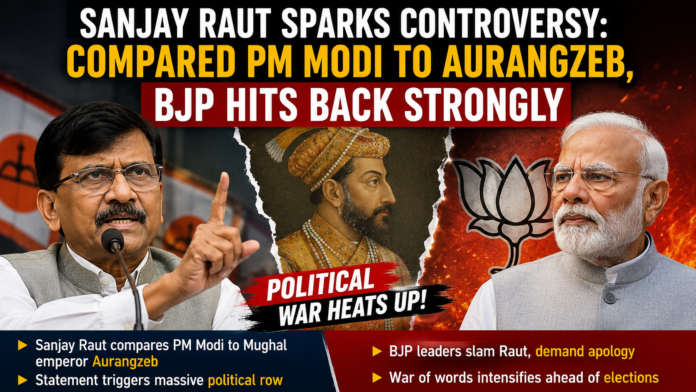

New Delhi, June 14, 2026: A major political storm erupted on Saturday after Shiv Sena (UBT) leader and Member of Parliament Sanjay Raut made highly controversial remarks comparing Prime Minister Narendra Modi to Mughal emperor Aurangzeb. The remarks, made during a press conference in Pune, triggered an immediate and sharp response from the ruling Bharatiya Janata Party (BJP), which condemned the comments as an insult not just to PM Modi but to the entire state of Gujarat.
What Did Sanjay Raut Say?
Speaking at a press conference in Pune on June 13, 2026, Sanjay Raut launched one of his sharpest attacks on Prime Minister Modi. He said: India has produced great leaders like Pandit Jawaharlal Nehru, Indira Gandhi, Lal Bahadur Shastri, Rajiv Gandhi, and Balasaheb Thackeray. But when I look at Modi’s character, it fills me with fear. Such an ‘aghori’ (ghoulish) person has never been born in Indian politics. Such a cruel person has never emerged before.
Raut further drew a highly controversial comparison, stating: ‘He comes from the same soil from which Aurangzeb was born. Aurangzeb was born in Gujarat, wasn’t he?’ This remark equating the birth state of the Mughal emperor Aurangzeb with PM Modi’s home state of Gujarat immediately set off a political firestorm across the country.
BJP Responds Sharply
The BJP reacted swiftly and strongly to Raut’s remarks. BJP spokesperson Shehzad Poonawalla said in a video statement: ‘The Congress and its allies have crossed all limits. They have used over 150 abusive words against the Prime Minister. Now, Congress ally Sanjay Raut has gone even further and insulted the entire state of Gujarat by calling it the land of Aurangzeb. This shows their mindset and their growing frustration.’ Poonawalla further argued that the opposition resorts to personal attacks only because they have no substantive criticisms against PM Modi’s governance record.
Political Context: Why This Statement Matters
This controversy comes at a particularly sensitive political moment. Just four days earlier, on June 10, 2026, Prime Minister Modi had achieved the historic milestone of becoming India’s longest-serving elected Prime Minister, surpassing the record held by Jawaharlal Nehru. The BJP had been celebrating this achievement nationally. Raut’s remarks are seen as a direct counter-attack by the INDIA bloc opposition amidst speculation about the Shiv Sena (UBT)’s political future and the strength of the opposition alliance.
Several leaders from within Shiv Sena (UBT) have distanced themselves from Raut’s comments, though no official party statement has been issued condemning or endorsing the remarks. Political observers note that Raut has a history of making provocative statements, but this comparison has been considered particularly sharp and has ignited a nationwide political debate.
Public and Political Reaction
Social media platforms were flooded with reactions from across the political spectrum. While BJP supporters and leaders strongly criticized Raut’s remarks as ‘below the belt’ and ‘undemocratic,’ opposition supporters argued that robust criticism of a sitting PM is a cornerstone of democratic discourse. Several TV news channels aired primetime debates on the controversy throughout Saturday evening.
Analysis: Opposition’s Political Strategy
Political analysts suggest that the opposition’s rhetoric has intensified as PM Modi enters his 13th year in office. With the BJP government completing 12 years under his leadership and PM Modi now holding the record for the longest tenure among elected Indian Prime Ministers, the INDIA bloc is struggling to find effective counter-narratives. Raut’s remarks, controversial as they are, appear to be part of a broader strategy to keep public discourse focused on opposition criticism of the ruling dispensation. Whether such extreme rhetoric helps or harms the opposition’s prospects in future elections remains to be seen.
Conclusion
The political confrontation between Sanjay Raut and the BJP is far from over. As the ruling party gears up for a formal response and possible legal action, the controversy highlights the increasingly heated nature of Indian political discourse. Press of Asia will continue to monitor this developing story and bring you the latest updates.