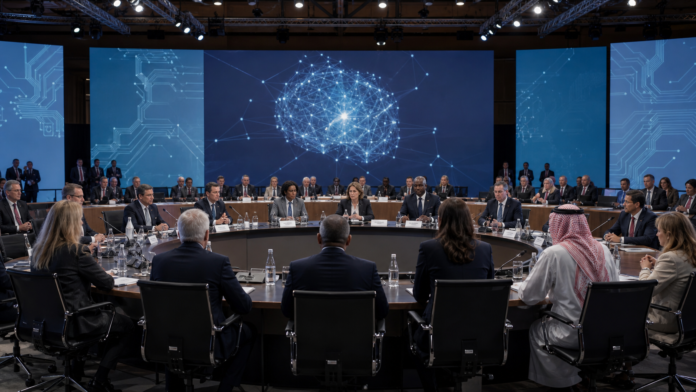
G20 AI regulation debate entered a decisive phase on Tuesday as the United States prepared to urge major economies to adopt a light-touch, growth-focused approach to artificial intelligence. The two-day Innovation Ministerial in Chapel Hill brings ministers together with technology executives while governments remain divided over how quickly binding safeguards should be imposed.
CHAPEL HILL, NORTH CAROLINA, 1 September 2026: The US Department of Commerce and White House Office of Science and Technology Policy are co-hosting the September 1–2 gathering. Commerce Secretary Howard Lutnick and White House technology adviser Michael Kratsios are leading the American delegation, with ministers from G20 members, including India, expected to participate.
Reuters reported that Washington will promote a “pro-growth” vision and argue against rules it believes could slow investment and adoption. That is an opening negotiating position rather than an agreed G20 policy. Any final principles will require support from governments with very different legal and political approaches to AI.
Key highlights
- The G20 Innovation Ministerial is being held on September 1 and 2.
- The United States is pushing for limited, innovation-friendly regulation.
- AI safety, scientific progress, manufacturing and supply chains are on the agenda.
- OpenAI CEO Sam Altman and Nvidia CEO Jensen Huang are among the industry figures expected at public sessions.
- No common G20 regulatory framework had been adopted when this article was published.
- India must balance growth, domestic AI capacity and safeguards for high-impact uses.
What the United States wants
The Trump administration has framed AI as an economic and national-security competition. Its officials argue that heavy rules could discourage investment, slow deployment and push countries toward rival technology ecosystems. The US position also reflects concern about China’s expanding capabilities in models, chips and digital infrastructure.
A light-touch approach can include voluntary standards, sector-specific guidance and enforcement through existing laws rather than a single comprehensive AI statute. Supporters say this allows technology to evolve before governments lock in rules that may become obsolete. Critics respond that voluntary commitments may be too weak when systems affect jobs, credit, healthcare, elections and security.
Why G20 members may disagree
The European Union has pursued a more prescriptive, risk-based system through its AI legislation. Other governments prefer principles and guidance, while some combine data-localisation, licensing and national-security controls. Emerging economies also want affordable access to computing power, models and training data rather than a debate dominated by US, Chinese and European companies.
These differences make a detailed global rulebook unlikely at a two-day meeting. More realistic outcomes include broad principles on innovation, safety testing, transparency, skills and international research cooperation.
The industry role
The presence of leaders from OpenAI and Nvidia highlights how strongly AI policy is tied to private infrastructure. Advanced models require chips, data centres, cloud services, electricity and specialised talent. A small number of companies control much of that supply chain, giving competition policy and market access a prominent place in the regulatory discussion.
Industry participation can provide technical expertise, but governments must also hear researchers, workers, civil-society groups and communities affected by automated decisions. Rules designed only around the needs of large developers could leave consumers and smaller firms with inadequate protection.
What the debate means for India
India has generally supported innovation while arguing that AI must be safe, inclusive and suited to developing-country needs. Its priorities include affordable computing, Indian-language systems, workforce training and the use of AI in public services. The Press of Asia’s India AI policy explainer examines this balance in detail.
New Delhi also has an economic interest in open technology markets. Indian IT firms, startups and researchers depend on global chips, cloud platforms and customers. At the same time, India needs safeguards for deepfakes, biased automated decisions, privacy breaches and unsafe applications in finance, health and law enforcement.
India’s expanding manufacturing role adds another layer. The region’s AI hardware opportunity and supply-chain constraints are covered in The Press of Asia’s analysis of Asia’s AI manufacturing and semiconductor supply chain. Recent collaboration between Nvidia and MediaTek also illustrates how commercial alliances can shape national technology choices.
Safety concerns governments cannot ignore
AI development is moving faster than many testing and accountability systems. Governments face unresolved questions about model evaluation, cybersecurity, copyright, energy use, children’s safety and responsibility when automated tools cause harm. Rules must be specific enough to address real risks without treating every low-risk software feature like a critical system.
A workable framework may distinguish between consumer tools, general-purpose models and high-impact systems used in medicine, policing, infrastructure or financial decisions. Transparency about AI-generated content and independent testing for powerful models are likely to remain central demands.
What happens next?
Delegates will examine whether they can agree on shared principles during the ministerial. The language of any concluding statement will show whether members accept the US preference for minimal restrictions or insist on stronger references to safety, accountability and sovereign regulation.
The meeting will not settle the global AI debate. It can, however, shape the agenda for future G20 negotiations and influence how governments align standards, research and supply-chain policy.
Sources / References
- US Department of Commerce — G20 Innovation Ministerial advisory
- Reuters — US position on G20 AI regulation
- Axios — ministerial participants and programme

The Tech Desk covers technology, artificial intelligence and cybersecurity. Stories are checked against at least two credible sources before publication.