Update: By September 4, Nepal’s disaster authority put the toll at 1,287 dead and 5,083 missing, while Chinese state media reported 21 dead and 541 missing on the Tibet side, Malay Mail reported; more than 800 foreigners remained unaccounted for. On September 17 a new barrier lake raised the threat of fresh floods (our report), and on September 27 Nepal proposed a Himalayan climate mechanism with India and China (our report).
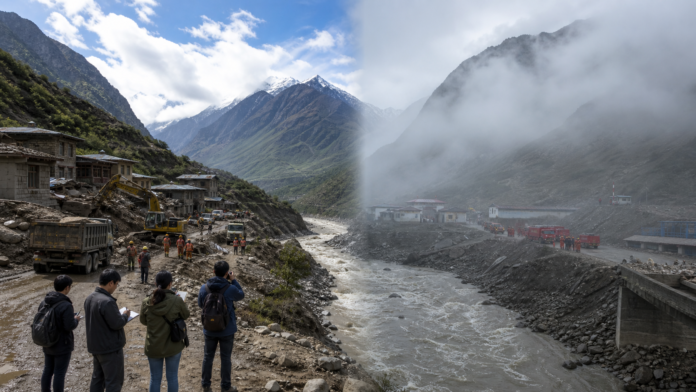
Kathmandu/New Delhi, August 31: The devastating flood and debris flow in the Himalayan region along the Nepal–Tibet border changed the lives of thousands of families within hours. From the Nepal side, images of destruction kept reaching the world: broken homes, villages buried under mud and debris, washed-away bridges, damaged hydropower projects, relief camps, hospitals, people searching for relatives, and rescue operations in the mountains. Our earlier Nepal flood rescue report covered the hydropower tunnels, Indian and Chinese specialists and the rescue updates available at the time.
The full picture of what happened across the border in Chinese-controlled Tibet (Xizang) is less clear. It would not be accurate to say China has released no information: Chinese authorities and the state news agency Xinhua have issued several official updates on deaths, missing people, foreign nationals and the relief operation in the Gyirong area. The real question is not whether information is missing altogether. It is whether official information from Tibet can be checked through independent journalists, local people and other sources as easily as information from Nepal.
Key highlights
- Nepal’s disaster authority recorded 788 deaths and 2,502 missing as of August 30, and 8,730 people rescued or evacuated.
- Xizang’s regional government reported 16 dead and 546 missing in the Gyirong area as of 6 p.m. on August 29.
- Chinese authorities listed 261 foreign nationals from 23 countries as unaccounted for, including 49 Indians.
- A Reuters investigation found Nepal had asked China for more detailed glacier and water-level data months before the disaster; China says it shared warnings.
- Experts told Reuters that limited cooperation cannot be called the main cause of the disaster.
One disaster, two information landscapes
| Measure | Nepal | Tibet (Xizang) |
|---|---|---|
| Dead | 788 (NDRRMA, August 30) | 16 (regional government, August 29, 6 p.m.) |
| Missing | 2,502 | 546 |
| Rescued or evacuated | 8,730 | Not given in the same form |
| Independent media access | Wide: local and foreign reporters on the ground | Restricted for foreign journalists |
| Main source of figures | Disaster authority, army, local officials, reporters | Official agencies and Xinhua |
In Nepal, many local and international journalists reached affected areas. Reporters spoke to survivors, families told the stories of missing relatives, and there was direct reporting from hospitals, relief camps and rescue centres. Information came from the Nepal Army, disaster authorities, local administration, hydropower officials and relief agencies, along with photos, video and satellite imagery. That does not mean every report from Nepal was immediately correct or final; casualty and missing figures change often in a disaster this size. But there is room to cross-check independent sources.
Tibet is different. It has long been one of China’s most sensitive regions, and foreign journalists and independent observers face strict limits on movement and reporting there. That makes the ground situation in Gyirong and nearby areas much harder to assess independently than in Nepal.
What China has disclosed
Chinese official media have issued rescue and relief updates throughout. According to the Xizang regional government’s August 30 press conference, 16 people had been confirmed dead and 546 were missing as of 6 p.m. on August 29. Chinese authorities also said 261 foreign nationals from 23 countries were unaccounted for, including 104 Nepalis, 49 Indians, 33 Latvians, 18 Americans and 15 Britons. China has also released information on rescue personnel, emergency vehicles, restoration of communications, temporary base stations and disaster monitoring.
Our calculation: five countries account for 219 of the 261 missing foreigners, or about 84%. Indians make up about 19% of the list. That is why the accuracy of information from the Chinese side matters directly to Indian families and Indian authorities.
So the more precise question is not “Why is China saying nothing?” but “How far can what China is saying be independently verified?” Independent reporters would normally check which villages were worst hit, how many people were displaced, how many homes were destroyed, which areas rescue teams have not reached, how missing lists are compiled, and whether official figures match the ground picture. In Nepal there are many channels to answer those questions; in Tibet, far fewer.
Is China hiding deaths or damage?
On the credible evidence available, it would not be fair to say China is definitely hiding casualty figures. Proving that would need strong independent evidence. Chinese authorities have published casualty and missing figures and information on the rescue. Transparency questions remain because independent media access is limited, but “independent access is limited” and “the government is definitely hiding the truth” are two different claims. The Press of Asia cannot present the second as an established fact.
The data-sharing question that came before the disaster
According to a detailed Reuters investigation, Nepali and Chinese officials and experts met in Kathmandu about three months before the disaster to strengthen cooperation on floods, weather and glacier hazards. Nepal sought more detailed information on glacier movement, water levels and upstream risks. Nepali officials told Reuters they did not receive information as detailed as they wanted, and that they wanted more systematic, near real-time data sharing.
China’s side matters too. China says it shared relevant weather information and warnings with Nepal in time, and the Chinese embassy rejected the criticism, saying the two countries had made progress on disaster information sharing. Chinese officials also said monitoring glacier and weather hazards in the Himalaya is technically very difficult. Reuters reported that China had shared heavy-rain forecasts and weather warnings; Nepal’s concern was the need for more on avalanche movement, glacier instability and specific upstream water levels. So the dispute is not that there was “no communication”, but whether the information was detailed and timely enough for future disasters.
Could better data sharing have prevented the disaster?
Saying so would not be scientifically sound at this stage. Available assessments say the disaster began with a large glacier or ice-rock collapse that sent a destructive torrent of water, rock, ice and debris down the valleys. Such events can develop very quickly, and experts told Reuters that limited bilateral cooperation cannot be called the main cause. But a second question remains: could better monitoring and faster data sharing have given people extra minutes or hours of warning? That is why Nepal now wants more formal cooperation, similar to its existing rainfall and river-level sharing with India.
Climate change raises the risk
This is not only a story about China–Nepal relations; it is also a warning about climate change and Himalayan glacier instability. The Hindu Kush Himalaya holds one of the largest ice reserves outside the poles, but rising temperatures, shrinking snow cover and faster glacier melt are increasing the risk of floods, landslides and glacial hazards across the region. For Nepal, India, Bhutan, Pakistan, Bangladesh and China, this is not just an environmental issue but one of national, water, energy and disaster security. Our report on the Indonesia wildfire haze crisis shows how climate-linked disasters are straining health and emergency systems across Asia.
Why this matters for India
Reports of missing Indian citizens make the disaster directly important for India, and the region is linked to Kailash-Mansarovar pilgrimage routes. There is also a strategic angle: several major rivers that rise in or pass through Tibet flow into South Asia, and floods, landslides, glacial lakes and sudden water releases upstream can affect people downstream. Himalayan hydrological data sharing and early-warning mechanisms have long mattered to India for this reason.
China’s rescue effort should not be ignored
A balanced analysis must also credit China’s rescue work. According to the Xizang regional emergency management update, 2,141 rescue personnel were deployed, and Beijing announced at least 220 million yuan in relief funding. Chinese Foreign Minister Wang Yi called it one of the most serious cross-border disasters of recent years. Efforts were made to restore road access and communications, set up temporary base stations and monitor hazardous terrain. A major state-led rescue with regular official updates, and limits on independent verification and journalist access, can both be true at the same time.
What to watch
- How the missing and casualty figures for Tibet change.
- Whether independent international journalists get more access to affected Tibetan areas.
- Whether China and Nepal sign a formal agreement on real-time glacier and river data.
- Whether Himalayan countries move towards a wider regional early-warning system. Geopolitical differences make this hard, as our analysis of the Bishkek SCO Summit 2026 shows, but climate risk does not wait for politics.
What it means
The most accurate conclusion is that China is providing information, but the ground reality in Tibet is much harder to verify independently than in Nepal. The Reuters investigation adds a second question: is data sharing between Himalayan countries fast and detailed enough to give people better warning? The lesson is not about assigning blame between China and Nepal. Himalayan disasters do not respect borders, so glacier, river and weather data should not stop at them either.
This article was first published in Hindi and has been translated. The Press of Asia now publishes in English only.
Sources
- Reuters (via MarketScreener): report on the Nepal–Tibet rescue and casualties, August 30, 2026
- Reuters (via Investing.com): investigation into Nepal–China glacier and water-level data sharing
- Xinhua: Xizang regional government factbox on casualties, foreign nationals and rescue
- Associated Press: report on Nepal’s warning, rescue and casualties
- Nepal NDRRMA: Official situation reports
- The Guardian: report on information controls hampering assessment of Tibet flood damage
- Malay Mail: Authorities: Nepal flood death toll rises to 1,287, with 5,083 missing

The International Desk covers world and Asian affairs, diplomacy and conflict, with a focus on what they mean for India. Stories are checked against at least two credible sources before publication.