
Dell Technologies has raised its full-year fiscal 2027 revenue outlook by $25 billion to $192 billion after reporting record quarterly revenue and a sharp acceleration in orders for AI-optimised servers.
ROUND ROCK, Texas | 2 September 2026
Key highlights
- Second-quarter revenue reached a record $47.0 billion, up 58% year on year.
- Dell booked $60.9 billion of AI-server orders, recognised $16.4 billion of AI-server revenue and ended the quarter with a $95 billion backlog.
- Full-year revenue guidance rose from $167 billion to $192 billion.
- The FY27 AI-optimised server revenue forecast increased from $60 billion to $74 billion.
- GAAP diluted EPS was $6.34; non-GAAP diluted EPS was $7.04.
What Dell reported
Dell’s fiscal second quarter ended on 31 July. The company reported net revenue of $46.971 billion, rounded to $47.0 billion, compared with $29.776 billion a year earlier. GAAP diluted earnings per share rose 273% to $6.34, while the company’s non-GAAP measure increased 203% to $7.04. Cash flow from operations was $2.2 billion.
The most closely watched figures came from AI infrastructure. Dell said it booked a record $60.9 billion in AI-server orders during the quarter, recognised $16.4 billion of AI-optimised server revenue and exited with a $95 billion backlog. A backlog is contracted or ordered business that has not yet been recognised as revenue; it is a demand signal, not a guarantee that every dollar will convert on the same schedule or margin.
The Infrastructure Solutions Group generated $31.8 billion of revenue, up 89%. Traditional servers and networking rose 122% to $10.5 billion, storage grew 26% to $4.9 billion and ISG operating income reached $4.8 billion. Client Solutions Group revenue was $15.0 billion, including $13.2 billion from commercial clients and $1.8 billion from consumers.
Why the guidance increase matters
Dell lifted FY27 revenue guidance from $167 billion to $192 billion, a 69% increase from the prior year. It also raised expected AI-server revenue from $60 billion to $74 billion, which would be about three times the prior-year level. GAAP diluted EPS guidance increased from $17.31 to $24.37 and non-GAAP diluted EPS guidance from $17.90 to $25.50.
For the third quarter, Dell forecast $49 billion in revenue, GAAP diluted EPS of $6.10 and non-GAAP diluted EPS of $6.50. Those are company forecasts, not realised results. Investors will need to compare them with subsequent filings and distinguish between GAAP and adjusted measures.
Demand is broadening beyond hyperscalers
Management said customer demand now includes large cloud operators, specialised “neocloud” providers, sovereign AI projects and enterprises. Dell reported more than 6,500 AI customers. The breadth matters because the market has questioned whether infrastructure spending is concentrated among a small number of buyers.
AI systems require more than accelerators. They need server assembly, high-speed networking, storage, power, cooling and services. Dell’s rise in traditional server and storage revenue suggests that AI deployments are pulling forward upgrades across the wider data centre. That pattern is consistent with the AI-led manufacturing recovery across Asia, where servers, memory and advanced components are supporting factory demand.
The company’s supply chain links also stretch deeply into Asia. Taiwanese manufacturers build many servers and components, while chip designers and foundries in Taiwan, South Korea and elsewhere supply key silicon and memory. The Nvidia–MediaTek AI chip alliance shows how hardware, interconnect and custom silicon partnerships are becoming more tightly connected.
The margin and execution questions
Fast revenue growth does not automatically produce the same rate of profit growth. AI servers can carry large component costs, especially for accelerators and memory, and product mix can affect gross margin. Dell’s operating results improved sharply in the quarter, but investors should still watch pricing discipline, component availability, customer concentration and the timing of backlog conversion.
Working capital is another issue. A company shipping expensive systems may need to finance inventory and receivables before collecting cash. Dell generated $2.2 billion of operating cash flow and returned $4.3 billion through repurchases and dividends in the quarter. The board declared a $0.63 quarterly dividend payable on 30 October to holders of record on 20 October.
What it means for India and Asia
For Asian suppliers, the guidance supports demand for server manufacturing, networking equipment, power systems, cooling and memory. It may also encourage further factory and data-centre investment. However, benefits will vary by company: those supplying scarce, high-value components can have different margins from contract assemblers.
For India, rising enterprise AI spending can create demand for data-centre construction, cloud migration, systems integration and managed services. Indian IT companies may benefit from implementation work, but they also face pressure to train staff and prove that projects deliver measurable returns. The sector’s consolidation and capability push is visible in the ITC Infotech–Happiest Minds transaction.
What happens next
The next tests are whether Dell converts its $95 billion backlog on schedule, maintains profitability as volumes expand and secures enough advanced components. Customer diversification, storage growth and cash conversion will show whether the current cycle is a durable infrastructure upgrade or a narrower surge in accelerator-heavy systems.
Dell’s quarter establishes that AI demand is translating into exceptional order and revenue growth. It does not settle the longer-term questions of data-centre returns, electricity constraints or competitive pricing. Those will determine how much of the FY27 step-up can be sustained.
Sources / References
- Dell Technologies: Q2 FY27 official results
- Dell Technologies: Q2 FY27 earnings-call transcript
- Reuters: Dell forecast and AI-demand context
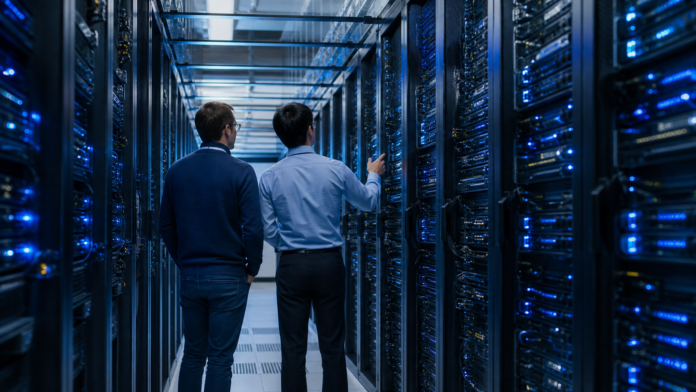
AI-generated editorial illustration | The Press of Asia

The Business Desk covers markets, the economy, companies and personal finance. Stories are checked against at least two credible sources before publication.