September 1, 2026: A global surge in demand for artificial-intelligence hardware kept factories expanding across much of Asia in August, with China, Japan and South Korea all reporting growth in private manufacturing surveys. The data shows how semiconductors, servers and electronics are supporting export-led economies even as the wider region faces high energy costs and an uneven recovery.
China’s private RatingDog manufacturing purchasing managers’ index rose to 51.5, Japan’s S&P Global manufacturing PMI climbed to 54.9 and South Korea’s reading was 52.3. Any number above 50 signals an expansion in activity. Taiwan, Malaysia and the Philippines also remained above that threshold, while Indonesia slipped into contraction.
Key highlights
- China’s private manufacturing PMI rose to 51.5 from 50.9 in July.
- Japan’s PMI reached 54.9, its highest since April and its eighth month of expansion.
- South Korea’s PMI eased to 52.3 but remained in growth territory for a ninth month.
- South Korean exports jumped 68.7% from a year earlier, helped by a semiconductor boom.
- Taiwan and the Philippines expanded strongly, but Indonesia’s PMI fell below 50.
Asia Manufacturing AI Boom: the regional picture
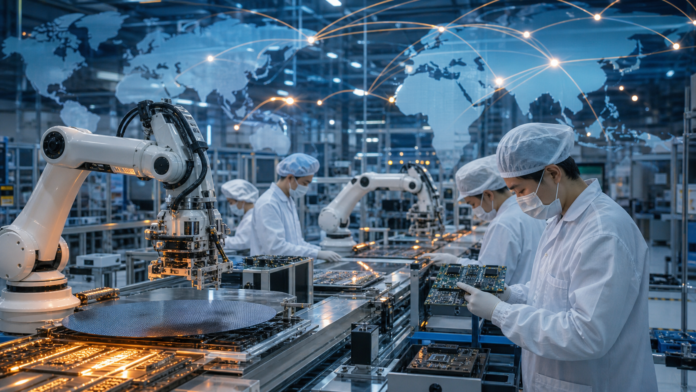
The latest surveys point to a common engine: rising orders for chips, computers and other equipment used in AI data centres. This demand is moving through a dense Asian supply chain that stretches from Japanese materials and machinery to Taiwanese chip manufacturing, South Korean memory and displays, Chinese electronics assembly and Southeast Asian components.
The expansion is broad enough to brighten the near-term outlook for the region, but it is not uniform. Survey data measures changes from the previous month rather than the absolute size of an economy. A PMI just above 50 means modest improvement, while a stronger number indicates faster expansion. The results should therefore be read alongside official production, trade and employment data.
China: private factories improve, official survey still weak
The RatingDog China General Manufacturing PMI, compiled by S&P Global, rose to 51.5 in August from 50.9 in July and beat the Reuters poll estimate of 51.0. Output grew at its fastest pace in three months, while export business recorded its sharpest rise in six months. Manufacturers nevertheless reported flat employment, rising backlogs and the first cut in output prices this year.
China’s official manufacturing PMI was 49.8, still below the 50 threshold. The difference is not necessarily a contradiction: the private survey gives greater weight to smaller and export-oriented firms, while the official gauge covers a broader mix including large state enterprises. Our report on China’s official August PMI explains why the recovery remains uneven.
AI-related export demand is stabilising parts of Chinese industry, but weak services, price discounting and subdued domestic demand remain constraints. A durable recovery would need stronger household spending and private investment, not only external orders for technology goods.
Japan records fastest new-business growth since 2018
Japan’s manufacturing PMI rose to 54.9 in August from 54.5, the highest level since April and the eighth straight month of expansion. New business and export orders grew at their fastest rates since January 2018, supported by demand for semiconductors and AI-related products from North America, Southeast Asia and China.
Employment increased for a 21st consecutive month and at its fastest pace since February 2018, a positive sign for business confidence. Yet the Middle East conflict and disruption risks around the Strait of Hormuz are lifting freight and input costs. Strong demand is helping firms absorb some pressure, but margins could narrow if oil stays elevated.
South Korea: exports surge while PMI cools slightly
South Korea’s PMI eased to 52.3 in August from 53.1 in July, but remained above 50 for a ninth consecutive month. New orders were healthy, and export demand rose at the fastest pace since November 2020, according to S&P Global Market Intelligence.
Separate official trade data showed exports reached $98.26 billion in August, up 68.7% from a year earlier and extending growth to a 15th month. Semiconductor exports more than tripled to about $46.65 billion, South Korea’s trade ministry said, as spending by AI hyperscalers drove demand for advanced memory and related components.
The 52.3 PMI and 68.7% export growth measure different things and should not be confused. PMI is a diffusion index based on whether surveyed companies report improvement, while the export figure compares the dollar value of shipments with a year earlier.
Taiwan and Southeast Asia add breadth
Taiwan’s PMI stood at 54.7 in August, down slightly from 55.1 but still showing firm expansion in one of the world’s most important chip centres. Malaysia’s reading eased to 50.2 from 50.7. The Philippines was the regional standout, with its PMI jumping to 54.9 from 51.8.
Indonesia moved the other way, slipping to 49.8 from 50.2. That divergence shows why the phrase “Asia factory boom” needs qualification: economies more directly connected to AI hardware and electronics are receiving a larger lift than those reliant on other domestic or commodity cycles.
Why the AI hardware cycle matters
AI models require data centres packed with accelerators, memory chips, networking equipment, power systems and cooling hardware. A single wave of investment therefore creates orders across several manufacturing layers. Asia’s concentration of semiconductor fabrication, packaging, testing and electronics assembly makes it a major beneficiary.
The same concentration also creates risk. A slowdown in hyperscaler spending, tighter export controls or disruption in the Taiwan Strait could quickly affect orders. The regional race for computing capacity is part of a larger contest explored in our US-China AI competition analysis. China is also using robotics to raise factory productivity, as seen in our report from a Chinese humanoid-robot training centre.
Middle East conflict is the main immediate threat
Brent crude above $91 a barrel raises shipping, plastics, chemicals and electricity costs across import-dependent Asia. Longer routes or insurance surcharges around the Strait of Hormuz would add further pressure. For India, the same shock threatens the import bill, inflation and the rupee; our oil-price impact analysis tracks those risks.
Factories can tolerate higher costs while orders are growing strongly, but the combination becomes harder if export demand cools. Purchasing managers’ reports over the next few months will show whether firms can pass on costs or must cut margins and hiring.
What to watch next
The next indicators are semiconductor export values, order backlogs, factory employment and selling prices. A sustained expansion beyond electronics would signal that the AI cycle is spreading into the wider economy. For now, August’s data shows a real but concentrated upturn: Asia’s technology supply chain is strong, while the broader manufacturing recovery remains exposed to energy shocks and uneven domestic demand.
Sources / References
- Reuters: Global AI boom fuels Asia factory expansion in August
- Reuters: Japan manufacturing new business rises at fastest pace since 2018
- Reuters: South Korea factory activity expands for ninth month
- Republic of Korea: official August 2026 trade data
- Reuters: China private factory activity improves

The Tech Desk covers technology, artificial intelligence and cybersecurity. Stories are checked against at least two credible sources before publication.