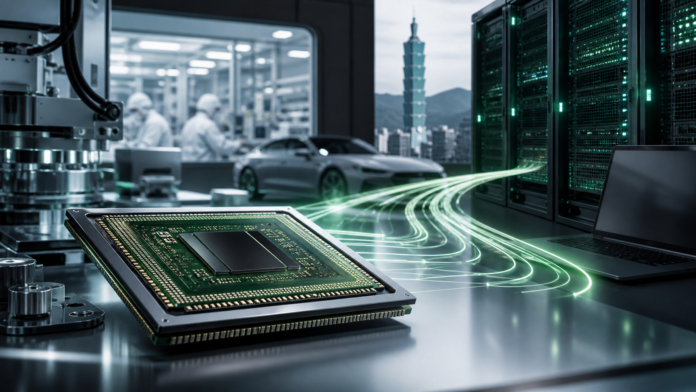
The Nvidia MediaTek investment puts $3.5 billion into convertible bonds issued by the Taiwanese chip designer as the companies expand their partnership across AI data centres, personal computers and software-defined vehicles. MediaTek will also adopt Nvidia’s NVLink Fusion platform for custom AI accelerators.
SANTA CLARA/HSINCHU | 1 September 2026
The deal announced on 31 August binds one of the world’s dominant AI computing companies more closely to a major designer of power-efficient chips and connectivity products. It matters beyond the investment amount: Nvidia wants its interconnect and software ecosystem to remain central even when cloud groups develop custom processors, while MediaTek gains a stronger path into high-value AI infrastructure.
What Nvidia and MediaTek announced
- Nvidia invested $3.5 billion in MediaTek convertible bonds.
- MediaTek will join the NVLink Fusion ecosystem to help customers build custom XPUs that connect with Nvidia rack-scale systems.
- The companies will continue joint work on chips for RTX Spark and DGX Spark personal-computing systems.
- They plan further platforms for AI-powered, software-defined vehicles.
Convertible bonds begin as debt but can turn into equity under agreed conditions. Nvidia’s announcement did not present the investment as a completed outright purchase of a fixed percentage of MediaTek shares. The exact economic outcome will depend on the bond terms, conversion conditions and future market value.
Why NVLink Fusion is the strategic centre
The most consequential technology detail is MediaTek’s adoption of NVLink Fusion. Large cloud companies increasingly want processors designed for their own workloads. Those custom accelerators, often called XPUs, can reduce cost or improve efficiency for particular AI tasks. But a processor is only one part of a modern AI system; thousands of chips must exchange data quickly across servers and racks.
Nvidia’s answer is to make its interconnect architecture available to partners building custom silicon. If MediaTek designs an accelerator around NVLink Fusion, a customer can create a differentiated chip while retaining compatibility with Nvidia’s broader rack-scale infrastructure. That gives customers more design choice and helps Nvidia keep its networking, software and system architecture at the centre of the deployment.
The deal arrives as Asian factories benefit from demand for servers, memory and advanced components. Our Asia manufacturing AI boom report found expansion in China, Japan and South Korea during August, with technology demand playing a central role. Taiwan’s chip design ecosystem is one of the key links between that manufacturing recovery and global AI capital spending.
What MediaTek gains
MediaTek is best known to many consumers for smartphone and connectivity chips, but the partnership gives it a route into more demanding data-centre designs. The company contributes system-on-chip engineering, custom silicon, advanced packaging, connectivity and power management. These skills are useful when a cloud operator wants a specialized processor that must still work inside a large computing platform.
MediaTek also gains continuity in personal computing. The two companies have already worked on PC chips that combine Nvidia graphics with MediaTek processing. Extending that work across multiple generations can help both companies compete as manufacturers add local AI functions to laptops and workstations.
Cars become a third computing market
The automotive part of the announcement covers software-defined vehicles and physical AI. Modern cars increasingly rely on centralized computing for driver assistance, infotainment, sensor processing and over-the-air updates. Nvidia supplies accelerated computing and software platforms, while MediaTek has experience in connectivity and efficient system-on-chip design.
The announcement does not identify vehicle customers, production dates or unit volumes. Those commercial details will determine how quickly the partnership translates into automotive revenue. For now, it shows the companies intend to reuse a common computing relationship across cloud systems, PCs and cars.
Why investors may still ask hard questions
Nvidia’s direct financing of companies that build around its architecture has attracted scrutiny because such investments can expand the market for Nvidia-linked systems while also exposing the company to its ecosystem’s financial risks. Reuters noted concern about “circular financing” across the AI sector. That phrase describes situations in which a supplier helps fund companies that may later purchase or support demand for its technology.
There is no evidence in the announcement that the transaction is improper. The useful investor questions are narrower: what are the bond’s conversion terms, how will MediaTek use the proceeds, how much business could flow to each company, and whether adoption is driven by competitive product value. Future regulatory filings should provide more detail.
The wider strategic contest is examined in our US-China AI race analysis. For a market example of chip demand’s effect on Asian equities, see our report on South Korea’s technology-led KOSPI record.
What happens next
The near-term signals will come from MediaTek’s bond disclosures and the first customer designs using NVLink Fusion. Product road maps for PCs and vehicles will show whether the partnership produces commercially distinct platforms rather than only a financing relationship. For cloud operators, the test will be performance, energy use, software compatibility and total cost at rack scale.
The central strategic point is clear: Nvidia is expanding from selling accelerators toward defining how a broader family of custom chips connects and operates. MediaTek now has $3.5 billion of Nvidia-backed financing and a prominent role in that effort.
Sources

The Tech Desk covers technology, artificial intelligence and cybersecurity. Stories are checked against at least two credible sources before publication.