
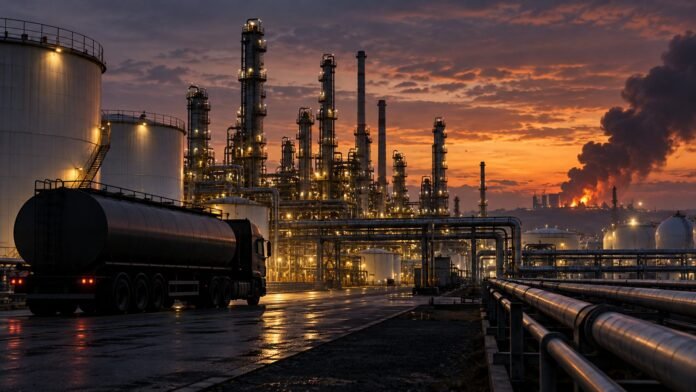

WASHINGTON/KYIV, September 14, 2026: US President Donald Trump has urged Ukrainian President Volodymyr Zelenskyy to halt attacks on Russian refineries and diesel infrastructure, saying the strikes are contributing to a severe global fuel shortage. The appeal puts Ukraine refinery strikes at the centre of a widening debate over military pressure, energy security and consumer prices.
Trump said the request came as diesel prices climbed sharply in the United States, where the national average moved above $6 a gallon on Friday. Diesel is used by trucks, farms, construction equipment, ships and industry, so sustained increases can spread through transport costs and the price of everyday goods.
Several shocks are tightening diesel supply
Ukraine has targeted Russian energy facilities to reduce Moscow’s ability to finance and sustain its war. The strikes have disrupted refinery operations and added pressure to Russia’s domestic fuel market. Moscow introduced a ban on diesel exports in July as authorities tried to protect supplies at home.
The shortage is not the result of one factor. Energy markets have also been affected by the Iran war and disruption around the Strait of Hormuz, a route central to global oil trade. When refinery outages, export restrictions and shipping risks occur together, the market loses the flexibility normally used to replace unavailable cargoes.
A difficult policy trade-off
For Kyiv, refinery strikes are part of a campaign against assets that support Russia’s military and state revenues. For Washington, the political and economic cost of fuel inflation is becoming harder to ignore ahead of the US midterm elections. Any change in Ukrainian tactics would therefore involve both strategic and economic calculations.
There is also a wider international effect. Import-dependent economies in Asia can feel the impact through higher freight costs, more expensive industrial fuel and currency pressure. India buys crude from multiple suppliers and has substantial refining capacity, but it is not insulated from global movements in product prices, insurance and shipping.
Signals energy markets will watch
- Whether Ukraine changes the pace or target set of its long-range strikes.
- How quickly damaged Russian refining capacity returns to service.
- Whether Moscow relaxes or extends its diesel export restrictions.
- Whether traffic and security conditions improve around the Strait of Hormuz.
- How governments respond if high diesel prices feed into broader inflation.
The next market move will depend less on political statements alone than on actual refinery output and the availability of export cargoes. A sustained shortage would raise costs across logistics and agriculture, while a rapid restoration of supply could ease the pressure.
Source: Associated Press. See more reporting from our Business desk.