September 29: North Korea told the United Nations on Monday that its status as a nuclear-armed state “can never be reversed in any circumstances or by any means”, on the same day South Korea’s military said North Korean landmines had very likely caused a blast that seriously injured its soldiers inside the Demilitarized Zone (DMZ). Together, the two developments point to rising tension on the Korean Peninsula.
Key highlights
- At the UN: Vice Foreign Minister Kim Son Gyong said Pyongyang’s nuclear status has been “uncompromisingly and permanently fixed both physically and legally.”
- Targets named: He criticised US-South Korea-Japan military cooperation and Seoul’s plan to acquire nuclear-powered submarines.
- DMZ blast: South Korea’s military said evidence “strongly points to North Korean land mines” in an explosion last week that injured three soldiers, two of them seriously.
- Response: Seoul vowed to hold North Korea “fully” accountable and to take “appropriate and corresponding measures” if the findings are confirmed.
‘Irreversible’: North Korea’s message at the UN
Speaking at the 81st UN General Assembly in New York, Kim Son Gyong described the country’s nuclear deterrent as a force designed “from A to Z” to safeguard its sovereignty, according to UN News. The Korea Times reported that he said the status “can never be reversed in any circumstances or by any means” and had been “uncompromisingly and permanently fixed both physically and legally.”
Kim accused Washington of “approving and encouraging Seoul’s ambition to possess nuclear-powered submarines” and deploying advanced military hardware on the peninsula. He said the trilateral military cooperation among South Korea, the United States and Japan was creating “security instability on the Korean Peninsula.” He also sharply criticised Japan’s military expansion.
The speech is a clear rejection of calls for denuclearisation. A week earlier, South Korea’s foreign minister had joined US and Japanese counterparts in reaffirming their commitment to North Korea’s “complete denuclearization,” the Korea Times noted. Seoul also recently set out a step-by-step approach to denuclearisation at the UN (our report).
What Seoul found in the DMZ
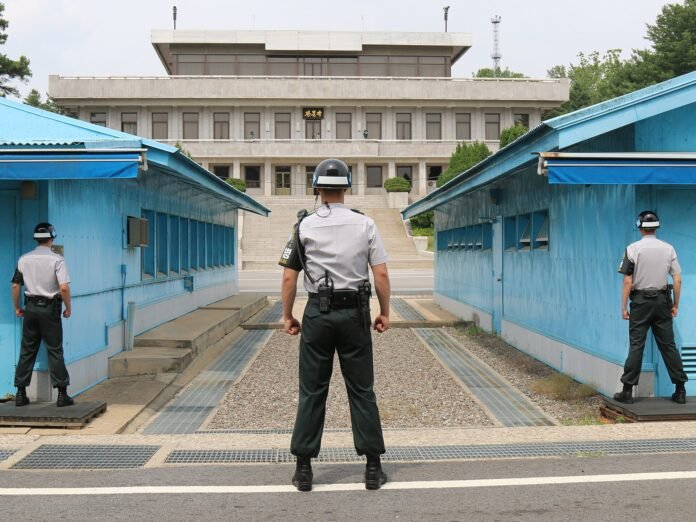
The explosion happened last week about 10 metres south of the Military Demarcation Line on the western front, during an operation to check suspected illegal North Korean mine-laying, according to the Korea Herald. Three South Korean soldiers were injured, two of them seriously.
Investigators found traces of TNT and brown synthetic material consistent with North Korean anti-personnel mines that use plastic resin casings. Three mines had been buried at the site, and two detonated. “Evidence strongly points to North Korean land mines,” Lt. Gen. Kwon Dae-won said, adding that they “highly likely caused the explosion.” Laying such mines would violate the 1953 Korean War armistice. The UN Command said it had no further comment while the investigation continues. North Korea has not responded.
What comes next
South Korean lawmakers scheduled an emergency session to question the Defence Ministry on Tuesday, SBS reported. Final investigation results are still pending. The main risk now is escalation: a confirmed North Korean role in the DMZ blast could push Seoul towards countermeasures at a time when Pyongyang is shutting the door on talks about its weapons. The episode also adds to a tense regional picture, with China, Japan and the US all watching the peninsula closely.
Sources
- UN News: DPR Korea tells UN its nuclear status is ‘irreversible’, rejects outside pressure
- The Korea Times: Senior NK diplomat says nuclear status can never be reversed ‘in any circumstances’
- The Korea Herald: N. Korean land mines highly likely cause of DMZ blast
- SBS News: Today’s Top News (September 29, 2026)
- Al Jazeera: South Korea suspects North Korean mines behind DMZ blast

The International Desk covers world and Asian affairs, diplomacy and conflict, with a focus on what they mean for India. Stories are checked against at least two credible sources before publication.