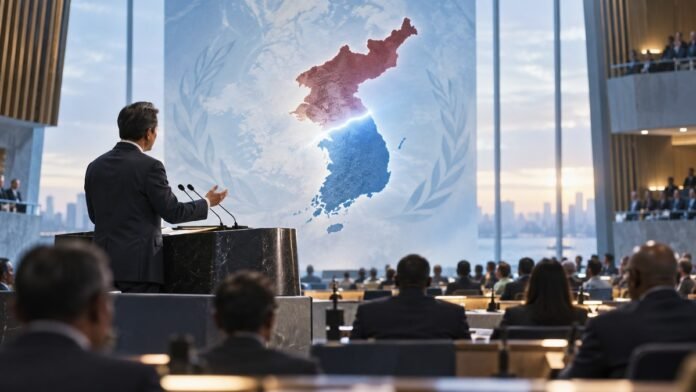
New York: South Korean President Lee Jae Myung has proposed a phased strategy for reducing the nuclear threat on the Korean Peninsula, arguing that diplomacy should begin by halting further advances in North Korea’s weapons programme before moving to reductions and eventual dismantlement.
Lee presented the approach during the high-level week of the 81st United Nations General Assembly. His government describes the plan as a practical route toward peaceful coexistence: first stop additional nuclear and missile development, then reduce existing capabilities over the medium term, and preserve denuclearisation as the long-term objective.
What the phased approach means
The proposal departs from an all-or-nothing demand for immediate, complete disarmament. Under Lee’s formulation, political and economic concessions could be matched to verified progress at each stage. The first task would be a freeze or halt that prevents the threat from growing while negotiators build a mechanism for monitoring and reciprocal steps.
A second stage would seek reductions in weapons, delivery systems or related material. Only after those steps would negotiations move toward full dismantlement. The structure recognises a central reality: North Korea treats its nuclear arsenal as a security guarantee and has repeatedly rejected talks based on unilateral surrender.
Lee’s message at the United Nations
In his UN address, Lee said South Korea would respect the North’s political system and pursue cooperation where possible, including public health, disaster response and climate change. He also invoked the 35th anniversary of both Koreas joining the United Nations as evidence that coexistence can be pursued without abandoning long-term peace goals.
Seoul wants to act as both a party to peace and a facilitator of renewed dialogue between Washington and Pyongyang. The policy is designed to create smaller openings even when a comprehensive agreement is not immediately possible.
The security environment is getting harder
The proposal comes as North Korea accelerates weapons testing. Seoul’s military said the North recently fired two short-range missiles from the Wonsan area, with reported flight distances of roughly 450km and 600km. Pyongyang later described the system as strategically significant, while images suggested a missile previously presented as hypersonic.
That activity raises the cost of delay. Each additional test can improve reliability, range or operational confidence. It also increases pressure on South Korea, Japan and the United States to strengthen deterrence, which Pyongyang then cites as justification for further development.
Can incentives restart talks?
A phased bargain would require credible incentives, reliable verification and agreement on sequencing. North Korea has previously objected when sanctions relief lagged behind its steps, while the United States and allies have worried that early concessions could be pocketed without irreversible disarmament.
Lee’s approach tries to address that dilemma by dividing the process into measurable stages. But it still depends on political decisions in Pyongyang and Washington. Domestic politics in South Korea and alliance coordination will also shape how much flexibility Seoul can offer.
The plan follows renewed emphasis on the alliance between Seoul and Washington. Our recent report on South Korea-US strategic cooperation explains the economic and security backdrop. The wider regional context also includes the US-China leaders’ meeting, where Korean Peninsula stability is likely to intersect with trade and technology concerns.
What to watch next
The immediate test is whether North Korea responds to the offer, even indirectly. Observers will also watch for a more detailed South Korean roadmap defining what counts as a halt, how compliance would be verified and which incentives would follow each step.
Another question is whether humanitarian and climate cooperation can proceed separately from nuclear negotiations. Small projects may build communication channels, but they can also stall when military tensions rise.
Lee’s proposal does not resolve those contradictions. It does, however, set out a sequence that can be judged against future policy: stop the expansion, reduce the danger and then negotiate dismantlement. In a standoff where maximalist positions have produced little progress, that is a significant diplomatic marker.
Sources / References
- Korea.net: official account of President Lee’s UN address, 23 September 2026
- Associated Press: interview on the phased denuclearisation approach
- United Nations General Assembly: 81st-session documents

The International Desk covers world and Asian affairs, diplomacy and conflict, with a focus on what they mean for India. Stories are checked against at least two credible sources before publication.