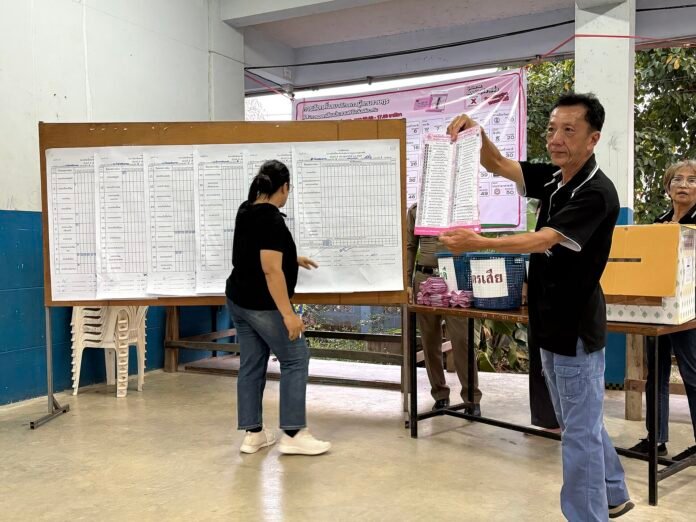
Bangkok, September 28: Thailand’s Constitutional Court on Monday ruled that the barcodes and QR codes printed on ballot papers in the February 8 general election did not violate the constitutional guarantee of a secret vote, dismissing a petition that could have forced the election to be re-run. The decision removes a major legal cloud over Prime Minister Anutin Charnvirakul’s coalition government.
Key highlights
- Election stands: The court found no grounds to invalidate the February 8 vote.
- The complaint: Barcodes on party-list ballots and QR codes on constituency ballots could, in theory, be linked back to individual voters.
- Court’s view: Ballots, ballot stubs and voter registers are stored separately with restricted access, so identifying a voter would be difficult; there was insufficient evidence that secrecy was actually compromised.
- Political impact: The ruling averts a possible fresh election and eases pressure on Anutin, whose coalition holds about 292 of the 500 seats in the House.
What the case was about
The dispute began soon after polling day, when it emerged that unique codes had been printed on the ballots: barcodes on the party-list papers and QR codes on the constituency papers. Critics argued that, combined with the numbered ballot stubs and the voter register, the codes could in theory reveal how a particular person voted. The Election Commission acknowledged the codes but maintained that separate storage of the documents prevented misuse.
The Ombudsman took up the complaints and referred the matter to the Constitutional Court in March. Khaosod English reported that the Ombudsman’s petition followed 22 complaints.
What the court decided
According to Khaosod English, the court accepted that the barcodes could theoretically be matched with ballot stubs and voter registers, but found that several legal and physical safeguards made that extremely difficult in practice. The three sets of documents are kept separately, with restricted access, so combining them without authorisation would be hard.
The judges drew a distinction between absolute secrecy and what Khaosod described as “conditional secrecy”, in which codes serve legitimate election-administration purposes, such as preventing fraud and tracking ballots, while voters’ identities remain effectively protected. The court concluded there was insufficient evidence that ballot secrecy had been breached. Reuters, in a report carried by TimesLIVE, said the court found that identifying voters would require access to the separately stored ballot stubs.
Why it matters for Anutin
Nearly 38 million Thais voted on February 8. Anutin’s Bhumjaithai Party emerged as the largest party and leads a coalition of about 292 MPs, including Pheu Thai, in the 500-seat House. A ruling against the ballots could have opened the door to annulment and a fresh vote. Bloomberg described the outcome as the prime minister surviving the court challenge.
The stakes were high because of history. Thailand’s Constitutional Court voided national elections in 2006 and 2014, and both rulings were followed by military coups, as Reuters noted. Monday’s decision avoids a repeat of that kind of crisis, although Reuters said Anutin’s government still faces economic difficulties and corruption allegations.
What comes next
With the petition dismissed, the February result is settled, and the government can focus on its agenda, including the response to the severe floods that have hit 25 provinces this month (our flood coverage). Critics of the coded ballots may still push the Election Commission to change the ballot design before future polls to remove any doubt about voter secrecy.
Sources
- Khaosod English: Court rules 2026 general election remains valid amid barcode controversy
- TimesLIVE (Reuters): Thai court dismisses petition challenging legality of 2026 election
- Bloomberg: Thailand Premier Anutin Survives Court Ruling on Election Ballots
- Wikipedia: 2026 Thai general election (seat and coalition figures)

The International Desk covers world and Asian affairs, diplomacy and conflict, with a focus on what they mean for India. Stories are checked against at least two credible sources before publication.