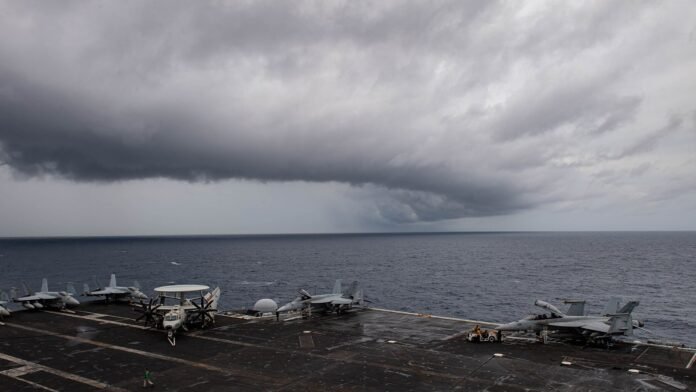
October 2: The United States is sending a third aircraft carrier strike group and about 9,000 more sailors and Marines to the Middle East, a US official told the Associated Press. The move comes as President Donald Trump rejected Iran’s latest proposal to end the war and warned that Tehran would be “hit very hard”. Iran’s foreign minister said his country is “fully prepared” for the fighting to resume. The war is now in its eighth month, Al Jazeera reported.
Key highlights
- What is moving: The USS Theodore Roosevelt carrier strike group and the USS Makin Island amphibious ready group, with more than 7,000 sailors and 2,000 Marines.
- Already in the region: The carriers USS George H.W. Bush and USS George Washington, and the USS Boxer amphibious ready group.
- When: Three carriers could be in the region as early as the end of October, the AP reported.
- Trump on Iran’s offer: “Not good enough.”
- Iran: Foreign Minister Abbas Araghchi told NBC that Tehran was “fully prepared” to resume the war.
What the US is sending
The Theodore Roosevelt group includes the cruiser USS Chosin. The Makin Island group includes the landing ships USS John P. Murtha and USS Anchorage. The official spoke to the AP on condition of anonymity to discuss sensitive military operations.
Once the new ships arrive, the US Navy would have more than 20,000 sailors and Marines and hundreds of aircraft in the region, according to the AP. Al Jazeera reported that the Theodore Roosevelt is deploying from San Diego and put the number of additional personnel at 9,000 to 10,000.
Why Trump rejected Iran’s proposal
Iran had proposed reopening the Strait of Hormuz within seven days. In return it wanted sanctions lifted, its frozen assets released and a guarantee that US strikes would end, Al Jazeera reported. We covered that plan and the US response here.
Trump said the offer to “open up” the strait was not enough. He said the proposal contained “things that I wouldn’t have approved a year ago” and “wouldn’t have today”, according to the AP. Al Jazeera reported that Washington wants Iran’s nuclear programme dealt with first.
Trump hints at more strikes
Asked whether Iran would face retaliation, Trump said: “Oh, they’ll be hit very hard, don’t worry.” In an interview with Time magazine published on Thursday, he said it was “possible” he would step up bombing after the US midterm elections on November 3, but gave no details. “I can’t tell you that because look, you know, you’re asking, where are you going to bomb?” he said.
The AP reported that a US Navy blockade has shut down Iran’s oil exports, while the US has loosened Iran’s grip on the Strait of Hormuz so that oil from Gulf allies can reach markets.
What Iran says
Araghchi told NBC that Iran was “fully prepared” if the war resumed. “We did not come to New York to sell a war. We came to forge peace,” he said, according to Al Jazeera.
Two incidents feeding the tension
The build-up follows two security incidents in which Iranian involvement has been alleged or is being examined. No evidence has been made public in either case.
- Flydubai flight: A co-pilot stabbed the captain of an Israel-bound Flydubai flight on Wednesday. Asked whether Iran was behind it, Trump said: “I would say the answer, based on what I’m hearing, is ‘yes,’ but we’re working on it right now.” Investigators have not announced a motive. The Indian captain, Smit Machchhar, has described the attack in a call with Prime Minister Narendra Modi, as we report here (in Hindi).
- RAF Fairford: British police arrested a 27-year-old dual UK-Iranian national in London on suspicion of a terror plot after a security incident at the air base, which US bombers have used for strikes on Iran. Five British nationals were arrested near the base earlier and released on bail, the AP reported.
Why it matters for India
India imports most of the crude oil it uses, and much of the Gulf’s oil passes through the Strait of Hormuz. When oil crossed $100 a barrel in September, Asian markets fell. A new round of strikes, or a longer closure of the strait, would add to that pressure.
What to watch
- When the Theodore Roosevelt group reaches the region.
- Whether Iran sends a revised proposal, and whether Washington replies.
- Any official finding on the Flydubai attack and the RAF Fairford arrests.
Sources
- Associated Press via Fortune: Trump sends roughly 9,000 troops and a third aircraft carrier to the Middle East
- Associated Press via Spectrum News: Third aircraft carrier and thousands of troops head to Mideast
- Al Jazeera: New aircraft carrier, 10,000 US troops: Is the Iran war about to escalate?

The International Desk covers world and Asian affairs, diplomacy and conflict, with a focus on what they mean for India. Stories are checked against at least two credible sources before publication.