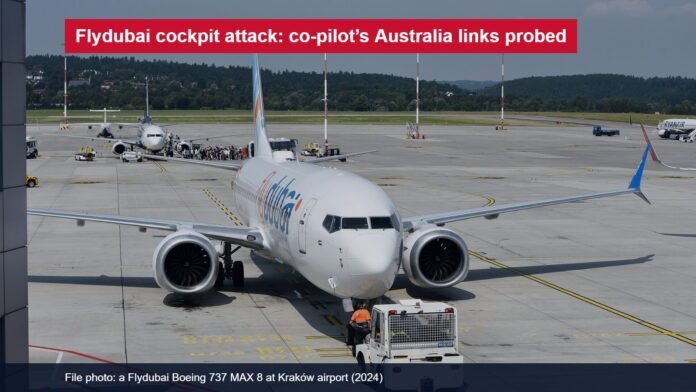
October 5: The investigation into the attack on the captain of Flydubai flight FZ1073 has widened to several countries. Australia’s Victorian Joint Counter Terrorism Team is examining the co-pilot’s links to the country, where he studied about a decade ago, Al Jazeera reported on Sunday. The United Arab Emirates, which is leading the inquiry, has called the attack an attempted “terrorist act”. The co-pilot has been named in these reports as Hamam al-Hammami, an Omani national. No motive has been established and he has not been tried.
Key highlights
- UAE: Prosecutor General Hamad Saif al-Shamsi said the co-pilot attempted to carry out a “terrorist act”.
- Australia: The Victorian Joint Counter Terrorism Team is looking into his time in the country.
- Background: He was earlier barred from flying in Oman because of concerns about extremist views, according to Al Jazeera and Business Standard.
- The weapon: The latest reports say the captain was attacked with a crash axe. Earlier reports described a stabbing.
- The captain: Smit Machchhar, an Indian national, is in stable condition after treatment in Abu Dhabi, Business Standard reported.
What Australia is looking at
Al Jazeera, citing Reuters, reported that the co-pilot studied at RMIT University in Melbourne roughly ten years ago. Business Standard, summarising international reports, said he held an Australian student visa from 2014 to 2017, studied there between 2015 and 2017, and had the visa cancelled in 2019 for administrative reasons.
The Financial Times reported that he allegedly visited “radical mosques and extremist websites” while in Australia, according to Al Jazeera. This is an allegation in a media report. Australian police have not announced any findings.
What the UAE and others have said
The UAE’s prosecutor general has described the attack as an attempted “terrorist act”. Anwar Gargash, an adviser to the UAE president, called it a fresh warning about the threat of extremism in the region, Al Jazeera reported. The UAE has not said publicly what the motive was or whether the co-pilot acted alone.
Business Standard reported that Israeli agencies, including the Shin Bet and Mossad, are examining how he came to be on the crew of a flight to Tel Aviv. It also reported that he had worked for Flydubai for about eight months.
The central unanswered question is how a pilot who had been barred from flying in one Gulf country was hired to fly in another. None of the reports reviewed for this article carries an answer from the airline or from regulators.
What happened on the flight
Flight FZ1073 was flying from Dubai to Tel Aviv on September 30 with 174 passengers on board. According to Business Standard, the co-pilot attacked Captain Machchhar with a crash axe inside the flight deck and tried to take control of the aircraft. A crash axe is part of the emergency equipment carried in an airliner’s cockpit.
The captain was badly hurt and fell to the floor. The aircraft was descending fast, from about 34,000 feet to around 16,000 feet, Business Standard reported. He then made “one last push”, in the words of the report, to open the cockpit door, which let people outside come in and overpower the attacker.
The aircraft landed safely at Prince Sultan bin Abdulaziz Airport in Tabuk, Saudi Arabia. Business Standard said two reserve pilots brought it down. Al Jazeera’s report mentions one reserve pilot.
Captain Machchhar has described those minutes himself, first to Prime Minister Narendra Modi and then to Israeli Prime Minister Benjamin Netanyahu. Read our earlier reports (in Hindi): what the captain told PM Modi and Netanyahu’s invitation to light Israel’s Independence Day torch.
Where the reports differ
- Weapon: Reports in the first days spoke of a stabbing. Al Jazeera now says an axe and Business Standard says a crash axe. Investigators have not published their findings.
- Who landed the plane: One reserve pilot in Al Jazeera’s account, two in Business Standard’s.
- Student years: “About a decade ago” in the Reuters account carried by Al Jazeera; 2015 to 2017 in Business Standard.
- Name: Al Jazeera and Business Standard spell it Hamam al-Hammami. Some earlier reports used other spellings.
What is not known
- Motive: Not established. The UAE’s use of the words “terrorist act” describes the nature of the attack as prosecutors see it. It is not a court finding.
- Accomplices: The UAE has not said whether anyone else was involved.
- Hiring checks: There is no public explanation yet of how the earlier ban in Oman was missed or weighed when he was hired.
- Charges: The reports reviewed here do not say what charges he faces or where he will be tried.
Sources
- Al Jazeera: Police investigating Flydubai co-pilot’s Australia ties
- Business Standard: Multiple nations probe FlyDubai co-pilot accused of cockpit attack

The International Desk covers world and Asian affairs, diplomacy and conflict, with a focus on what they mean for India. Stories are checked against at least two credible sources before publication.