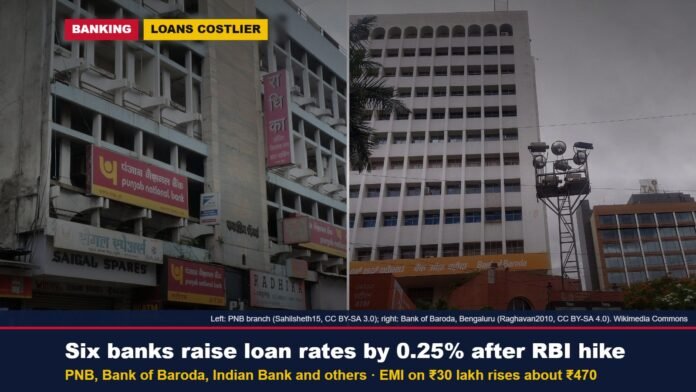
October 8: A day after the Reserve Bank of India raised the repo rate by 0.25% to 5.50%, several banks made their loans costlier. Punjab National Bank (PNB), Bank of Baroda, Indian Bank, Bank of India, Indian Overseas Bank and Tamilnad Mercantile Bank have raised their repo-linked lending rates by 0.25%. Most of the new rates apply from October 8. This directly affects customers whose home loan, car loan or other borrowing is linked to the repo rate.
Key highlights
- PNB’s repo-linked lending rate (RLLR) has risen from 8.10% to 8.35%. This includes a business strategic premium of 0.35%.
- Bank of Baroda’s repo-based lending rate has gone from 7.90% to 8.15%, and Indian Bank’s from 7.95% to 8.20%.
- The new rate at Bank of India and Indian Overseas Bank is 8.35%. Their old rates were not given in the reports.
- PNB said its MCLR and base rate are unchanged.
- Our calculation: on a 20-year loan of ₹30 lakh, the EMI rises by about ₹470 if the rate goes from 8.10% to 8.35%. If the EMI is kept the same, the tenure of a new loan rises by about 12 months.
- These reports do not yet include any change by SBI, HDFC Bank or ICICI Bank.
Which bank raised its rate, and by how much
| Bank | Benchmark | Old rate | New rate | From |
|---|---|---|---|---|
| Punjab National Bank | RLLR (including 0.35% premium) | 8.10% | 8.35% | October 8 |
| Bank of Baroda | Repo-based lending rate | 7.90% | 8.15% | Not in reports |
| Indian Bank | RBLR | 7.95% | 8.20% | October 8 |
| Bank of India | RBLR | Not in reports | 8.35% | October 8 |
| Indian Overseas Bank | RBLR | Not in reports | 8.35% | October 8 |
| Tamilnad Mercantile Bank | RLLR | 8.25% | 8.50% | Not in reports |
Banks give this benchmark different names, such as RLLR or RBLR, but all of them are rates linked to the repo rate. A customer’s actual interest rate is this benchmark plus a margin (spread) set by the bank, so each customer’s rate can be different.
How much your EMI rises: our calculation
The table below uses the standard EMI formula. It assumes a 20-year loan that has just started and an interest rate rising from 8.10% to 8.35%, the same 0.25% increase these banks have made. If your actual rate or remaining tenure is different, the impact will be different too.
| Loan amount | EMI at 8.10% | EMI at 8.35% | Extra each month | Extra over 20 years* |
|---|---|---|---|---|
| ₹20 lakh | ₹16,853 | ₹17,167 | ₹314 | about ₹75,000 |
| ₹30 lakh | ₹25,280 | ₹25,751 | ₹470 | about ₹1.13 lakh |
| ₹50 lakh | ₹42,134 | ₹42,918 | ₹784 | about ₹1.88 lakh |
| ₹75 lakh | ₹63,201 | ₹64,376 | ₹1,176 | about ₹2.82 lakh |
Keeping the EMI the same: When rates rise, there are two options: the EMI goes up, or the EMI stays the same and the loan tenure gets longer. By our calculation, for any of the new 20-year loans above, keeping the old EMI stretches the tenure from 240 months to about 252 months, or about a year more. For a loan that has been running for several years, the effect may be smaller or larger. You can find out what applies to your loan by asking your bank about its next reset date and options.
Which loans are affected
| Type of loan | Impact |
|---|---|
| Repo-linked (external benchmark) loans | The bank’s higher benchmark rate applies at the loan’s next reset. Direct impact on such customers of the six banks above. |
| MCLR-linked loans | No immediate impact unless the bank changes its MCLR. PNB has said its MCLR has not changed for now. |
| Fixed-rate loans | The rate stays fixed for the contract period; check your loan agreement. |
Reports so far do not mention any change in fixed deposit (FD) rates at these banks.
Background: what the RBI did
The Reserve Bank’s Monetary Policy Committee raised the repo rate from 5.25% to 5.50% on October 7, the first increase since February 2023. The central bank has changed its stance to “calibrated tightening”, reducing hopes of rate cuts in the near future. The RBI expects retail inflation to reach 6.0% in the October–December quarter. Full details are in our report: RBI raises the repo rate to 5.50%.
What to watch
- Other banks may also raise their benchmark rates soon. Watch for decisions by SBI, HDFC Bank and ICICI Bank.
- The minutes of the Monetary Policy Committee meeting, due on October 21.
- The next policy meeting, on December 2–4.
- Changes in FD rates, which have not been reported yet.
What it means
A single 0.25% increase raises most households’ EMIs by a few hundred rupees, as the table shows. The bigger point is that the Reserve Bank has signalled more tightening ahead. If there is another increase in December, this impact will roughly double. By raising rates within 24 hours, the public sector banks have shown how quickly policy reaches customers on repo-linked loans.
Note: this article is general information, not financial advice. Contact your bank for your loan’s exact rate and terms. This article was first published in Hindi and has been translated. The Press of Asia now publishes in English only.

The Business Desk covers markets, the economy, companies and personal finance. Stories are checked against at least two credible sources before publication.