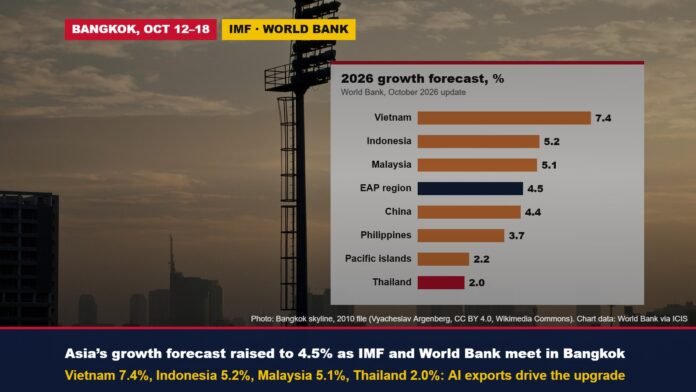
October 10: Finance ministers and central bankers gather in Bangkok from Monday, October 12, for the annual meetings of the International Monetary Fund and the World Bank, hosted by Thailand. They arrive with an upgraded outlook for the region: the World Bank expects developing East Asia and the Pacific to grow 4.5% in 2026, up from the 4.2% it forecast in June, largely because of booming exports of AI-related goods, ICIS reported. The meetings run until October 18, according to the IMF.
Key highlights
- The World Bank’s East Asia and Pacific Economic Update, released on October 6 under the title “Riding the AI Wave”, expects regional growth to average 4.4% a year in 2026–28.
- China is forecast to grow 4.4% in 2026, up from 4.2%, but domestic demand is held back by a soft labour market and the property downturn, ICIS reported.
- Vietnam got the biggest upgrade among major economies, to 7.4% from 6.3%. Thailand, the host, is forecast to grow 2.0%.
- AI-related goods made up more than 70% of export growth in Malaysia, the Philippines, Thailand and Vietnam, according to ICIS’s summary of the report.
- The main risks are a reversal in AI investment, energy prices staying high for longer and damage from a severe El Niño, the World Bank said.
The forecasts, country by country
The table compares the World Bank’s June and October forecasts for 2026 growth. The change column is our calculation; where the earlier figure is not published, we derived it from the size of the revision reported.
| Economy | June forecast | October forecast | Change |
|---|---|---|---|
| East Asia and Pacific (developing) | 4.2% | 4.5% | +0.3 points |
| China | 4.2% | 4.4% | +0.2 points |
| Vietnam | 6.3% | 7.4% | +1.1 points |
| Indonesia | 4.7% | 5.2% | +0.5 points |
| Malaysia | 4.4% | 5.1% | +0.7 points |
| Thailand | 1.3% (derived) | 2.0% | +0.7 points |
| Philippines | 3.7% | 3.7% | Unchanged |
| Pacific Island countries | 2.7% (derived) | 2.2% | −0.5 points |
By our calculation, Vietnam’s forecast growth is 3.7 times Thailand’s. Thailand, the host, has the lowest 2026 forecast of any economy in the table, below even the Pacific Island countries. The Philippines, at 3.7%, is the only economy in the table whose forecast stayed the same.
The AI effect
The report’s central finding is that AI-related production is lifting growth in countries that are part of AI supply chains, the World Bank said. China, Indonesia, Malaysia, the Philippines, Thailand and Vietnam together exported $1.4 trillion of AI-related goods between May 2025 and April 2026, ICIS reported. But the World Bank said the influence of AI is clear in industry and less so in the wider economy, and AI use is less common in the region than in advanced economies.
“The challenge now is to turn the region’s strength in producing AI-related goods into widespread AI adoption,” said Carlos Felipe Jaramillo, the World Bank’s vice president for East Asia and Pacific, according to Fibre2Fashion. The report also says AI innovation in the region is shifting from Japan to China and South Korea, and that for most countries the main near-term benefit lies in adopting existing small AI tools.
The energy problem
High energy prices have pushed up inflation globally, and the rise has been larger in East Asia and the Pacific because the region is a major net oil importer, the World Bank said. Vietnam’s oil import bill rose 36% in value after the Middle East conflict began in late February, ICIS reported.
| Economy | September inflation | Note |
|---|---|---|
| Philippines | 7.2% | Up from 6.1% in August |
| Vietnam | 5.08% | |
| Indonesia | 3.28% |
Pacific Island economies have been hit hardest by energy costs, which is why their forecast was cut, the World Bank said.
What to watch in Bangkok
- The IMF’s updated growth forecasts, which it usually publishes around the annual meetings.
- How finance ministers respond to the risk of an AI investment slowdown, which the World Bank names as the biggest threat to the upgrade.
- Energy prices and the Strait of Hormuz, which drive inflation in oil-importing Asian economies.
- Thailand’s own pitch as host, with the weakest growth forecast of the major Southeast Asian economies.
What it means
The upgrade is real but narrow. It rests on one product cycle: chips, servers and other AI hardware made in a handful of Asian economies. Trade outside AI-related products has been weak or negative, ICIS noted, so if global AI spending slows, the same economies that gained most could lose most. For countries like Thailand and the Philippines, with slower growth and, in the Philippines’ case, high inflation, the question in Bangkok is how to share in the AI boom without becoming more exposed to it.
Sources
- World Bank: East Asia and Pacific Economic Update, October 2026
- ICIS: World Bank updates East Asia and Pacific GDP growth forecast to 4.5% in 2026
- Fibre2Fashion: East Asia & Pacific growth seen at 4.5% in 2026: World Bank
- IMF: 2026 Annual Meetings

The Business Desk covers markets, the economy, companies and personal finance. Stories are checked against at least two credible sources before publication.