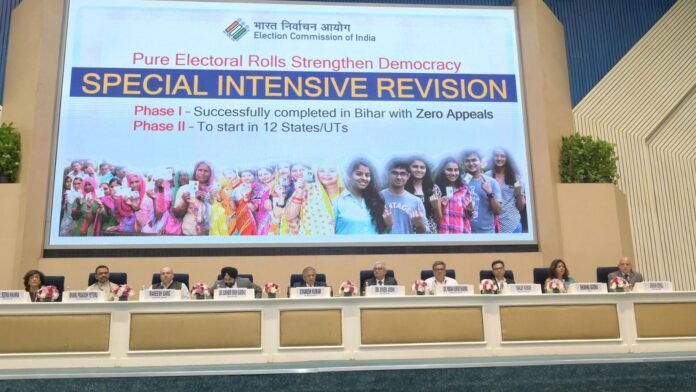
Featured image: File photograph of the Election Commission’s SIR press conference at Vigyan Bhawan, New Delhi, October 27, 2025. Credit: Election Commission of India / Wikimedia Commons (GODL-India).
An investigation into disagreements within the Election Commission became the immediate trigger for a renewed resignation campaign. What did it report, how did the Commission respond, and where does the controversy fit into the longer timeline?
The renewed demand for Chief Election Commissioner Gyanesh Kumar’s resignation gathered momentum after an Indian Express investigation published on September 23, 2026. The report described repeated disagreements within the Election Commission over the management of electoral rolls and the Special Intensive Revision, or SIR.
The following day, the Cockroach Janta Party, or CJP, demanded that Kumar resign within 48 hours. Congress leader Rahul Gandhi separately called for his immediate resignation.
That sequence provides the clearest explanation of how the current campaign intensified: an investigation into the Commission’s internal functioning was followed by explicit resignation demands and plans for public protests.
However, the September campaign was not the first effort to secure Kumar’s departure. Opposition MPs had already submitted parliamentary removal notices earlier in 2026. Distinguishing those earlier proceedings from the immediate trigger for the latest mobilisation is essential to understanding the controversy. Sources: CJP’s September 24 announcement and Rahul Gandhi’s resignation demand.
What Did The Indian Express Investigation Report?
The investigation reported that Election Commissioners Sukhbir Singh Sandhu and Vivek Joshi had raised written objections on at least 14 occasions between November 2025 and August 2026.
According to the newspaper, the disagreements concerned electoral-roll administration, access to voter data, voter-registration procedures and how decisions were taken within the Commission.
The newspaper said its reporting drew on internal exchanges and interviews with officials. Its account raised questions about whether the other commissioners had adequate involvement in decisions concerning the revision exercise.
These are findings reported by The Indian Express. The Press of Asia has not independently examined the internal correspondence underlying that investigation.
The significance of the report lay in its focus on institutional decision-making. It introduced reported concerns from within the Commission into a debate previously dominated by accusations from political parties.
Nevertheless, an internal disagreement does not by itself prove electoral manipulation. Nor does reporting that commissioners objected to a procedure establish that every disputed decision was unlawful. Those conclusions require evidence and, where applicable, determination by the appropriate legal authority. Read the original investigation.
Why Did the Report Become a Political Flashpoint?
The investigation arrived against an existing dispute over electoral rolls.
Electoral-roll accuracy matters because registration determines whether an eligible person can vote. Public confidence depends on transparent procedures for adding eligible voters, correcting errors and removing entries that should not remain on the rolls.
In this context, reporting about disagreements within the body responsible for supervising elections carried particular political weight.
For critics, the investigation provided grounds to question the Commission’s transparency and collective functioning. For defenders of the Commission, differing views were part of normal deliberation rather than proof of institutional failure.
The report therefore sharpened an existing argument. It did not independently settle all the allegations made by either side.
September 24: CJP Issues a 48-Hour Ultimatum
At a New Delhi press conference on September 24, CJP national convenor Abhijeet Dipke, accompanied by co-convenors Saurav Das and Ashutosh Ranka, demanded Kumar’s resignation within 48 hours.
The organisation announced its “Election Commission Thik Karo” campaign and warned of wider agitation if its demand was not met.
Its proposals went beyond a change of leadership. They included an independent inquiry, a halt to further exclusions under SIR and restoration of January 2025 electoral rolls pending verification.
These were the organisation’s demands, not measures already ordered by a court or accepted by the Election Commission.
CJP’s intervention helped translate the controversy into a public campaign with a deadline and an announced protest strategy. It is accurate to identify the organisation as a prominent participant in the September mobilisation. It would be inaccurate to use that fact alone to credit it with originating every earlier demand for Kumar’s departure. Report on CJP’s ultimatum and demands.
Rahul Gandhi Separately Demands Resignation
Rahul Gandhi also demanded Kumar’s immediate resignation on September 24, citing the investigation and reiterating Congress’s allegations concerning electoral manipulation.
His intervention brought the renewed demand into the wider opposition campaign against the Commission’s handling of electoral matters.
The chronology establishes that both Gandhi and CJP publicly demanded resignation that day. The sources reviewed do not provide a sufficient basis to determine definitively which intervention came first.
Their accusations must also remain clearly attributed. A political leader’s allegation that an election was manipulated is not equivalent to a judicial finding establishing that allegation. Report on Gandhi’s intervention.
What Was the Election Commission’s Response?
The Commission disputed the interpretation that the reported disagreements demonstrated improper decision-making.
Reporting on its response said it characterised differing views as part of deliberations and maintained that SIR decisions were approved unanimously.
BJP spokesperson Sambit Patra similarly argued that disagreement within the Commission reflected discussion within a democratic institution.
This response is important to the article’s central question. The controversy concerns both the reported internal exchanges and competing interpretations of what those exchanges demonstrate.
Questions about consultation, data access and procedure deserve examination. But neither the existence of disagreement nor a statement of unanimity alone resolves every question about how a particular decision was reached. Report on the Commission’s response and BJP’s position.
The Earlier Parliamentary Attempts
The September investigation intensified the campaign, but demands for Kumar’s removal already had a parliamentary history.
On March 13, 2026, opposition MPs submitted removal notices carrying 130 Lok Sabha signatures and 63 Rajya Sabha signatures. The notices alleged misconduct, including partisan handling of electoral matters.
The presiding officers subsequently rejected those notices. That prevented them from proceeding through the removal process; it should not be described as a court ruling determining every disputed allegation. Report on the earlier removal notices.
A fresh Rajya Sabha notice, signed by 73 MPs, followed on April 24. It cited additional grounds relating to subsequent events. These proceedings establish that the September mobilisation was a renewed phase of pressure, rather than the beginning of all efforts to remove Kumar. Report on the April notice.
How the Demand Moved Into Public Protests
Following the September 24 ultimatum, CJP announced plans for nationwide protests beginning on October 2.
The campaign subsequently expanded. Shiv Sena (UBT) and MNS held a Mumbai march on October 4 demanding Kumar’s resignation. On October 6, opposition MPs attempted to march towards the Election Commission in Delhi.
These developments show how a controversy over institutional functioning became a broader political mobilisation. They do not establish that every participating organisation shared an identical strategy or that the allegations had been legally proved. Sources: CJP’s protest announcement, Mumbai mobilisation, and Delhi opposition march.
Timeline: From Removal Notices to the Renewed Campaign
| Date | Development | Significance |
|---|---|---|
| March 13, 2026 | Opposition MPs submitted parliamentary removal notices. | An earlier formal attempt to secure Kumar’s departure. |
| April 24, 2026 | A fresh Rajya Sabha notice followed. | Parliamentary pressure continued before the September investigation. |
| September 23, 2026 | The Indian Express published its investigation. | The immediate trigger for the renewed resignation campaign. |
| September 24, 2026 | CJP issued an ultimatum; Rahul Gandhi separately demanded resignation. | The reported internal disagreements became the basis for explicit public demands. |
| September 25, 2026 | CJP announced a nationwide protest plan. | The campaign moved towards organised mobilisation. |
| October 4–6, 2026 | Further marches took place in Mumbai and Delhi. | The demand expanded beyond the initial announcements. |
Can a Resignation Demand Remove the CEC?
No. A demand for resignation asks an officeholder to leave voluntarily. Compulsory removal is a separate constitutional matter.
Article 324(5) provides that the Chief Election Commissioner cannot be removed except through the same manner and on the same grounds applicable to a Supreme Court judge.
The protection is intended to safeguard the office’s independence. A press conference, ultimatum or demonstration does not itself remove the CEC. Political pressure and the constitutional removal process must therefore be explained separately. Official constitutional text: Article 324.
What Remains Unresolved?
The reporting and political responses leave several questions requiring careful examination: how the disputed decisions were reached, how commissioners’ concerns were recorded and addressed, and whether particular procedures adequately protected eligible voters.
Answering those questions requires documentary evidence and institutional scrutiny. Protest attendance, political slogans and the intensity of public criticism cannot substitute for that examination.
Equally, criticism of the Commission should not be dismissed solely because it comes from political opponents. Its substance should be assessed against the records and applicable rules.
Conclusion: The Report Was the Catalyst, Not the Entire Origin
The most defensible account is that The Indian Express investigation of September 23, 2026 became the immediate catalyst for the renewed resignation campaign.
CJP’s ultimatum and Rahul Gandhi’s demand followed the next day, with wider mobilisation developing afterwards.
But the longer record includes parliamentary removal efforts in March and April. The story is therefore one of escalation: an existing dispute over electoral administration intensified after reporting about the Commission’s internal functioning.
The central distinction remains essential. An investigation can raise serious questions; political groups can demand accountability; and the Commission can contest their interpretation. Establishing misconduct requires a separate assessment of evidence.

The National Desk covers India's politics, governance, security and public-interest news. Stories are checked against at least two credible sources before publication.