India’s tally of Ramsar sites has reached 103 following the addition of Sukhna Wetland in Chandigarh and Sauj Jheel in Uttar Pradesh, the Ministry of Environment, Forest and Climate Change announced on October 15.
Environment Minister Bhupender Yadav announced the additions in a social media post cited by the ministry. He linked wetland protection with biodiversity, water and climate security, and livelihoods.
The two additions at a glance
| Wetland | Location | Announced development |
|---|---|---|
| Sukhna Wetland | Chandigarh | Added to India’s Ramsar list |
| Sauj Jheel | Uttar Pradesh | Added to India’s Ramsar list |
The ministry’s announcement identifies the sites and the new national total. It does not provide their designation documents, mapped boundaries, ecological character descriptions or site-specific management budgets. Those records are important for understanding precisely which areas and conservation commitments are covered.
Why the announcement matters
The government’s explanation places wetlands within a wider environmental agenda. It highlights their ecological benefits as well as their relationship with water security and local livelihoods. That framing is broader than treating a wetland simply as a tourist attraction or a body of water.
The designation also creates a clear point from which readers can track subsequent action: what monitoring takes place, which pressures are identified and how conservation measures are implemented. A higher national count is a measure of recognition; it is not, by itself, evidence that every recognised site is in good ecological condition.
What remains to be clarified
The brief release does not announce a new admission policy, construction restriction, tourism facility or public funding allocation at either site. Such changes should not be assumed from the Ramsar announcement. Likewise, the release does not give a new nationwide environmental performance ranking.
For residents and researchers, the useful next documents will be the individual site records and any management or monitoring information released by the responsible authorities. These will allow a closer assessment of habitat protection and local implementation than the headline total alone.
Information for visitors
Yadav invited tourists to visit Sukhna and Sauj to see their natural surroundings. The ministry did not publish opening hours, access rules or visitor facilities in this announcement. Travellers should use current local guidance rather than treat the designation as a change to entry arrangements.
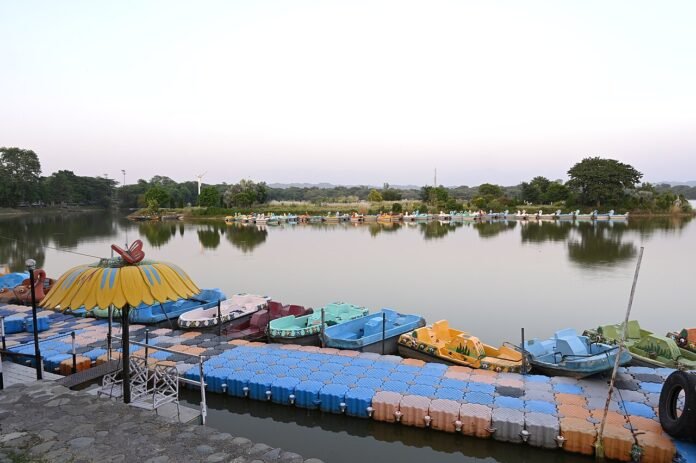
The image accompanying this report is an archival photograph of Sukhna Lake. It illustrates the location and does not show an October 2026 event or a survey of the newly designated wetland’s boundary.
Sources and image credit
Reporting source: Official ministry announcement, October 15, 2026. This report distinguishes announced decisions from details not disclosed in the source.
Photo: Navneet Sharma / Wikimedia Commons, CC BY-SA 4.0. Sukhna Lake, October 4, 2020; archival photograph, not the designation ceremony. Supplied image resized for display. Image source · Reuse terms.

The National Desk covers India's politics, governance, security and public-interest news. Stories are checked against at least two credible sources before publication.