October 23: A new United Nations Environment Programme assessment says the world must sharply reduce greenhouse-gas emissions to limit the scale and duration of warming above 1.5°C and create a chance of returning to that level later this century. The Emissions Gap Report 2026, released on October 21, presents a conditional pathway, not a prediction that the required action will happen.
Key highlights
- UNEP examines a lowest-possible overshoot pathway with peak warming around 1.7–1.8°C.
- The pathway requires deep emissions cuts relative to 2025 and additional carbon-dioxide removal.
- Existing national commitments fall well short of that pathway.
- Asia’s exposure to heat, ocean warming and changing water risks makes the findings directly relevant to the region.
What the new report says
UNEP’s report summary describes a pathway that would offer about a 50% chance of returning to or below 1.5°C by 2100. It requires global emissions to fall 18% by 2030, 45% by 2035 and 69% by 2040, all measured against 2025.
By comparison, UNEP says fully implementing national climate commitments would deliver much smaller reductions and leave warming this century at about 2.6°C. These are scenario results based on assumptions about policy and action. They are not precise forecasts for an individual city or country.
At a glance: the report’s reduction pathway
| Target year | Reduction from 2025 emissions | Meaning |
|---|---|---|
| 2030 | 18% | Near-term cuts required in the lowest-overshoot pathway. |
| 2035 | 45% | Further global reduction, not an additional 45% on top of the 2030 figure. |
| 2040 | 69% | A substantially smaller remaining emissions level. |
| 2100 | Return to or below 1.5°C with about a 50% chance | Conditional on the pathway, including carbon removal. |
Overshoot is not a reason to stop cutting emissions
UNEP’s accompanying explainer says the chance of avoiding or only briefly exceeding 1.5°C has gone, but that a larger or longer overshoot is not inevitable. Faster cuts can reduce peak temperatures and the period spent above that level.
It also warns that carbon removal is uncertain, faces technological and socioeconomic constraints, and cannot replace emissions reductions. The important distinction is between using removals as a limited part of a pathway and assuming they can cancel unlimited pollution in the future.
Associated Press’s October 21 report described the assessment as a deterioration from the previous year and quoted independent climate scientist Adelle Thomas saying that delay increases both danger and cost. That external response supports the urgency of acting, without turning a scenario into a guarantee of success.
Why Asia has a direct stake
The World Meteorological Organization’s June 2026 assessment of Asia’s climate in 2025 reported extreme heat and rainfall, glacier loss and record ocean heat. It said Asia had warmed faster than the global average in recent decades, with its 1991–2025 warming trend approximately twice the region’s 1961–1990 trend.
Those are regional observations over specified periods, not a claim that every location is warming at the same rate. WMO also identified rising sea levels and water-related risks. This existing evidence gives Asian readers a concrete reason to follow the global emissions debate, from coastal infrastructure to mountain water systems.
How to read the numbers carefully
The emissions percentages share a 2025 baseline; they should not be added together. Likewise, the global temperature goal is not a local weather forecast. Neither the UNEP report nor this article establishes the cause of a particular storm, flood or heatwave solely from a headline number.
What to watch
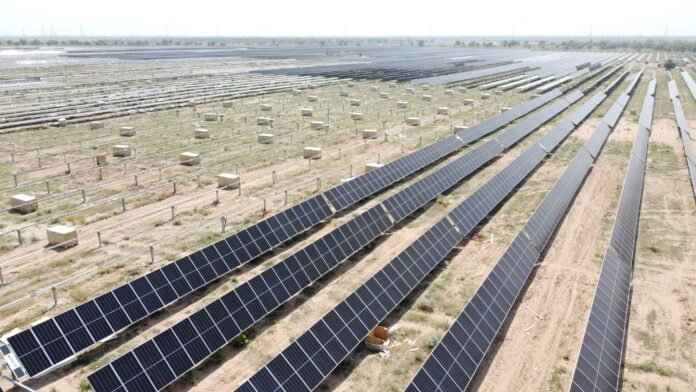
The practical test is whether governments and industries implement measurable cuts rather than only announce distant targets. Updated emissions inventories, funded energy policies and transparent progress reporting will show whether the gap is narrowing. A solar project in India is shown in the file photo as an example of energy infrastructure, not as evidence that the report’s global pathway has already been achieved.
Featured image: Sarvajanik Puralekh / Wikimedia Commons, CC BY-SA 2.0. Licence information. Displayed with responsive cropping.
Sources
- UNEP: Emissions Gap Report 2026
- UNEP: As temperatures spike, this new report outlines humanity’s options for containing climate change
- Associated Press: US is a big reason for the world losing ground in the fight against climate change, UN report says
- WMO: Extreme heat and rainfall, glacier loss and record ocean heat impact Asia in 2025

The International Desk covers world and Asian affairs, diplomacy and conflict, with a focus on what they mean for India. Stories are checked against at least two credible sources before publication.