DHAKA, October 25: Bangladesh Prime Minister Tarique Rahman is scheduled to begin an official working visit to Japan on October 26, with bilateral relations and the next steps in the two countries’ strategic partnership in focus. Japan’s Foreign Ministry has confirmed the four-day visit and a meeting with Prime Minister Sanae Takaichi. The announcement establishes the programme; it does not establish that new agreements have already been signed.
Key highlights
- The official working visit is scheduled for October 26–29.
- Japan has announced a leaders’ meeting and lunch.
- Bangladesh’s embassy records an economic partnership agreement signed in February.
- Any new commitments should be assessed against the documents issued after the talks.
What the two governments have put on record
Tokyo’s October 20 announcement says Rahman will travel with his spouse, Dr Zubaida Rahman. The Japanese government presents the visit as an opportunity to strengthen strategic ties and cooperation in the Indo-Pacific. The wording is prospective: it describes what the visit is intended to achieve, rather than reporting completed negotiations.
Bangladesh’s Foreign Ministry had already recorded an invitation from Takaichi during bilateral engagement in August. That earlier account links the forthcoming visit to an ongoing diplomatic process. It also refers to cooperation on regional issues, including support for Rohingya refugees, rather than treating the relationship as a single trade negotiation.
At a glance
| Item | Confirmed position |
|---|---|
| Visit | October 26–29, official working visit |
| Host | Japan; meeting with Prime Minister Sanae Takaichi |
| Economic background | Bangladesh embassy records an EPA signed on February 6, 2026 |
| Next evidence | Joint statements, signed documents and implementation details |
Why the economic background matters
The Bangladesh embassy in Tokyo says the countries signed an Economic Partnership Agreement in February. That is important context, but signature and practical implementation are different questions. Businesses need to know which provisions are in force, what documentation is required and which agencies administer the arrangements. A visit by a prime minister can give these questions political attention without automatically resolving every operational issue.
The useful test for any new announcement is therefore specificity. Does it identify an implementing institution, a timetable or a financing mechanism? Does it describe a binding commitment or an intention to explore cooperation? Those distinctions help readers separate an immediate change for exporters and workers from a longer-term diplomatic objective.
A partnership with several tracks
The embassy’s account of bilateral relations describes exchanges involving energy, agriculture, development projects and human resources. That breadth explains why the visit matters beyond a ceremonial meeting. Different parts of the relationship operate through different institutions, and progress on one track does not mean every other track has advanced at the same pace.
For a global reader, another distinction matters: the Japanese government’s description of its Indo-Pacific objectives is its stated policy position. It should not be read as proof that Bangladesh has accepted an unannounced security commitment. The language of a subsequent joint statement, if issued, will provide a firmer basis for assessing convergence and any remaining differences.
What to watch
Watch for official readouts after the leaders meet, followed by the actual texts of any agreements. Compare new commitments with the existing economic partnership rather than counting every mention of cooperation as a fresh deal. Until those documents are available, the strongest conclusion is that a confirmed high-level visit is about to begin; its substantive outcomes remain ahead.
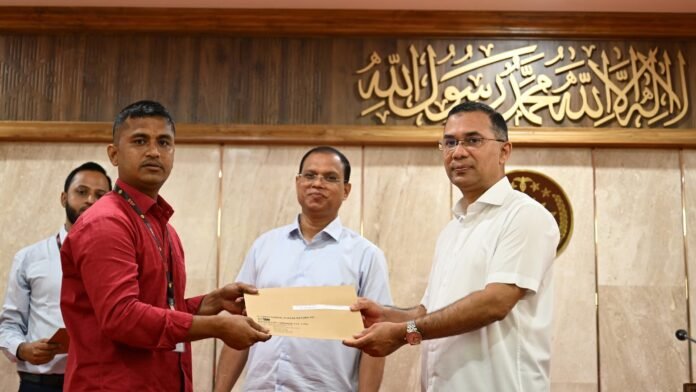
File photo: Tarique Rahman, right, at an official event in Dhaka on August 29, 2026. Press Information Department, Bangladesh; this is not a photograph of the Japan visit. Photo source; Public domain, PID Bangladesh. Cropped and resized.
Sources
- Japan Ministry of Foreign Affairs: Visit to Japan by Prime Minister Rahman
- Bangladesh Ministry of Foreign Affairs: Bangladesh and Japan reaffirm strategic partnership
- Bangladesh Embassy, Tokyo: Bilateral Political Relations

The International Desk covers world and Asian affairs, diplomacy and conflict, with a focus on what they mean for India. Stories are checked against at least two credible sources before publication.