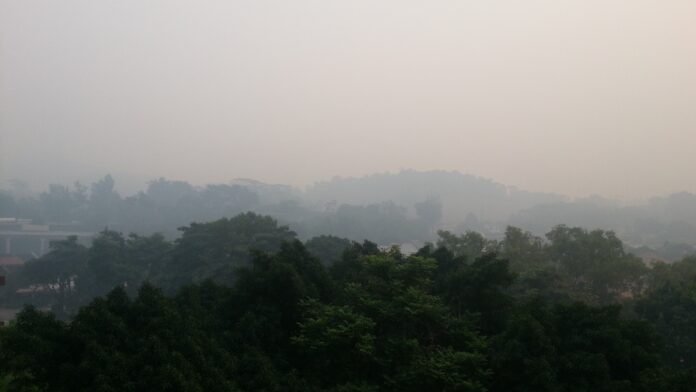
SINGAPORE, October 25: Singapore’s National Environment Agency has forecast air quality in the moderate-to-unhealthy range for Sunday, while expecting winds and showers that could improve haze conditions. Its advisory gives a 24-hour PSI forecast of 80–130 for October 25. That forecast is a planning guide, not a live reading for every neighbourhood or every hour.
Key highlights
- NEA’s October 24 advisory forecasts a PSI range of 80–130 for Sunday.
- Southwesterly or westerly winds and showers could help limit incoming smoke.
- The agency distinguishes next-day planning from immediate outdoor activity decisions.
- Current readings should be checked before activities; conditions can differ from the forecast.
What the official bulletin says
The advisory records unhealthy air quality late on Saturday and describes smoke moving towards Singapore from Sumatra. It anticipates a more favourable wind pattern on Sunday and into Monday and Tuesday. NEA uses conditional language about improvement: the statement does not say that the haze has ended or that all subsequent readings will fall below the unhealthy band.
That distinction matters when sharing the headline. A forecast covering a range can include both better and worse periods. A photograph of clearer skies in one place cannot establish conditions elsewhere, just as a hazy photograph taken on another date cannot establish the current reading.
Two measures with different purposes
| Measure | What it is useful for | What it does not establish |
|---|---|---|
| 24-hour PSI forecast | Planning next-day activities with the corresponding advisory | The pollution level at a particular moment |
| Current 1-hour PM2.5 | Assessing immediate outdoor plans using the official personal guide | A guarantee about conditions throughout the day |
| A photograph | Showing the scene at a stated place and time | A substitute for instrument measurements |
How to read the guidance without mixing the numbers
NEA directs readers to the PSI forecast and associated advice for advance planning, and to one-hour fine-particle readings for immediate outdoor plans. These are different indicators, so their numerical values should not be compared as though they were competing versions of the same measurement. The haze portal labels the reading and unit to help users make that distinction.
The agency’s general advice also takes account of the person involved and the duration and intensity of activity. That is why the official guide contains different recommendations for different groups. A single headline number cannot capture those differences, and a general news article should not replace the guidance relevant to a person’s situation.
The regional picture remains important
The ASEAN Specialised Meteorological Centre monitors hotspots, winds and smoke across the region. Its information provides context for how smoke can travel, while NEA’s local measurements answer a different question: what is being measured in Singapore. A hotspot count is not a count of people exposed, and a satellite image does not by itself measure street-level air quality.
Cloud cover can also limit what satellites show. Readers should therefore avoid interpreting an apparently empty part of a map as definitive evidence that no fire or smoke exists there. The safest interpretation stays within the map’s stated purpose and the limitations disclosed by the monitoring agency.
What to watch
Check the latest NEA advisory, haze portal and myENV information before relying on Sunday’s forecast later in the day. For schools, sports organisers and employers, any activity-specific instructions remain relevant alongside the general bulletin. The immediate development is the possibility of improvement, with current measurements and subsequent official updates needed to establish whether that improvement is sustained.
File photo: Haze near Rifle Range Road in Singapore on June 21, 2013. Photo: Oliverlyc.; not an image of October 2026 conditions. Photo source; CC0 1.0. Cropped and resized.
Sources
- National Environment Agency: Haze Situation Update, October 24, 2026
- Singapore Government: Haze readings and activity guidance
- ASEAN Specialised Meteorological Centre: Regional monitoring

The International Desk covers world and Asian affairs, diplomacy and conflict, with a focus on what they mean for India. Stories are checked against at least two credible sources before publication.