PARIS, October 25: Global Media and Information Literacy Week has begun, with UNESCO’s 2026 programme placing readers, educators, parents and digital creators within the same effort to improve how information is evaluated and shared. The October 24–31 observance includes activities across Asia. Its practical question is straightforward: how can people make better decisions about information before they pass it on?
Key highlights
- The United Nations lists the observance for October 24–31.
- The 2026 campaign emphasises participation by different parts of society.
- The published programme includes activities in New Delhi, Bishkek, Jakarta and Qatar.
- Recognising the origin, date and context of information is as important as recognising its format.
What the programme includes
UNESCO’s flagship listing connects education, policymaking, digital content creation and community participation. The Asia programme includes formal education in New Delhi on October 26–27 and policymaking in Bishkek on October 28–29. Its international schedule also links events focused on creators, researchers and local communities.
The UN’s campaign page describes the ability to navigate misinformation, assess trustworthy material and engage responsibly with digital platforms and AI as shared skills. Those are campaign objectives, not a claim that every listed activity has already produced measurable improvements. Scheduled events and demonstrated outcomes should be reported separately.
A reader’s checklist
| Check | A useful question |
|---|---|
| Origin | Who first published the claim or document? |
| Date | Is this a new event, an old image or a recirculated report? |
| Evidence | Does the material support the headline, or only a narrower statement? |
| Independence | Are several accounts checking separately or repeating one original claim? |
| Uncertainty | What is still unknown, disputed or awaiting confirmation? |
Why this is relevant to Asian audiences
The regional events show that media literacy is not confined to the work of professional newsrooms. Schools, families and public institutions also make choices about information. A parent deciding whether a school closure notice is current and a reader examining a financial announcement face a similar task: finding the original instruction and understanding exactly what it says.
The steps are practical. A genuine document can still be used misleadingly if the date is omitted. A real photograph can be attached to the wrong event. An accurate quotation can be shortened in a way that changes its meaning. Checking authenticity therefore needs to be followed by checking context; one does not automatically establish the other.
What creators and publishers can contribute
For a publisher, useful transparency includes making it possible to distinguish observation, attribution and analysis. A statement from an institution should be described as that institution’s statement. A calculation should show its assumptions. A file photograph should carry a date and a clear caption. These practices let the audience examine the basis of a story without having to take every sentence on trust.
The same principle applies to AI-assisted material. Smooth language and convincing imagery do not establish that an event occurred. A tool can help organise information, but the evidence still needs to be checked against the underlying material. Treating fluency as proof risks turning an unsupported claim into something that merely looks authoritative.
What to watch
UNESCO’s programme and the organisers’ own notices are the appropriate places to check event details. Some activities extend beyond the core observance, so readers should verify the individual date rather than assuming all events follow an identical timetable. The more meaningful measure of the campaign will be usable teaching, clearer publishing practices and habits that last after the week ends.
For readers, the immediate takeaway is not to distrust everything. It is to apply proportionate checks, especially before sharing a consequential claim about someone’s safety, reputation or money. A short pause to inspect the original evidence can be more valuable than the number of accounts already repeating it.
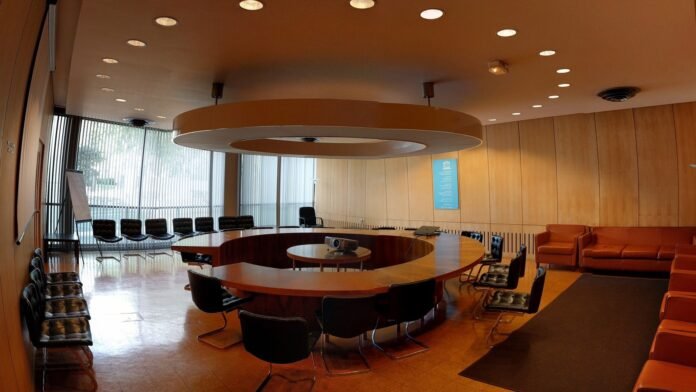
File photo: Room V at UNESCO headquarters in Paris, photographed in May 2016. Photo: John Cummings; not an image of a 2026 Media Literacy Week event. Photo source; CC BY-SA 4.0; this crop uses the same licence. Cropped and resized.
Sources
- UNESCO: Global Media and Information Literacy Week 2026
- United Nations: Global Media and Information Literacy Week
- UNESCO: Celebrations around the world, 2026

The Tech Desk covers technology, artificial intelligence and cybersecurity. Stories are checked against at least two credible sources before publication.