October 26: UNAIDS has called for pandemic preparedness to be judged by who can actually access protection and treatment, as well as by laboratories and surveillance systems. Its new statement welcomes the UN General Assembly’s pandemic declaration while urging governments to complete negotiations on pathogen access and benefit-sharing, known as PABS.
Key highlights
- UNAIDS issued its statement on October 26, welcoming a declaration adopted on October 12.
- It argues that inequality and exclusion can undermine technical preparedness.
- PABS is intended to link sharing pathogens and scientific information with access to resulting health products.
- The political declaration and the still-negotiated PABS annex are separate instruments.
What UNAIDS is asking governments to change
The agency says preparedness frameworks should examine access to care, social protection, discrimination and community-led systems alongside technical capacity. It calls for measures that reduce inequalities rather than deepen them during emergencies.
It also argues that developing countries need affordable financing and room in public budgets to respond. These are the agency’s policy recommendations, not an announcement that debt payments have been suspended or that a new fund has begun disbursing money.
What PABS is designed to do
WHO’s September negotiating update describes the proposed annex as a way to connect the rapid sharing of materials and sequence information from pathogens with pandemic potential to equitable access to vaccines, diagnostics and treatments developed from them.
The WHO Pandemic Agreement was adopted in 2025, but that does not mean every operational detail of PABS is settled. WHO said finalising the annex would open the path for countries to sign and consider ratification. Readers should distinguish adoption of the agreement from completion of the annex and subsequent national steps.
Three documents, different meanings
| Instrument or statement | What it represents | What it does not establish |
|---|---|---|
| UN pandemic political declaration | A statement of political commitment | Automatic delivery of vaccines to every country |
| WHO Pandemic Agreement | The framework adopted in 2025 | That all PABS terms are completed |
| PABS annex negotiations | Work on access and benefit-sharing arrangements | A fully operational system today |
Where negotiations stand
An October 21 statement to the UK Parliament said differences remained over complex technical questions after the July and September negotiating rounds. It described a deadline for the working group’s final outcome at the May 2027 World Health Assembly, or earlier through a special session if necessary.
That national negotiating update provides a separate check against reading the new UNAIDS statement as a declaration that a final deal has been reached. Neither a call for urgency nor a political endorsement should be turned into a claim that unresolved terms are already binding arrangements.
Why the distinction matters for Asia
For Asian health systems, the practical issue is the connection between contributing scientific information and gaining timely access to useful products. A laboratory’s ability to identify a threat and a health service’s ability to obtain diagnostics are related but different capabilities. That is the access question highlighted by the proposed system.
A useful future assessment would look for published terms, participation arrangements and delivery mechanisms. It would also ask how communities outside major urban centres are reached. Those are questions for implementation, not evidence that a particular Asian country has already secured an allocation under PABS.
What to watch
The next material developments are a negotiated annex, the relevant World Health Assembly decisions and subsequent national action. Until then, the verified news is renewed pressure for equitable preparedness, not a completed global distribution system or a guarantee of access during the next emergency.
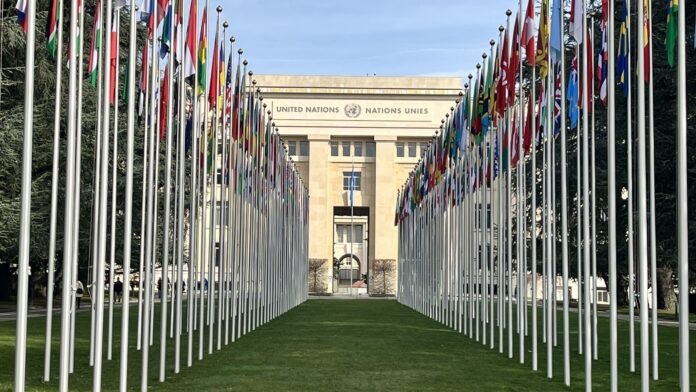
File photo: the United Nations Alley of Flags in Geneva, February 2024. Credit: TomIsNotResponding; CC0 1.0. Cropped/resized for 1600×900. Not a photograph of the current event. Image source; Licence.
Sources
- UNAIDS: October 26 statement on pandemic prevention, preparedness and response
- WHO: September update on pathogen access and benefit-sharing negotiations
- UK Parliament: October 21 ministerial update on PABS negotiations

The International Desk covers world and Asian affairs, diplomacy and conflict, with a focus on what they mean for India. Stories are checked against at least two credible sources before publication.