October 28: India’s Cabinet has approved a ₹10,000-crore Container Manufacturing Promotion Scheme through financial year 2039–40, supporting new factories and expansion of existing units. The programme seeks to reduce import dependence and build a more competitive domestic supply chain, according to the official Cabinet release.
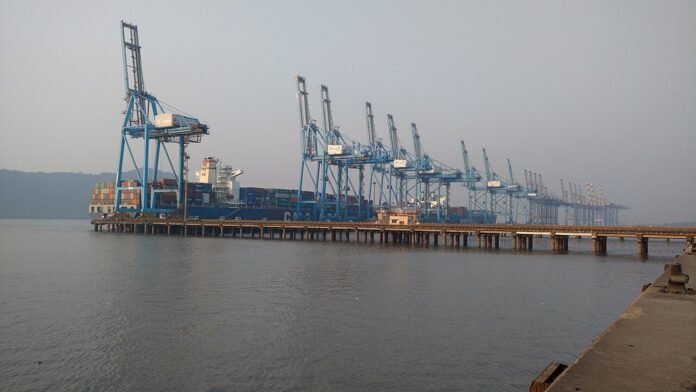
File photo: Container handling at Jawaharlal Nehru Port, November 29, 2017. Ccmarathe / Wikimedia Commons, CC BY-SA 4.0. Cropped and resized; not a new CMPS manufacturing facility. Image source · Licence
Key highlights
- The programme was announced in the Union Budget 2026–27 and now has Cabinet approval.
- Operating support forms the largest part of the allocation.
- Eligible capital loans can receive interest support of 3% per year.
- The government envisages annual capacity of up to 7.5 lakh TEUs.
How the budget is divided
| Component | Allocation | Purpose stated by Cabinet |
|---|---|---|
| Operational Expenditure Assistance | ₹8,891 crore | Support qualifying containers manufactured and sold |
| Interest Subvention Assistance | ₹859 crore | 3% annual support on eligible capital loans |
| Testing and certification | ₹150 crore | Common testing infrastructure |
Our calculation: The three allocations add to ₹10,000 crore. Operating assistance accounts for 88.91% of that total, loan support for 8.59%, and testing for 1.5%.
Factories, finance and standards
The interest component covers eligible term loans for greenfield manufacturing and brownfield capacity expansion. A greenfield project is a new facility; a brownfield expansion adds capacity to an existing operation. The operating component supports qualifying units that manufacture containers to global shipping standards and sell them.
This structure addresses more than the cost of building a factory. The Cabinet’s explanation links operating support to the cost gap facing domestic production, while common testing facilities address certification. The programme’s design therefore combines financing, production and quality infrastructure.
What the capacity target means
The release envisages roughly a tenfold rise in annual domestic manufacturing capacity to as much as 7.5 lakh twenty-foot equivalent units. TEU is a capacity measure based on a twenty-foot container: a forty-foot unit represents two TEUs. It should not be read as a count of identical physical boxes.
Capacity is also different from output. A factory’s ability to make containers is not proof that all available production has been sold. Tracking actual commissioning, utilisation and sales will be necessary to judge the programme’s results.
The employment ambition
The government estimates potential for 3,000 direct jobs and more than 50,000 indirect jobs, with activity extending to specialised steel, corner castings, wooden frames and paints. These are projected benefits, rather than a record of jobs already created by Wednesday’s approval.
What to watch
Detailed eligibility, application procedures and implementation milestones will determine how manufacturers use the programme. The most useful follow-up measures will be commissioned capacity, certified production and actual sales against the stated long-term ambition.
Sources

The Business Desk covers markets, the economy, companies and personal finance. Stories are checked against at least two credible sources before publication.