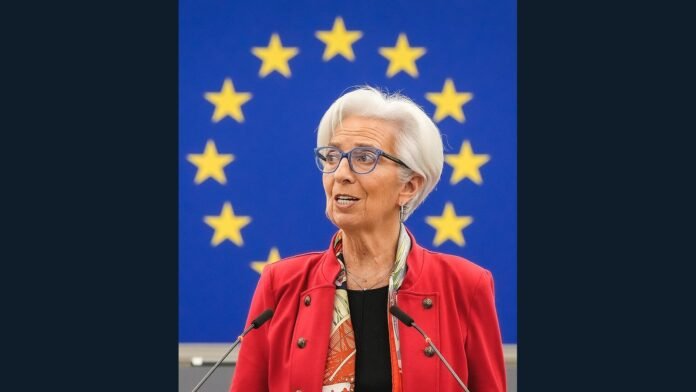
October 29: European Central Bank President Christine Lagarde will step down on February 7, 2027, the ECB announced today. The bank said the European Council would appoint her successor through the treaty-based nomination process. The announcement sets a future departure date; Lagarde remains president in the meantime.
Key highlights
- The ECB published the departure announcement on October 29.
- No successor was named in the announcement.
- The European Council makes the appointment after the prescribed consultations.
- Separately, the ECB kept its three policy rates unchanged today.
What the ECB has announced
The ECB said Lagarde informed its Governing Council and European Council President António Costa of her decision. Its short statement did not give a reason for the departure or identify a candidate to replace her. The announcement is therefore a confirmed leadership timetable, rather than evidence for speculation about her next role.
How the successor is appointed
| Stage | Institutional step described by the European Council |
|---|---|
| Proposal | Euro-area member states propose candidates |
| Discussion | The Eurogroup agrees on a candidate |
| Recommendation | The Council recommends an appointment |
| Consultation | The European Parliament and ECB Governing Council give opinions |
| Appointment | The European Council adopts the decision |
The Council’s guide says executive-board appointments use a reinforced qualified majority among euro-area members. Board members serve non-renewable eight-year terms and must meet nationality and professional-experience requirements. The process involves several institutions, rather than an appointment made by the departing president.
The separate interest-rate decision
In its October 29 monetary-policy announcement, the ECB kept the deposit facility rate at 2.50%, the main refinancing rate at 2.65% and the marginal lending rate at 2.90%. It identified rising energy prices as an inflation risk and a drag on growth, while retaining a data-dependent, meeting-by-meeting approach.
The Governing Council, which includes the executive board and euro-area national central-bank governors, makes monetary-policy decisions. A change in the presidency should therefore be assessed alongside the institution’s collective decision-making structure. A departure announcement alone does not establish the direction of the next rate move.
Why Asian readers should follow the transition
European demand, euro-denominated payments and the cost of finance are relevant to many Asian businesses. A supplier invoicing a European customer in euros has a different exposure from a company borrowing in euros. The first is concerned with the value and timing of receipts; the second also needs to examine the benchmark and reset provisions of its financing.
The practical task is to separate leadership developments from policy decisions and from market prices. An exchange-rate move would need a dated market record of its own. The ECB announcement does not provide a forecast for the euro against an Asian currency.
For comparison, the US Federal Reserve also held its policy range this week. The two institutions’ decisions concern different economies and should be read on their own terms.
What to watch
The next verified milestones will be a recommendation, the required institutional opinions and an appointment decision. Until those are published, a named contender remains distinct from a confirmed successor. For monetary policy, subsequent ECB decisions and their supporting economic assessment remain the relevant records.
Sources
- ECB: President Lagarde to step down on February 7, 2027
- European Council: Appointment of the ECB executive board
- ECB: Monetary policy decisions, October 29, 2026

The Business Desk covers markets, the economy, companies and personal finance. Stories are checked against at least two credible sources before publication.