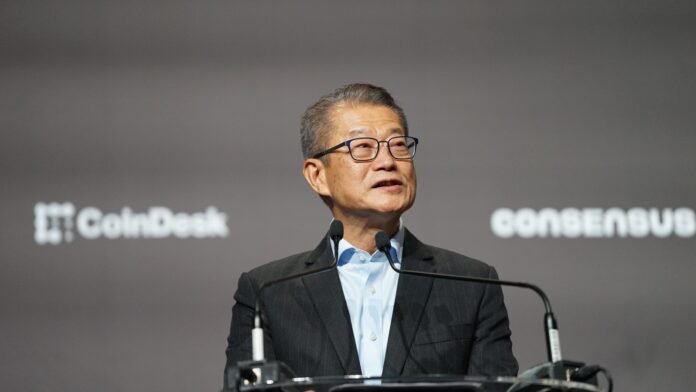
November 6: Hong Kong Financial Secretary Paul Chan has set out how the city wants to connect artificial intelligence, biomedical research and financing, using a November 6 BioComputing summit speech to argue that drug discovery needs a wider research and commercial ecosystem.
Key highlights
- Chan spoke at the third International BioComputing Innovation Summit.
- The speech linked AI research with clinical validation, regulation and financing.
- Cross-border collaboration with Shenzhen forms part of the proposed ecosystem.
- An AI research ambition is not evidence that a drug is safe, effective or approved.
From discovery to a usable medicine
In the published speech, Chan described AI as a way to support biological research and drug discovery. He also discussed the institutions needed around that technology: clinical research, regulatory capacity and routes to commercialisation. The central distinction for patients is between identifying a promising candidate and establishing that a treatment works.
A model can help researchers prioritise experiments, but a prediction is not a clinical outcome. That is why the policy discussion matters beyond computing power. If a project cannot obtain suitable data, validate its findings or complete the relevant clinical and regulatory steps, a faster discovery stage does not by itself deliver an approved medicine.
What Hong Kong is trying to connect
Chan’s speech pointed to plans for a medical-products regulatory centre and a life-and-health technology research institute, alongside cross-boundary collaboration in the Hetao area. He also discussed the role of the planned third medical school at the Hong Kong University of Science and Technology. These references describe capacity-building plans and institutional development, not a list of newly approved treatments.
For a biotechnology company, the proposed appeal is a connected chain: research expertise, facilities to test ideas, clinical evidence and access to finance. For a reader assessing the policy, the important question is whether those links become usable services with clear responsibilities and measurable results. Announcing the links is an earlier stage.
A financing partnership has an earlier history
The Hong Kong Investment Corporation announced its strategic partnership with BioMap in June 2024. Its statement described a BioX initiative targeting support for more than 50 early-stage research and development projects over five years and a Hong Kong InnoHub. That provides background to the summit’s discussion of AI and life sciences.
The figure is a programme target. It should not be presented as proof that more than 50 projects have already succeeded, obtained approval or produced commercial revenue. A follow-up assessment would need the number selected, their stage of development and the outcomes achieved. This distinction keeps the financing story separate from the science story.
What would count as progress?
Useful measures include published validation results, clearly identified research collaborations, regulatory milestones and clinical evidence. Capital raised is relevant to whether work can continue, but it cannot substitute for those measures. Equally, a promising experiment does not establish that a business has a viable manufacturing or distribution model.
For Asian research groups, cross-border cooperation may offer a larger pool of expertise. The practical test remains whether data and samples can be used under the applicable safeguards and whether results can be reproduced. The speech does not remove those obligations or make the outcome of an individual project certain.
What to watch
Watch for implementation details on the proposed institutions and published project outcomes from the existing partnership. The next meaningful story will be evidence that the research-to-clinical pathway is working, rather than a claim that AI alone has solved the difficult parts of medicine.
At a glance
| Item | What the official record says |
|---|---|
| Speaker | Hong Kong Financial Secretary Paul Chan |
| Event | Third International BioComputing Innovation Summit, November 6 |
| Policy focus | AI, life sciences, clinical research and finance |
| Background partnership | HKIC–BioMap, announced June 2024 |
| BioX target | More than 50 early-stage R&D projects over five years; a target, not completed outcomes |
Sources

The Business Desk covers markets, the economy, companies and personal finance. Stories are checked against at least two credible sources before publication.