NEW DELHI, November 7: The Bank of England has raised its main interest rate by a quarter of a percentage point to 4%, saying the rise in energy prices caused by the conflict in the Middle East has built up enough inflation pressure to justify tighter policy. Its Monetary Policy Committee (MPC) voted 8–1 for the increase at the meeting that ended on November 4; one member, Catherine L Mann, wanted a bigger rise to 4.25%.
Key highlights
- Bank Rate: raised to 4% from 3.75%.
- Vote: 8–1; Catherine L Mann voted for a half-point rise.
- Inflation: UK consumer price inflation rose to 3.5% in September and is expected to reach around 5% by the middle of 2027.
- Energy: Brent crude futures averaged $108 a barrel in the 15 UK working days to October 27, 38% higher than at the time of the Bank’s July forecasts.
- Next decision: December 17, 2026.
| Measure | Figure |
|---|---|
| Bank Rate | 4% (from 3.75%) |
| MPC vote | 8 for +0.25 point; 1 for +0.5 point |
| UK CPI inflation, September 2026 | 3.5% |
| Energy’s direct contribution to September inflation | About 1 percentage point |
| Staff projection for CPI, 2027 Q1 | Around 4½% |
| Staff projection for CPI, 2027 Q2 | Around 5% |
| Brent crude futures (15 working days to October 27) | $108 a barrel |
| UK natural gas futures (same period) | 216 pence per therm |
Why the Bank raised rates
The MPC said the conflict in the Middle East was “now in its ninth month” and that global energy prices had “continued to rise from an already elevated level”. Energy contributed about one percentage point of September’s 3.5% inflation rate, mostly through fuels. The committee said there was still “limited evidence” of energy costs spreading to other prices and wages, but judged that “the degree of inflationary pressure in the pipeline is now sufficient to warrant an increase in Bank Rate”. It added that recent activity data had generally been stronger than expected.
Bank staff now expect inflation to reach around 4½% in the first quarter of 2027, about 1¼ points higher than in the July forecast, and around 5% in the second quarter. The minutes said many firms were absorbing higher costs through lower profit margins, but that this buffer would probably prove temporary if the energy shock lasted.
Who voted how
Governor Andrew Bailey, Sarah Breeden, Swati Dhingra, Megan Greene, Clare Lombardelli, Huw Pill, Dave Ramsden and Alan Taylor voted for the quarter-point rise. Catherine L Mann preferred half a point, arguing that “an activist approach was needed” to stop persistent inflation becoming embedded. The committee said monetary policy “is not on a pre-set path” and will be decided meeting by meeting.
Our calculation
- With Bank Rate at 4% and inflation at 3.5%, the “real” policy rate is about +0.5 point; if inflation reaches 5% and rates stay at 4%, it would turn negative.
- UK gas futures were 81% higher than at the time of the July forecasts, more than double the 38% rise in oil.
What it means for India and Asia
The Bank of England is now among several central banks tightening policy because of the energy shock. In Asia, the Reserve Bank of Australia raised its cash rate to 4.85% this week, as we reported in our RBA story, and the Philippines raised its policy rate last month, covered in our report on that decision. Higher rates in big economies tend to support their currencies against emerging-market ones and can make borrowing abroad dearer for Asian companies. For India, the UK is a major trading and investment partner, and slower UK growth from tighter policy could weigh on demand for Indian services.
What to watch
- The MPC’s next decision on December 17, 2026.
- UK inflation for October, and any sign that energy costs are feeding into wages.
- Oil and gas prices, which depend on events in the Middle East.
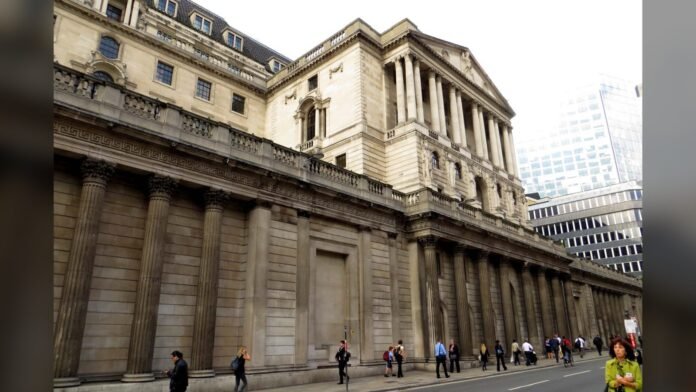
The Bank of England on Threadneedle Street in the City of London. Image: Steve Daniels, CC BY-SA 2.0, via Wikimedia Commons. Photo source · Licence
Sources

The Business Desk covers markets, the economy, companies and personal finance. Stories are checked against at least two credible sources before publication.