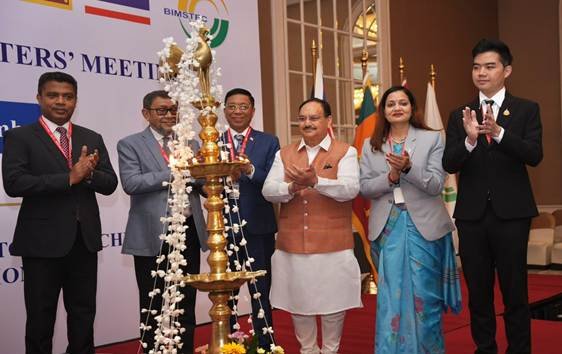
November 13: BIMSTEC’s first meeting of health ministers has adopted a regional public-health roadmap for 2026–2030, placing disease surveillance, emergency readiness and digital cooperation on a shared agenda. The November 11 meeting in Colombo was confirmed by the BIMSTEC Secretariat, while India’s Health Ministry published details of the adopted plan and associated bilateral initiatives.
Key highlights
- The inaugural ministerial meeting took place in Colombo on November 11.
- The revised plan spans 2026–2030 and covers preparedness, workforce and digital health.
- India and Sri Lanka also exchanged an MoU covering 100 additional ambulances.
What was agreed
BIMSTEC said ministers reviewed public health and traditional-medicine cooperation and adopted a joint statement. India’s official account identified disease surveillance, pandemic preparedness, One Health, digital health and workforce development among the revised plan’s priorities. It also described exploration of a digital-health framework involving telemedicine and interoperable electronic records. These are cooperation commitments; the meeting announcement does not establish that a region-wide digital record system is already operating.
Regional plan and bilateral projects
| Initiative | What the official account says |
| Public-health roadmap | Regional plan for 2026–2030 |
| Digital health | Exploration of a BIMSTEC framework |
| Traditional medicine | Indian centre proposed at ITRA, Jamnagar |
| Sri Lanka ambulances | MoU for 100 additional vehicles |
| Primary-care kiosks | Indian support announced for 50 kiosks/Health ATMs |
Why surveillance is a regional issue
Analysis: An outbreak can cross borders before health systems recognise a common pattern. Coordination can help officials compare signals, share laboratory information and agree when to alert neighbouring countries. However, sharing data requires more than an announcement. Definitions, reporting frequency, privacy protections and responsibility for verifying unusual signals all affect whether a common system becomes useful in practice.
A digital framework is not a finished platform
Analysis: Two hospitals can both use electronic records and still be unable to exchange information in a useful form. Interoperability concerns the meaning, format and secure transfer of that information. Telemedicine similarly depends on staffing, connectivity and arrangements for referral when a patient needs in-person care. The meeting creates an agenda for cooperation, but the technical and clinical work must be assessed through subsequent implementation.
Separate the grant initiatives from the regional roadmap
India’s Health Ministry said the ambulance assistance for Sri Lanka involves a grant of approximately US$5.28 million and also announced support for the primary-care kiosks. Analysis: These bilateral measures are distinct from the regional public-health plan. Ambulances, kiosks, a research centre and a disease-alert framework serve different functions and should not be added together as though they were one already-delivered programme.
What to watch
Follow-up milestones should include assigned responsibilities, timetables, financing and evidence of services reaching patients. For digital and traditional-medicine cooperation, transparent standards and evaluation will be particularly important. The most meaningful test is whether governments turn the agreed priorities into safer, more accessible care and more effective early warning, rather than how many new institutions or platforms are announced.
File photo: BIMSTEC health ministers’ meeting in Colombo, November 11, 2026. Photo: Ministry of Health and Family Welfare / PIB, official press-release photograph. Photo source.
Sources
- BIMSTEC Secretariat: First health ministers’ meeting in Colombo
- India Health Ministry: Regional health statement and 2026–2030 plan

The International Desk covers world and Asian affairs, diplomacy and conflict, with a focus on what they mean for India. Stories are checked against at least two credible sources before publication.