November 13: Japan and Australia have used a parliamentary exchange in Tokyo to discuss resources, energy and economic security, including critical minerals. Japan’s Foreign Ministry published accounts on November 12 of meetings involving Australian parliamentarians and Japanese ministers, in a year marking 50 years since the countries signed their Basic Treaty of Friendship and Co-operation.
Key highlights
- The delegation participated in the Japan–Australia Young Political Leaders Exchange programme.
- An official dinner included discussion of security, resources, energy and critical minerals.
- The releases describe dialogue and relationships, rather than a newly signed minerals contract.
Who took part
The Japanese ministry named Senator Richard Dowling, MP Tom Venning and Senator Charlotte Walker as members of the visiting delegation. State Minister Iwao Horii hosted a dinner on November 11. Parliamentary Vice-Minister Kazuhiro Fujii received the delegation on November 12 under the 33rd exchange programme. The official accounts stress people-to-people links and the development of understanding between parliamentarians.
The visit in context
| Item | Confirmed detail |
| Programme | Japan–Australia Young Political Leaders Exchange |
| November 11 | Dinner hosted by State Minister Horii |
| November 12 | Courtesy call on Parliamentary Vice-Minister Fujii |
| Economic subjects | Resources, energy and critical minerals |
| New commercial agreement | Not announced in these releases |
Why minerals feature in economic diplomacy
Analysis: A secure supply chain involves more than locating a mineral deposit. Mining, processing, transport, financing and industrial demand must connect. Parliamentary dialogue can help build familiarity with the policy issues on each side, especially where projects need long investment periods. It cannot substitute for a company’s investment decision, a project approval or a contract specifying volumes and prices.
Energy cooperation also has several layers
Analysis: A discussion of energy can include reliability, investment and the transition between different fuels and technologies. The short accounts of this visit do not identify a new energy shipment or a fresh financial commitment. Readers should distinguish the broad scope of a diplomatic conversation from a measurable project outcome. Such a distinction helps avoid overstating a routine but potentially useful exchange.
What the 50-year milestone means here
Fujii’s account explicitly placed the visit in the treaty’s anniversary year and linked the relationship’s strength to exchanges across society. Analysis: Political familiarity can matter when governments and businesses face difficult choices, but it is not itself evidence that every policy difference has disappeared. The value of a programme of this kind is often continuity: creating contacts and knowledge that can be drawn on after the delegation returns home.
What to watch
Further official statements may identify follow-up meetings or specific areas of work. For commercial implications, readers should look for named projects, financing terms, approvals and delivery schedules. At this stage, the verified development is the exchange and its stated agenda. The ministry’s releases provide no basis for describing it as a new alliance, an exclusive minerals arrangement or a completed supply diversification programme.
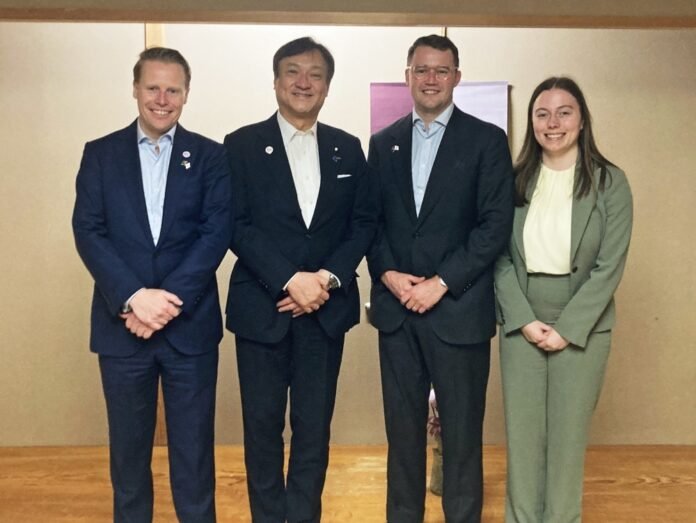
File photo: Japanese State Minister Iwao Horii with the Australian parliamentary delegation, November 2026. Photo: Ministry of Foreign Affairs of Japan, official press-release photograph. Photo source.
Sources
- Japan Foreign Ministry: Horii’s dinner with Australian parliamentary delegation
- Japan Foreign Ministry: Delegation’s courtesy call on Fujii

The International Desk covers world and Asian affairs, diplomacy and conflict, with a focus on what they mean for India. Stories are checked against at least two credible sources before publication.