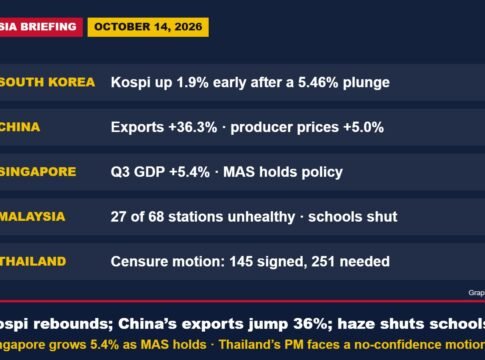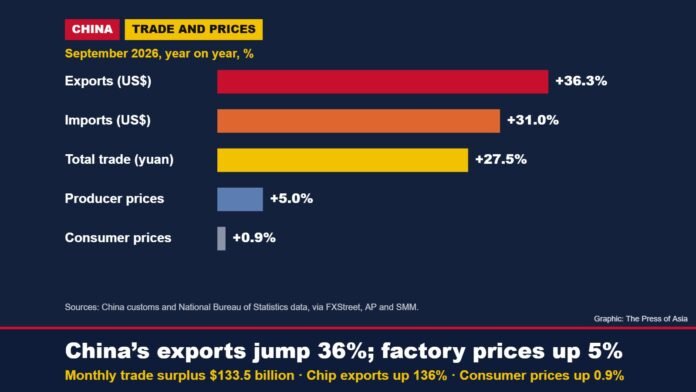
October 14: China’s exports rose 36.3% year on year in September in dollar terms, accelerating from 25% in August and beating forecasts, and imports grew 31%, customs data showed, AP reported. The monthly trade surplus widened to $133.5 billion. Separate figures from the National Bureau of Statistics showed producer prices up 5.0% from a year earlier, driven by fuel costs, while consumer prices rose 0.9%.
Key highlights
- Total goods trade topped 5 trillion yuan in a single month for the first time, at 5.16 trillion yuan, up 27.5%, according to customs data reported by Shanghai Metals Market (SMM).
- Exports of integrated circuits reached $44.95 billion in September, up 136%, customs data showed.
- In the first three quarters, exports rose 16.4% to 23.2 trillion yuan and imports 22.3% to 16.74 trillion yuan.
- Producer prices rose 5.0% year on year and 1.2% from August. Gasoline prices were up 16.6% on the year.
- Deputy customs chief Wang Jun said foreign trade growth in the first three quarters was the fastest for the period in nearly five years, SMM reported.
The September trade numbers
| Measure | September 2026 | Expected | August 2026 |
|---|---|---|---|
| Exports, year on year (US dollars) | +36.3% | +25.5% | +25.0% |
| Imports, year on year (US dollars) | +31.0% | +24.5% | +28.2% |
| Trade surplus (US dollars) | $133.5 billion | $118.1 billion | $119.1 billion |
| Exports, year on year (yuan) | +29.6% | — | +18.6% |
| Imports, year on year (yuan) | +24.6% | — | +21.7% |
| Trade surplus (yuan) | 906 billion yuan | 805 billion yuan | 809 billion yuan |
In yuan terms, exports were 3.03 trillion yuan and imports 2.13 trillion yuan, SMM reported. The dollar growth rates are higher than the yuan rates because the yuan has strengthened against the dollar over the past year.
The first nine months
| Measure (January–September 2026) | Value | Year-on-year change |
|---|---|---|
| Total goods trade | 39.94 trillion yuan | +18.8% |
| Exports | 23.2 trillion yuan | +16.4% |
| Imports | 16.74 trillion yuan | +22.3% |
| Trade surplus | 6.46 trillion yuan | Our calculation (exports minus imports) |
| Trade with the United States | 3.18 trillion yuan | +4.1% |
Customs data also showed exports of electronic components up 70% in the first three quarters, ship exports above 350 billion yuan, up 24.6%, and industrial robot exports approaching 10 billion yuan, up 16.9%, SMM reported. AP said high-tech goods such as semiconductors and cars have driven the rise in overseas shipments, at a time when trading partners, including the European Union, are pressing Beijing to rebalance trade.
Prices: factories feel the oil shock
| Measure | September 2026 | Change from August |
|---|---|---|
| Consumer prices (CPI), year on year | +0.9% | Up 0.1 point |
| CPI, month on month | +0.2% | Down 0.2 point |
| Core CPI (excluding food and energy) | +1.0% | Unchanged |
| Food prices | −1.7% | Decline widened by 0.3 point |
| Pork prices | −10.0% | — |
| Gasoline prices | +16.6% | Up 7.3 points |
| Producer prices (PPI), year on year | +5.0% | Up 1.2 points |
| PPI, month on month | +1.2% | Up 0.8 point |
A 5.0% rise in producer prices is the highest since June 2022, when the PPI rose 6.1%, according to official data. The jump reflects higher fuel and energy costs as oil trades above $100 a barrel amid the conflict in West Asia. Consumer prices are rising far more slowly, held down by falling food and pork prices, which shows that weak household demand remains a problem even as factories pay more for inputs.
What to watch
- China’s third-quarter GDP data, due later in October.
- Reactions from the EU and other trading partners to the widening surplus.
- Whether higher factory-gate prices start to pass through to consumers and export prices.
- Chip export controls, as integrated-circuit shipments surge.
What it means
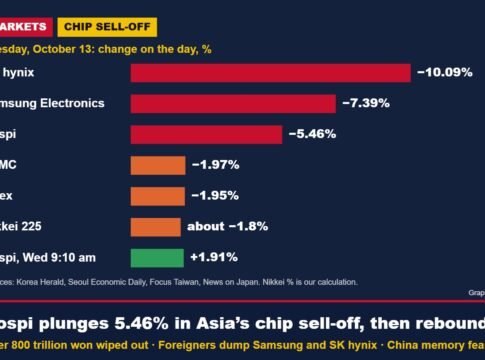
China’s export machine is running at its fastest pace in months, powered by AI-related electronics and chips, while domestic consumption stays soft. That combination widens the trade surplus and adds to friction with trading partners. It also explains some of this week’s nervousness in Seoul and Tokyo: investors worry that Chinese chipmakers such as ChangXin Memory Technologies are catching up with South Korean and Japanese rivals. For Asian neighbours, China is both a growing customer and a sharper competitor.
Sources
- FXStreet: China’s September Trade Balance: Exports and imports beat estimates
- AP, via WDBO: China’s exports surge 36.3% in September as pressure ramps up to rebalance trade
- SMM: In September, China’s goods trade imports and exports exceeded 5 trillion yuan for the first time, up 27.5%
- SMM: China’s September integrated circuit exports hit $44.951 billion, up 136% YoY
- SMM: GAC: foreign trade growth in the first three quarters was the fastest for the same period in nearly five years
- SMM: GAC: China’s trade with US continues to rebound
- SMM: NBS: September CPI up 0.9% YoY, PPI up 5.0% YoY, with both YoY growth rates widening

The Business Desk covers markets, the economy, companies and personal finance. Stories are checked against at least two credible sources before publication.