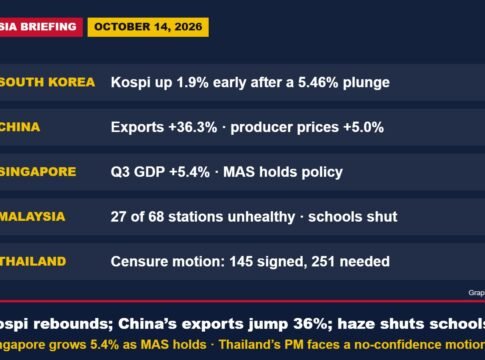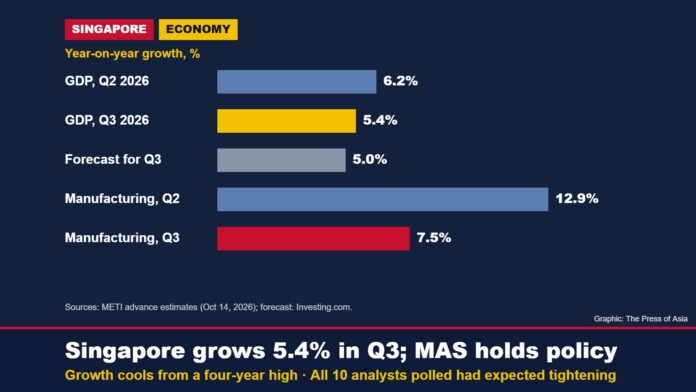
October 14: Singapore’s economy grew 5.4% year on year in the third quarter of 2026, slower than 6.2% in the second quarter, according to advance estimates from the Ministry of Economy, Trade and Industry (METI). The figure beat the 5.0% economists had expected, Investing.com reported. On the same day, the Monetary Authority of Singapore (MAS) left its exchange-rate-based policy unchanged, surprising all 10 analysts in a Reuters poll who had expected a third tightening this year, investingLive reported.
Key highlights
- Quarter on quarter, seasonally adjusted, GDP grew 1.1% in the third quarter, after 1.5% in the second, METI said. Economists had expected 1.2%.
- Manufacturing grew 7.5% year on year, down from 12.9%, and shrank 0.9% quarter on quarter after a 6.3% jump.
- Electronics, precision engineering, transport engineering and general manufacturing grew; chemicals and biomedical manufacturing declined.
- MAS kept the slope, width and centre of its policy band for the Singapore dollar unchanged, after tightening in April and July.
- MAS expects core inflation to average 1.5% to 2.0% in 2026, with risks tilted to the upside, according to investingLive.
The quarter in numbers
| Measure | Q2 2026 | Q3 2026 | Change |
|---|---|---|---|
| GDP, year on year | 6.2% | 5.4% | −0.8 points |
| GDP, quarter on quarter (seasonally adjusted) | 1.5% | 1.1% | −0.4 points |
| Manufacturing, year on year | 12.9% | 7.5% | −5.4 points |
| Manufacturing, quarter on quarter (seasonally adjusted) | 6.3% | −0.9% | −7.2 points |
| Economists’ forecast for Q3 GDP (year on year) | — | 5.0% | Actual beat by 0.4 points |
The second quarter’s 6.2% was the fastest growth in four years, so some cooling was expected. The advance estimate is based mainly on data for the first two months of the quarter and is usually revised when the full figures come out in November.
What the MAS decided
| Policy setting | Decision on October 14 |
|---|---|
| Slope (pace of appreciation of the policy band) | Unchanged |
| Width of the band | Unchanged |
| Centre of the band | Unchanged |
| Analysts expecting tightening (Reuters poll) | 10 of 10 |
| Previous moves this year | Tightening in April and July |
MAS manages monetary policy through the Singapore dollar’s exchange rate against a basket of currencies, rather than an interest rate. Because the band is still on an appreciating path, the decision is a pause in tightening, not an easing. According to investingLive, MAS expects growth to stay firm in the near term and then moderate as the AI-driven boom slows in the second half of 2027, and sees upside risks to inflation from any sharp, sustained rise in energy or food prices.
What to watch
- The final third-quarter GDP figures and the government’s updated growth forecasts in November.
- Whether energy prices, already high because of the conflict in West Asia, push inflation above MAS’s range.
- Electronics orders, which have driven Singapore’s manufacturing upturn this year.
What it means
Singapore is still growing quickly, but the second-quarter burst is fading, especially in factories. MAS chose to wait rather than tighten again, judging that inflation pressure will ease as the AI boom cools and import costs fall. For the region, Singapore’s numbers are an early signal: the electronics cycle that lifted Asian exporters this year is still positive, but slowing.
Sources
- METI: Singapore’s GDP Grew by 5.4 Per Cent in the Third Quarter of 2026
- Investing.com: Singapore Q3 GDP beats forecasts at 5.4% as growth cools from Q2
- investingLive: Singapore’s MAS holds policy steady, surprising all 10 analysts who expected tightening

The Business Desk covers markets, the economy, companies and personal finance. Stories are checked against at least two credible sources before publication.