November 10: A new UN climate-action yearbook reports progress on 44 global indicators while highlighting gaps in methane emissions, food loss and available data. Released at COP31, the findings offer a way to assess implementation beyond the number of pledges announced at a summit.
Key highlights
- The 2026 Yearbook examines 96 global socio-economic indicators.
- Its headline figures cover several different datasets, rather than one emissions score.
- Some initiative-level evidence is self-reported, UN Climate Change says.
- New clean-power financing cooperation gives Southeast Asia a practical connection to the implementation debate.
What the yearbook measures
UN Climate Change launched the report on November 9. It covers action by businesses, cities, regions and civil society alongside the formal intergovernmental negotiations. The agency identifies progress in areas including renewable energy, forests and adaptation, but says important gaps remain.
The online yearbook arranges the Action Agenda around six thematic axes and 30 objectives. Its framework spans energy and transport, nature, food systems, resilient infrastructure, human development and the finance, technology and capacity needed to deliver change.
Read the numbers with their denominators
| Headline | What it describes | What it does not establish |
|---|---|---|
| 44 indicators progressing | Global indicators within a set of 96 | A 44% reduction in emissions |
| 83 cooperative initiatives | Initiatives providing progress reports | 83 countries meeting all climate targets |
| 84% reporting progress | Plans to Accelerate Solutions after one year | 84% completion of global climate goals |
UN Climate Change says the initiatives reported more than 200 actions. The agency explicitly describes those actions as self-reported. That label matters when assessing the strength and comparability of evidence; it does not mean every action has been independently audited.
The financing connection for Asia
In a separate November 10 update, the UK government said the ASEAN Centre for Energy had joined the Global Clean Power Alliance Finance Mission as its first Asian member. The UK and Brazil presented the update at COP31, describing work to improve energy investment planning, prepare projects and attract private finance.
The UK announcement says an action plan for the new partnership will be published during the week. Membership and a proposed plan should therefore be distinguished from a completed investment or an electricity project already operating.
This gives Asian readers a concrete test of the summit’s implementation language: what projects are identified, which barriers are addressed, how finance is structured and what is eventually delivered. Those questions are more useful than assuming that participation in an alliance automatically supplies capital.
What to watch
The yearbook is a monitoring framework rather than a declaration that the climate problem has been solved. An indicator can improve while remaining short of the required outcome. Likewise, a plan can record progress without being complete.
For future comparisons, readers should look for consistent definitions, reporting periods and evidence of results. The next useful developments will be the promised financing plans and specific implementation records, alongside any additions to the online yearbook as COP31 proceeds.
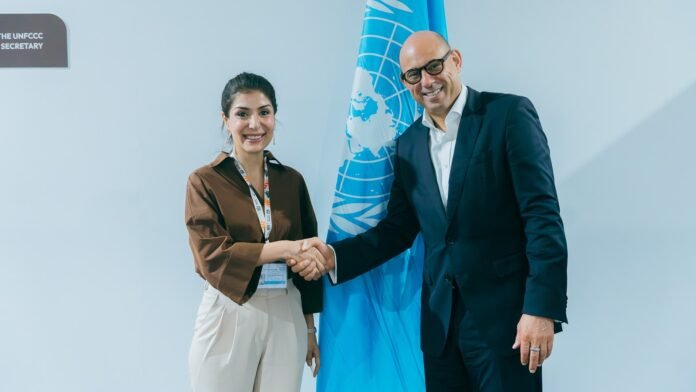
File photo: Simon Stiell and Nigar Arpadarai at COP30, November 15, 2025. Credit: Kenny Garcia for the Climate Champions Team / hlcchampions / Wikimedia Commons, CC BY 4.0. Cropped and resized. Archival COP30 photograph, not the 2026 yearbook launch.
Sources
- UN Climate Change: Yearbook of Global Climate Action 2026 findings
- UN Climate Change: Yearbook 2026 online dashboard
- UK Government: Global Clean Power Alliance finance mission update

The International Desk covers world and Asian affairs, diplomacy and conflict, with a focus on what they mean for India. Stories are checked against at least two credible sources before publication.