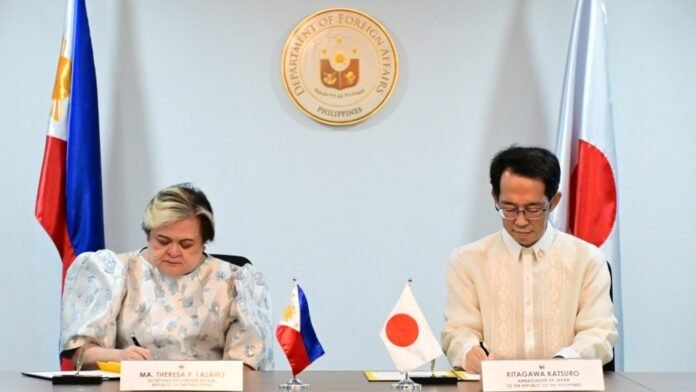
November 10: Japan and the Philippines have signed a ¥4.3 billion security-assistance agreement covering a coastal radar system and surveillance drones. Japan’s foreign ministry says the November 9 exchange of notes in Manila marks the first defence-equipment transfer project under its Official Security Assistance programme.
Key highlights
- The coastal radar system is intended for the Philippine Navy.
- Monitoring and surveillance unmanned aircraft are intended for the Philippine Air Force.
- The agreement is a fiscal-year 2026 OSA grant project, according to Japan.
- The announcement does not specify equipment quantities or a delivery timetable.
What was signed in Manila
Philippine Foreign Affairs Secretary Maria Theresa Lazaro and Japanese Ambassador Kitagawa Katsuro signed and exchanged the notes on November 9, Japan’s Ministry of Foreign Affairs said. The ministry identifies stronger maritime awareness and surveillance as intended outcomes.
Tokyo places the project in the context of important sea lanes, including the South China Sea and Luzon Strait. That is Japan’s stated strategic rationale. It should be distinguished from an assessment of how the systems will perform after deployment.
The package at a glance
| Item | Recipient or status |
|---|---|
| Total grant | ¥4.3 billion |
| Coastal radar system | Philippine Navy |
| Monitoring and surveillance UAVs | Philippine Air Force |
| Signed exchange of notes | November 9, 2026, Manila |
| Unit numbers and delivery dates | Not specified in the ministry’s release |
The total grant is a programme amount. It is not a published unit price for either a radar or an aircraft, and the release does not provide a split between the two components.
How OSA differs from development assistance
Japan’s official programme overview describes OSA as a framework supporting the armed forces and related organisations of partner countries through equipment, supplies and infrastructure. It explicitly distinguishes OSA from Official Development Assistance, which supports developing countries’ economic and social development.
The framework appears in Japan’s December 2022 National Security Strategy. The ministry’s overview explains its objectives in terms of partner security and deterrence capabilities, security cooperation and a favourable regional security environment.
The “first” in the latest announcement is specific: a defence-equipment transfer under OSA. It should not be expanded into a claim that Japan has never previously supplied defence equipment to the Philippines through any arrangement.
From agreement to usable capability
A signed funding agreement is one milestone in a longer process. It is different from equipment being delivered, accepted, integrated into existing systems and used operationally. The November 9 release establishes the agreement and intended recipients, rather than completion of all those steps.
For a reader judging the project’s effect, the next useful details would be technical specifications, procurement milestones and confirmed handovers. The absence of those details in the release is a reason to leave them open, rather than to infer a model, range or deployment location.
What to watch
Future official announcements may clarify the quantities and implementation schedule. Until then, the concrete development is a new grant commitment for maritime monitoring, with the operational results still to be demonstrated.
The wider significance lies in the relationship between Japan’s security-assistance framework and Philippine surveillance needs. The agreement’s scope can be reported precisely without treating it as a new basing deal, combat deployment or a completed transfer.
File photo: Foreign Secretary Maria Theresa Lazaro and Ambassador Kitagawa Katsuro sign the exchange of notes in Manila, November 9, 2026. Source: Ministry of Foreign Affairs of Japan website, accessed November 10, 2026. Public Data License 1.0 and ministry usage terms. Cropped and resized by The Press of Asia; no government endorsement implied.
Sources
- Ministry of Foreign Affairs of Japan: Signing of the Philippines OSA FY2026 project
- Ministry of Foreign Affairs of Japan: Official Security Assistance programme overview

The International Desk covers world and Asian affairs, diplomacy and conflict, with a focus on what they mean for India. Stories are checked against at least two credible sources before publication.