November 15: UN Secretary-General António Guterres used his last climate summit in office to say that overshooting the 1.5°C warming limit is now inevitable and that emissions must fall by about 6% a year for the next few years to keep the overshoot “as small and brief as possible”. Speaking at COP31 in Antalya, Türkiye, on Friday, he said current national plans put the world on course for more than 2.5°C of warming, “a recipe for catastrophe”. The talks pause on Sunday and resume on Monday for their final week, with India pressing rich countries on climate finance.
Key highlights
- Final COP: Guterres called COP31 “my final COP as Secretary-General”.
- 1.5°C: an overshoot is inevitable; the goal is to make it small and brief and return below 1.5°C as quickly as possible.
- Emissions: cuts of roughly 6% a year are needed for the next few years.
- Finance: even tripling adaptation finance would meet less than 30% of needs, he said.
- India: says public finance from developed countries, under Article 9.1 of the Paris Agreement, must remain central.
- Schedule: COP31 runs from November 9 to 20; the venue is closed on November 15.
What Guterres said
Guterres said “fossil fuels are driving the climate crisis” and that there is “no credible path to a safe climate” without moving away from them, through a transition that is “just, orderly and equitable”. He said renewable energy “has moved from the margins to the mainstream” and called for a large expansion of clean power, grids, storage and efficiency. Developed countries, he said, must deliver the finance they promised at recent COPs, and the most vulnerable countries need far more support for adaptation and for loss and damage. He ended with: “Face the facts. Follow the science. Choose the future. And never give up.”
Where national plans stand
| Measure | Figure |
|---|---|
| New national climate plans (NDCs) recorded, January 2024–August 2026 | 127, covering 154 Parties |
| Share of global emissions they cover | About 70% |
| Expected cut in global emissions by 2035, below 2019 | About 6% |
| Cut if all current pledges are fully implemented | About 9% |
| Global climate finance, annual average 2023–2024 | US$1.9 trillion, up 32% |
India’s position
In India’s opening statement, Narendra Bhooshan, Secretary in the Environment Ministry, thanked Türkiye and Australia for leading COP31 and said India aligns with the G77 and China, the Like-Minded Developing Countries and the BASIC group. India welcomed the presidency’s idea of a “COP of Implementation” but stressed equity and the principle of common but differentiated responsibilities. It said public finance from developed countries remains central to climate action in developing countries, and that just transition and adaptation are major challenges for the Global South.
Who is running the talks
| Role | Person |
|---|---|
| COP31 President | Murat Kurum (Türkiye) |
| President of Negotiations | Chris Bowen (Australia) |
| UN Climate Change Executive Secretary | Simon Stiell |
Our calculation
| Question | Answer | How we got it |
|---|---|---|
| Average yearly cut implied by current pledges | Under 0.5% a year | About 6% over the 16 years from 2019 to 2035 |
| Cut Guterres says is needed | About 6% a year | His remarks at COP31 |
| Negotiating days left | 5 | November 16 to 20 |
What it means for India and Asia
For Asia, the gap between what countries have pledged and what Guterres says is needed is the central issue. India’s line at Antalya is consistent: it will do its “fair share”, but expects developed countries to pay for much of the transition and for adaptation. Guterres’s estimate that even tripled adaptation finance would cover less than 30% of needs supports the argument India has made at the talks that adaptation finance must rise.
What to watch
- The final decisions on climate finance and adaptation when COP31 closes on November 20.
- Any presidency text on the transition away from fossil fuels.
- Whether more countries submit new NDCs during the conference.
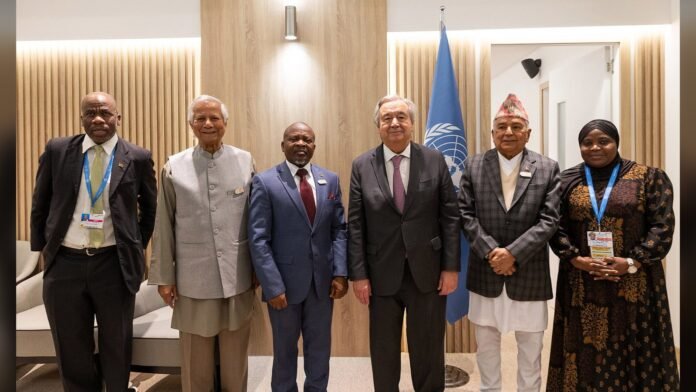
António Guterres with Bangladesh’s Chief Adviser Muhammad Yunus after a meeting of least developed countries at COP29 in Baku, 2024 (file photo). Image: Press Information Department, Public domain, via Wikimedia Commons. Photo source
Sources
- UNFCCC: Remarks by UN Secretary-General António Guterres at his final COP press conference (November 13, 2026)
- UNFCCC: COP31 live updates and schedule
- UNFCCC: Reports show Paris Agreement supporting whole-of-economy approaches, but progress insufficient (October 27, 2026)
- PIB (Ministry of Environment, Forest and Climate Change): India reaffirms commitment to climate multilateralism at COP31

The International Desk covers world and Asian affairs, diplomacy and conflict, with a focus on what they mean for India. Stories are checked against at least two credible sources before publication.