November 15: India’s production-linked incentive (PLI) schemes had drawn ₹2.40 lakh crore of investment, ₹22.66 lakh crore of production and sales, and about 8.49 lakh jobs across 14 sectors by March 2026, according to an impact assessment released by NITI Aayog with IIM Ahmedabad. But only ₹35,354 crore, or 18.5% of the ₹1.91 lakh crore outlay, had been paid to companies, and the report says nearly 70% of targeted segments are on track.
Key highlights
- Outlay: ₹1,91,049 crore across 14 sectors.
- Investment: ₹2,40,138 crore cumulative, including ₹51,585 crore in 2025-26.
- Production and sales: ₹22,66,412 crore cumulative, including ₹6,75,478 crore in 2025-26.
- Jobs: 8,49,069 cumulative, including 2,41,525 in 2025-26.
- Incentives paid: ₹35,354 crore (18.51% of outlay); ₹15,519 crore in 2025-26 against a plan of ₹15,472 crore.
- Overall verdict: nearly 70% of targeted segments on track; drones called an early implementation success.
The scheme in numbers
| Measure | Cumulative to March 2026 | In 2025-26 |
|---|---|---|
| Investment | ₹2,40,138 crore | ₹51,585 crore |
| Production / sales | ₹22,66,412 crore | ₹6,75,478 crore |
| Employment | 8,49,069 | 2,41,525 |
| Incentives disbursed | ₹35,354 crore | ₹15,519 crore |
Which sectors are doing well
The report sorts sector outcomes into four groups: on track, partial impact, insignificant evidence of impact, and data unavailable. According to NITI Aayog’s summary, pharmaceuticals, mobile manufacturing under large-scale electronics, food processing, telecom, white goods, automobiles and drones have shown notable progress in investment, production and capacity creation. Manufacturing capacity for high-efficiency solar PV modules has also expanded significantly.
Sectors built on advanced technologies, such as advanced chemistry cell (ACC) batteries, specialty steel and technical textiles, are seeing “gradual capacity creation”, the report says. It notes that ACC battery production has yet to begin and points to limited technology, a weak upstream ecosystem, imported machinery, delays and shortages of skilled workers.
What the report recommends
- Standardise the data that firms report and ministries share, so the schemes can be tracked.
- Add demand-side incentives so that downstream firms and consumers buy from PLI companies.
- Judge results on several measures, including volume, capacity, productivity, jobs, exports and domestic value addition, not only nominal values.
- Deepen value addition in telecom and electronics, where final assembly still dominates.
- Bring more MSMEs into the schemes, especially in food processing and pharmaceuticals.
Our calculation
| Question | Answer | How we got it |
|---|---|---|
| Investment compared with the total outlay | 1.26 times | ₹2,40,138 crore ÷ ₹1,91,049 crore |
| Production for every rupee of incentive paid | About ₹64 | ₹22,66,412 crore ÷ ₹35,354 crore |
| Outlay still to be paid | About ₹1.56 lakh crore | ₹1,91,049 crore − ₹35,354 crore |
| Share of all PLI jobs added in 2025-26 alone | About 28% | 2,41,525 ÷ 8,49,069 |
| Scheme time elapsed | 58% | 578 of 996 implementation months |
What it means for India and Asia
The PLI schemes are a central part of India’s effort to win factory investment that might otherwise go to China or Southeast Asia. The assessment suggests that the money has worked best where industry was ready to invest, such as phones, medicines and appliances, and more slowly in capital-heavy, technology-intensive areas such as batteries. With 58% of the scheme period gone and less than a fifth of the outlay paid, the next two to three years will decide how much of the promised manufacturing shift actually happens.
What to watch
- Whether ACC battery plants start production.
- Any changes to incentive rates or new sectors in the next Union Budget.
- Export data for electronics and pharmaceuticals.
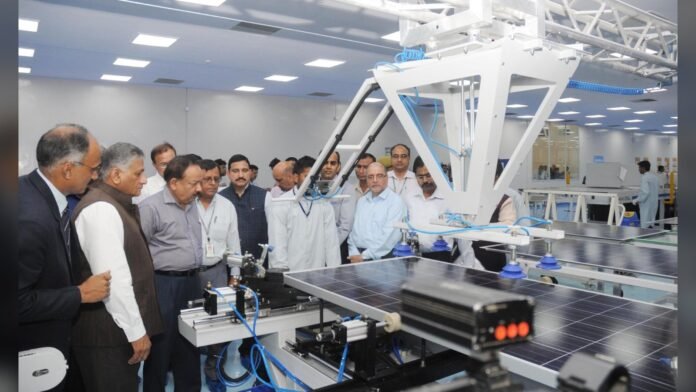
An automated solar photovoltaic module manufacturing line at Central Electronics Ltd in Sahibabad (file photo). Image: Ministry of Science and Technology, GODL-India, via Wikimedia Commons. Photo source · Licence
Sources
- PIB (NITI Aayog): NITI Aayog launches report on Impact Assessment of PLI Schemes
- NITI Aayog: Impact Assessment of PLI Schemes (PDF)

The Business Desk covers markets, the economy, companies and personal finance. Stories are checked against at least two credible sources before publication.