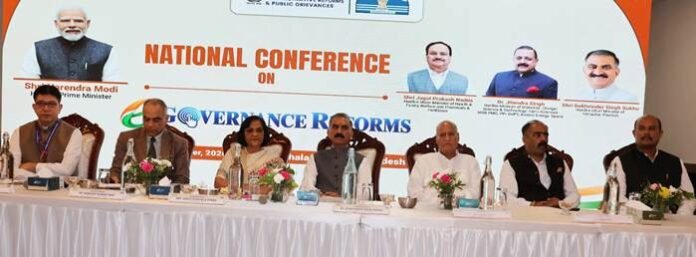
DHARAMSHALA: A national conference on e-governance reforms opened in Himachal Pradesh on October 16, 2026, bringing together officials and practitioners to discuss how digital systems can improve public services. The two-day programme was scheduled for October 16–17.
According to the Department of Administrative Reforms and Public Grievances’ opening-day report, Chief Minister Sukhvinder Singh Sukhu, DARPG Secretary Nivedita Shukla Verma and Himachal Chief Secretary Kamlesh Kumar Pant addressed the inaugural session. Discussions emphasised taking useful local innovations beyond individual pilots.
Himachal initiatives presented at the conference
The first day featured Him Parivar, Sukhashraya, Vidya Samiksha Kendra, Green Himachal and the Rajiv Gandhi Van Samvardhan Yojna. Other presentations covered digital initiatives in agriculture, consumer disputes, telemedicine, training and travel. Cybersecurity, data analytics and replication were listed for the second day.
These were conference presentations and programme themes. The report does not establish that every showcased system has been adopted throughout Himachal or that all participating departments have introduced a common new service. A presentation is not a substitute for a formal implementation notice.
Where residents can find existing online services
The state’s Him Seva portal already provides a citizen entry point with application tracking, certificate verification, downloadable forms and a feedback or grievance option. Its listed services include bonafide Himachali, income and character certificates, alongside other departmental applications.
Residents should begin with the requirements for the exact service they need. A general account or portal homepage does not establish eligibility for every scheme. The document list, responsible department, fee and application process can differ between services. Check the current instructions before submitting personal details or paying an authorised charge.
The portal’s department-wise service directory also links to services involving electricity, water, tourism, public examinations and other functions. This is useful as a navigation aid, but the relevant department remains the source for the conditions applying to an individual application. Do not assume that a link in a directory means the service was newly launched at this conference.
Keep the application trail
For someone applying online, a practical habit is to save the acknowledgement, application number, submitted form and any payment receipt. Keep these privately rather than posting screenshots containing personal information on social media. If the service asks for a correction, compare the request with the copy originally submitted before uploading replacement documents.
This is also where a meaningful digital improvement can be measured. A clear acknowledgement, understandable status and a specific explanation of missing information can save more effort than a redesigned homepage. Those are editorial tests for usefulness, not performance outcomes independently demonstrated by the conference report.
What to do when an application stalls
Use the service’s stated help or grievance route and explain the issue precisely: which application, when it was submitted and what step has not progressed. Retain the correspondence. Avoid treating an automated acknowledgement as approval, and avoid submitting repeated applications unless the responsible office instructs you to do so.
For public grievances more broadly, the CPGRAMS official FAQ explains that a grievance receives a unique registration number and can be tracked online. It says grievances concerning state governments are forwarded to the government concerned; the respective authority handles redressal. This is distinct from the underlying application and does not automatically grant a certificate, benefit or permission.
The FAQ also identifies matters outside its grievance mechanism, including RTI matters and cases concerning court judgments or pending litigation. Readers should check the current scope before choosing a channel. A public grievance system is not a replacement for a statutory appeal where one is required.
Before seeking help, note the error message and the approximate time of the problem. A short, factual description can make a support request easier to investigate without disclosing more personal information than necessary.
How to judge the conference’s follow-through
For Himachal residents, the useful question after the event is what changes in a real transaction. Can a person understand the instructions, submit the necessary material once, track progress and obtain a reasoned response? Can someone who encounters a technical problem reach a responsible office without starting again?
Departments could make progress easier to assess by publishing the services selected for improvement, the responsible teams and the measures used to compare results. Completion rates, repeat visits and the clarity of rejection or correction notices would be useful indicators. They should be measured rather than inferred from the number of presentations or the presence of artificial intelligence in a project description.
The Dharamshala programme creates an opportunity to share practical administrative lessons. Whether those lessons become easier everyday services will depend on implementation, maintenance and feedback from the people using them. This report describes the opening-day announcement and existing official service routes; it does not claim that final conference outcomes or statewide improvements have already been verified.
Photo: The Dharamshala conference, supplied with the October 16, 2026 government release. Credit: DARPG / Press Information Bureau. Reproduced with source acknowledgement under PIB’s copyright policy. Display resized.

The National Desk covers India's politics, governance, security and public-interest news. Stories are checked against at least two credible sources before publication.